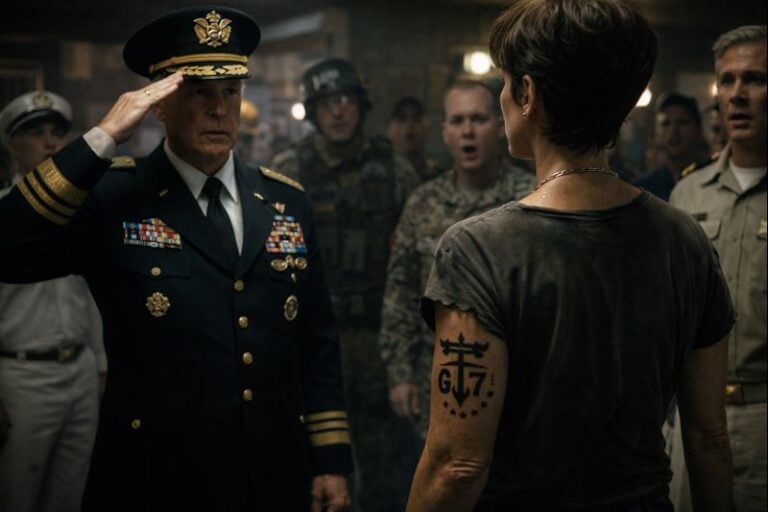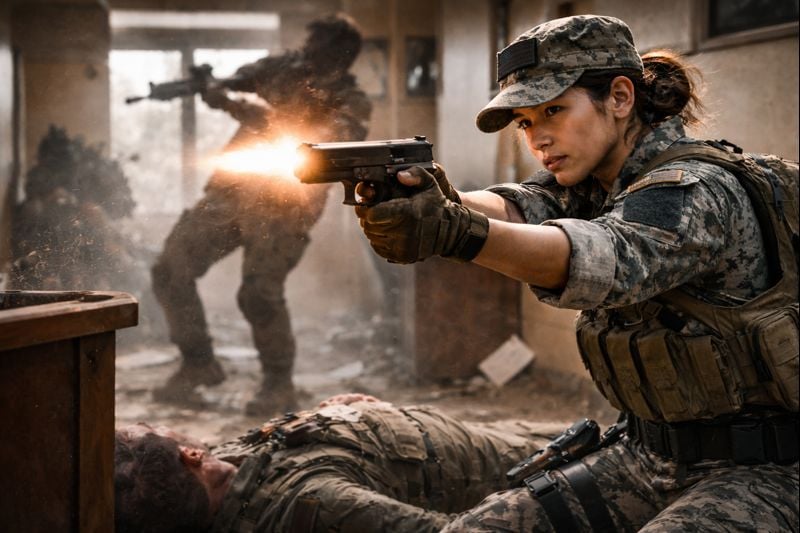
Laughter cut through the echo of gunfire from the outdoor rifle range. Maya Rodriguez stood at the threshold of the Shoot House medic bag, hanging from her shoulder, 42 lbs of trauma equipment field, surgical supplies, and emergency medications. 5’3, 115 lb, 24 years old. The SEAL team running close quarter battle drills turned as one automatic weapons lowering sweat still glisting on their combat uniforms under the California sun who called a medic petty officer first class Derek Stone 6’1 210 lb of solid muscle earned through 8 years of SEAL operations laughed loud enough to carry across the training bay ought anyone yet sweetheart ripples of laughter spread through the group eight seals every single one towering over her by at least 6 in, outweighing her by a minimum of 70 lb. Their gear alone probably weighed more than she did.
Maya set the medic bag on the concrete floor with a heavy thump that silenced some of the laughter. Hospital corman Third Class Rodriguez reporting for team integration training. Master Chief Tom Bradford standing in the corner with a clipboard and the weathered expression of someone who’d seen 30 years of military service raised an eyebrow. You’re the new Doc Command said they were sending someone with experience. I have experience, Master Chief. How much experience are we talking about? 18 months Fleet Marine Force, 6 months advanced combat trauma certification.
Derek crossed his arms, biceps straining against his shirt sleeves. 18 months, kid, I’ve got boots older than your entire career. He glanced toward the team leader standing near the tactics board. Sir, with all respect, we can’t be babysitting a boot corman while we’re trying to train for deployment. Lieutenant Commander James Morrison studied Maya with the careful assessment of someone who’d learned to read people in hostile environments. His eyes were calm, but penetrating the kind that missed nothing.
Chief Bradford, what does her service record say? Bradford flipped through the papers on his clipboard, reading without much interest. Standard qualifications, medical certifications, all current. Combat lifesaver instructor rated rifle qualification. He stopped squinting at the page as if the print had suddenly become unclear. Huh? Distinguished expert. That’s unusual for a corman. Someone in the back. Seaman Jake Turner. Another corman who’d been vocally disappointed when he didn’t get this team assignment muttered just loud enough to be heard. Lucky range day. Probably shot it three times before she qualified.
Maya didn’t respond. She stood at parade rest hands clasped behind her back face completely neutral, but her eyes tracked everything with the precision of a targeting system, weapon positions, team spacing, exit routes, blind spots in the room’s geometry. The observations were automatic, ingrained as natural as breathing.
Morrison gestured toward the training area, a complex maze of rooms with pop-up targets and ballistic walls. All right, Rodriguez, you’re here to observe the way we operate and learn how this team functions. Stay clear of the firing lanes. Don’t touch any equipment without permission. And try not to become a casualty yourself. We clear. Crystal clear, sir. Dererick’s laugh had an edge to it now. Something between amusement and dismissal. This should be entertaining.
Last corman we had could at least keep up on a ruck march. The comment hung in the air, a reference to the corman they had lost 3 months ago. Petty Officer Secondass David Martinez killed by sniper fire while treating a wounded Marine during a firefight in Syria. His absence was a wound that hadn’t healed an empty space in their formation that nobody wanted filled by someone who couldn’t measure up to his memory.
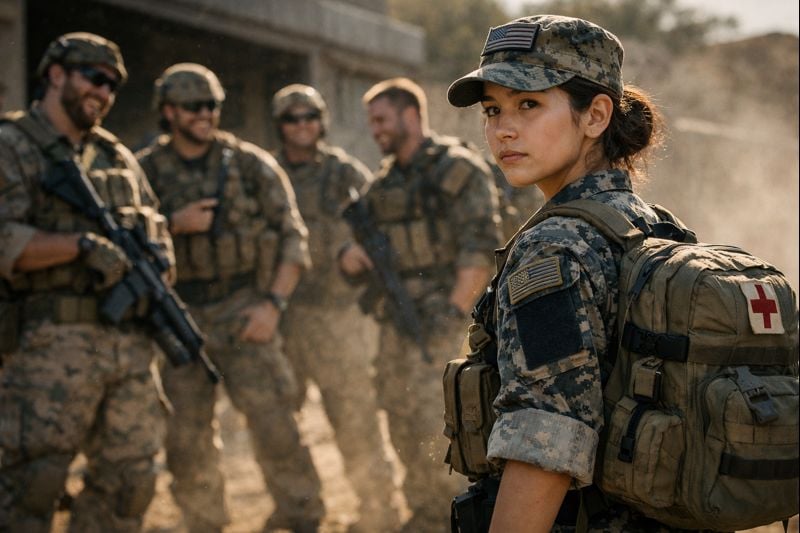
Maya understood that even if they didn’t think she did, grief often manifested as gatekeeping, especially in communities where trust meant survival. She didn’t take it personally. She just needed to prove herself worthy of the position, worthy of Martinez’s legacy.
Let’s run the scenario again. Morrison ordered his voice, cutting through the lingering tension. House clearing, unknown number of hostiles, potential civilian presence. Rules of engagement are strict positive ID before engaging. Hammer, you’re on point. Oz, you’ve got rear security.
The team moved into position with the fluid coordination of people who’d trained together for months. Petty Officer First Class Ryan Osborne. Oz, to everyone who knew him, caught Maya’s eye for a brief moment and gave her a slight nod. Not quite welcoming, but not hostile either. Recognition of her presence at least.
They flowed through the shoot house like water through pipes. Each person covering their sector communication happening in hand signals and minimal verbal cues. Pop-up targets appeared at intervals, some with weapons, some without. The team’s discrimination was flawless, engaging only legitimate threats while holding fire on civilians.
Maya watched from her position near the entrance, analyzing their movements with the critical eye of someone who understood tactics beyond medical applications. She noticed the way Derrick’s stance shifted slightly right when he prepared to fire, compensating for a dominant eye. observed how petty officer secondass Andre Matthews, the team’s designated marksman, always checked his six before committing to a shot. Saw the micro adjustment in Oz’s grip when he transitioned from long gun to sidearm during a malfunction drill.
And when Oz fumbled a magazine change, just barely recovering in under two seconds, but still sloppy by SEAL standards, Ma’s hands twitched involuntarily, muscle memory trying to correct a mistake she had no authority to address. Bradford noticed. His eyes flicked from Oz to Maya and back again, but he said nothing.
The drill concluded with the team securing the final room. Morrison called them back to the staging area for debrief. Good work overall, Oz. That mag change needs tightening up. Run it 50 times before tomorrow’s session. Roger that, sir. Oz’s face showed embarrassment but acceptance.
Chief Petty Officer Lisa Chen, Viper in team communications, approached from the adjacent building where she’d been monitoring radio traffic. She was one of the few women in the SEAL support structure, a communication specialist who’d fought hard for every ounce of respect in a male-dominated field. She looked at Maya the way a fortress guard looks at someone trying to breach the walls.
So, you’re the new Doc, Viper said, her tone professionally neutral, but her eyes calculating. Hope you’re tougher than you look. We don’t have room for soft medics who can’t handle the reality of combat operations. I understand the requirements, chief, Maya replied, keeping her voice even and respectful.
Do you? Because our last corman died doing his job. Died trying to save one of ours while taking fire. That’s the standard you’re being measured against. Not classroom exercises. Not sanitized training scenarios. real combat where the bullets don’t care about your feelings.
The words were harsh, but Maya heard the grief underneath them. Viper had known Martinez had probably worked closely with him. This wasn’t just hazing. It was protection. Protection of the team’s integrity. Protection of Martinez’s memory. Protection against the possibility of caring about someone who might not be capable of surviving what was coming.
“I’m aware of Petty Officer Martinez’s sacrifice,” Mia said quietly. I’ll do my best to honor his legacy. Viper studied her for a long moment, then nodded once and walked away. Not acceptance, but not outright rejection either. A holding pattern while she gathered more information.
Before we continue with what’s about to unfold in that shoot house, I need you to understand something crucial. The men laughing at Maya right now have no idea what they’re dealing with. None. Zero. In the next 8 minutes, everything they think they know about combat medics is going to get completely demolished. Hover over that subscribe button. Don’t click yet because you need to see this transformation happen in real time. When Maya finally picks up that rifle, you’ll understand why some people choose to hide their greatest strengths. Hit subscribe now.
Morrison gathered the team around a planning table covered with building schematics and tactical overlays. Tomorrow we run a combined exercise tactical movement with integrated casualty care. Rodriguez, you’ll be working the medical scenarios while the team continues operations. Questions?
Derek raised a hand. Sir, not a question, more of a concern. If she’s never trained with us before, how do we know she can keep pace? No offense to Rodriguez, but combat medicine under fire is different from clinic work. None taken,” Maya said before Morrison could respond. “You’re right to have concerns. I’m new to this team. I need to prove I can integrate with your operations without becoming a liability.”
The directness of her answer seemed to surprise several team members. They’d expected defensiveness, maybe some appeal to her qualifications or training. Instead, she’d acknowledge their concerns as legitimate. Exactly right, Morrison said. Which is why we’re taking the time to evaluate integration before we deploy together.
Bradford, what’s the training schedule? Medical trauma drill at,400 hours, Bradford replied, checking his notes. Then we’ve got live fire qualifications at the range starting at 15:30. Everyone shoots, including support personnel. He looked at Maya. You current on your rifle quall Rodriguez? Yes, Master Chief. qualified 6 weeks ago.
Score. Maya hesitated for just a moment. Distinguished expert, Master Chief. The statement hung in the air like a challenge flag. Distinguished expert wasn’t just passing. It was the highest level of rifle marksmanship qualification in the military, requiring nearperfect accuracy across multiple shooting positions and distances. Most service members never achieved it. Even among combat troops, it was rare.
Jake Turner snorted from his position near the back. Sure, and I’m an Olympic shooter. Come on, there’s no way. Records don’t lie. Bradford interrupted, still reading from his clipboard. Says here she’s qualified expert or distinguished expert on every weapon system she’s been tested on. M4, M9, M16A4. Even the M249 saw, which is weird for a Corman. He looked up at Maya. Where did you learn to shoot? My father taught me Master Chief.
Your father military? Marine Corps? Master Chief. Gunnery sergeant. Bradford grunted. Well, that explains some of it. Marine Corps knows how to shoot. He turned to Morrison. Sir, I’d like to add Rodriguez to the afternoon qualification course. See if those scores hold up under observation. Derek laughed. That’s cold, Master Chief, but fair. Actions speak louder than paperwork.
Then it’s settled, Morrison said. Medical drill at 1400 range time at 15:30. Everyone participates. Dismissed for cow. Be back here in 30 minutes.
The team dispersed most, heading toward the dining facility. Maya remained behind, checking the contents of her medic bag, inventorying supplies with the thoroughess of someone who’d learned that missing equipment in training meant missing equipment in combat. Oz lingered near the door, then approached her.
Hey Rodriguez, don’t take the hazing personally. They’re just protective of the team slot. Martinez was he was good people. I understand petty officer. I’m not offended. Also, that magazine change I messed up earlier. You noticed, didn’t you? I saw your hands move.
Maya looked up surprised. He’d caught that. Yes, but you corrected it quickly. Under 2 seconds. That’s still within acceptable parameters. But not optimal. No, not optimal. But everyone has off moments. The important thing is recognizing and correcting them.
Oz smiled slightly. You sound like an instructor, not a medic. I’m whatever the team needs me to be, Maya said simply. After he left, she continued her equipment check, methodically verifying every item. Tourniquets, heatic gauze, chest seals, airway adjuncts, IV supplies, emergency medications. Each piece of equipment represented a potential life saved or lost. She treated the inventory with the reverence it deserved.
Petty Officer third class Marcus Williams doc to distinguish him from the other Williams on base entered the chute house from this medical training facility next door. He was the senior corman responsible for training a man who’d spent 15 years in the Navy and had strong opinions about what made a good combat medic. Rodriguez. He said his tone professionally neutral. I’m going to be evaluating your performance during the 1400 drill. Fair warning, I’ve got high standards. Combat trauma isn’t about memorizing protocols. It’s about making life or death decisions under conditions that would make most people freeze.
I understand, petty officer. Do you? Because I’ve seen a lot of young corman come through here thinking they’re ready for combat operations. Most of them wash out when they face realistic stress scenarios. The ones who don’t wash out sometimes get people killed because they couldn’t handle the pressure. He moved closer, voice dropping. So, I need to know, have you ever treated a real trauma casualty? Not a training mannequin, a real person bleeding out in front of you.
Maya met his eyes steadily. Yes, petty officer. Fleet Marine Force deployment included 6 months at a forward aid station in Syria. I’ve treated combat casualties. Doc Williams’ expression shifted slightly. Not quite respect, but recognition that she wasn’t completely green.
How many? 47 casualties during my deployment. 39 survived to reach higher echelon care. The numbers spoke for themselves. An 83% survival rate in a combat zone was exceptional for a junior corman. Doc Williams eyebrows rose slightly. That’s better than expected.
“What was your most challenging case?” Maya remembered without wanting to. The memory was vivid, visceral. Marine Lance Corporal, 19 years old, IED strike. Traumatic amputation of left leg above the knee shrapnel, wounds to abdomen and chest tension, pumothorax, class 4 hemorrhagic shock, no medevac available for 45 minutes due to weather. I had to perform a needle decompression control multiple bleeding sources and manage fluid resuscitation with limited supplies. Outcome: He survived. Lost the leg but kept his life. Last I heard, he was learning to walk with a prosthetic and planning to finish his degree in engineering.
Doc Williams was quiet for a moment. You did good work. That’s a save most senior corman would be proud of. He paused. But this is a SEAL team. The operational tempo is different. The expectations are different. These guys move fast, hit hard, and expect their corman to keep up with full combat load while being ready to provide trauma care at a moment’s notice. It’s not the same as working an aid station.
I know, petty officer. That’s why I’m here to learn how this team operates and integrate my medical capabilities with their tactical requirements. Fair enough. I’ll see you at 1400. Bring your agame.
After he left, Maya sat on a ballistic barrier and pulled out a protein bar from her cargo pocket. The morning had been exactly what she’d expected. Skepticism testing the weight of proving herself against assumptions. She’d known this was coming, had prepared for it mentally and emotionally.
What they didn’t know, what she hadn’t told them, was why she’d chosen this path. Her father, gunnery sergeant Carlos Ghost Rodriguez, was a Marine Corps legend, scout sniper with over 100 confirmed neutralizations across three deployments, instructor at the Marine Corps Scout Sniper School, a man whose reputation preceded him everywhere he went, whose shadow was long enough to eclipse anyone standing near him.
Growing up as Ghost’s daughter meant living with constant comparison. Every shooting competition she entered, every qualification she achieved, every accomplishment was filtered through the lens of being Ghost’s kid. People either expected her to be exceptional because of her genetics or dismissed her achievements as inherited talent rather than earned skill.
By age 18, she’d won seven national shooting championships in various disciplines. Could field strip and reassemble a rifle blindfolded faster than most Marines could do it with their eyes open. had been offered a slot in the Marine Corps scout sniper pipeline. A rare opportunity, especially for a female candidate, and she turned it down it because Maya Rodriguez didn’t want to be another shooter. Didn’t want to be ghost daughter who became a sniper like dad. Didn’t want her identity defined by her lethality. She wanted to save lives, not take them.
So she joined the Navy, chosen the hospital corman rating, specialized in combat medicine, and deliberately hidden the full extent of her shooting capability. Not because she was ashamed of it, but because she wanted to be valued for something else first. Wanted to prove she could be excellent at healing before anyone knew she was excellent at fighting.
Her father had been disappointed. Not angry, but sad in a way that hurt worse than anger would have. He’d understood her reasoning, but couldn’t fully accept it. Couldn’t understand why someone with her level of skill would choose not to use it as a primary capability.
“You’re running from yourself, Miha,” he’d said the day she left for Navy boot camp. “Running from what you’re good at. That’s not strength. That’s fear. I’m not running from anything, Dad. I’m running towards something different. Toward being my own person. You can be your own person and still embrace your gifts. My gifts include more than just shooting. They include healing, teaching, leadership. I want to explore those, not just the one thing everyone expects from me.”
He’d hugged her anyway, told her he loved her, told her to be safe, but she’d seen the disappointment in his eyes, the sense that she was wasting potential. Maybe she was, or maybe she was finding a different kind of potential one that integrated all of her capabilities rather than focusing on just the most obvious one.
The question she’d been wrestling with for months was whether she could truly separate her identity as a healer from her training as a shooter, or whether they were inextricably linked parts of who she was. Whether hiding one part of herself to prove another part was authentic was really any different from the people who’d reduced her to just ghost daughter.
She finished the protein bar and stood slinging her medic bag back over her shoulder. The weight was familiar, comfortable. This was who she’d chosen to be. Now she just had to prove she was good enough at it that nobody questioned whether she belonged.
The medical trauma drill at 1400 hours was held in a specialized training building designed to replicate field conditions. Mannequins with simulated wounds, pyrochnic effects to create stress and disorientation. Audio tracks playing screaming and radio chatter and weapons fire. Maya entered the scenario with Doc Williams observing clipboard in hand, stopwatch ready.
The mannequin casualty had simulated blast injuries, partial leg amputation, penetrating chest trauma, facial injuries. The kind of complex multi-system trauma that required rapid assessment priority treatment and perfect sequencing. Maya’s hands moved with practice precision. Tourniquet on the leg, first high and tight, stopping the simulated bleeding. Quick assessment of airway compromised but manageable. Chest seal over the sucking chest wound. IV access for fluid resuscitation. Communication with simulated medevac providing accurate casualty report with mechanism of injury. Vital signs and treatment rendered.
She worked in silence. No wasted motion, no hesitation. Each step flowed into the next with the fluidity of someone who’d done this hundreds of times. When the drill ended, Doc Williams checked his stopwatch and made notes on his clipboard. Time? Maya asked. 4 minutes 30 seconds. That’s That’s very good. Most corman take six to seven minutes on this scenario.
He reviewed his notes. Assessment was perfect. Treatment priorities were correct. Communications were clear and complete. Technical skills were flawless. He looked up. Where did you train? That wasn’t just combat trauma course standard. That was advanced. I took additional training during my fleet Marine Force time. Maya said, removing the bloodied gloves. Worked with Navy trauma surgeons during my off hours. Learned advanced techniques.
It shows. That was textbook perfect performance. Doc Williams made another note. I’m going to recommend you for the advanced combat medic course at Fort Sam Houston. You’ve got the foundation for it. Thank you, petty officer. Don’t thank me yet. That course has a 40% wash out rate, but you might be one of the ones who makes it. He glanced at his watch. Range time in 30 minutes. Bradford’s going to put you through your paces. Hope your shooting is as good as your medical work.
Maya just nodded. No boasting, no false modesty, just quiet acceptance of the challenge. She checked her tactical medical kit one more time. The kind of advanced trauma equipment that represented decades of battlefield medicine evolution. Modern combat medical technology had transformed casualty care with portable ultrasound devices. hemostatic agents and advanced airway management tools that functioned in the most austere environments imaginable.
These weren’t hospital supplies adapted for field use. They were purpose-built systems designed for moments when every second counted. And traditional medical infrastructure simply didn’t exist. The difference between surviving and dying on the battlefield often came down to having the right medical technology in trained hands equipment that costs less than a single day’s hospital stay. but could save lives in minutes when properly employed.
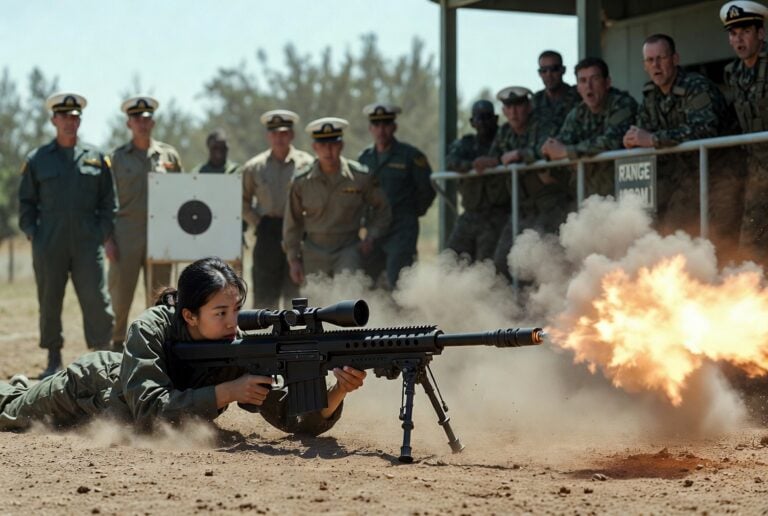
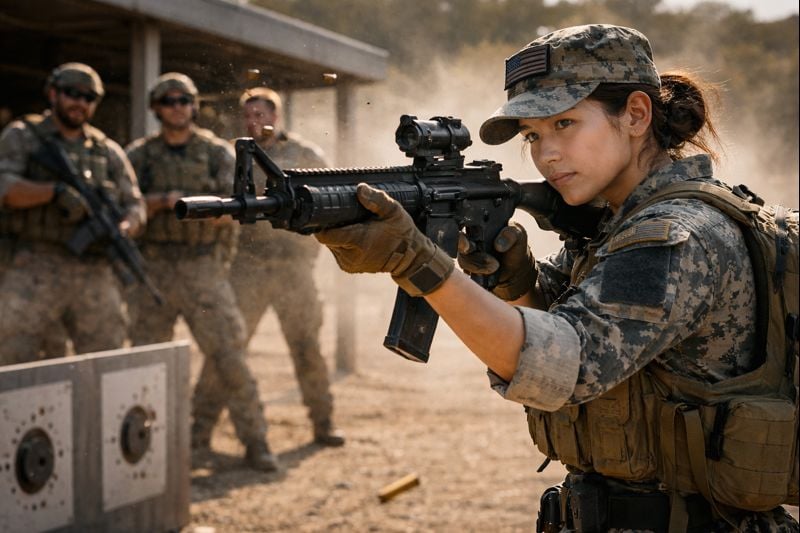
The outdoor rifle range sprawled across 500 yards of cleared terrain, eight shooting lanes marked with numbered posts, an observation tower rising at the rear for range safety oversight. The afternoon sun beat down with typical Southern California intensity heat shimmering off the ground in visible waves. The SEAL team assembled at the firing line, weapons already drawn from the armory magazines loaded and ready.
Maya received her assigned M4 carbine from the range master, Master Sergeant Frank Stone, a Marine Corps liaison who’d spent 30 years in the infantry and took weapons qualification seriously. Rodriguez Stone said, handing her the rifle with both hands in the traditional respectful transfer. This weapon is zeroed for a standard shooter. You’ll need to confirm zero before running the qualification. Understand? Yes, Master Sergeant. Good. You’ve got 10 rounds to confirm and adjust. Use them wisely.
Maya accepted the weapon automatically checking chamber and magazine. Well, even though she knew Stone would have cleared it before handing it over. Muscle memory drilled into her by her father from age 8. Treat every weapon as if it’s loaded until you personally verify it’s clear.
She moved to lane four, set the rifle on the bench, and took a moment to familiarize herself with this specific weapon’s characteristics. Each rifle had its own personality. Subtle differences in trigger pull balance how it settled into the shoulder. Learning those characteristics quickly was part of being an effective shooter.
Derek positioned himself in the adjacent lane close enough to watch far enough to maintain proper safety spacing. So Rodriguez, you really qualified, distinguished expert, or was that a paperwork error? I really qualified petty officer. We’ll see. Paper targets don’t shoot back. No pressure, no stress, just you and the target. Let’s see if you can perform when people are watching.
Maya didn’t respond. She settled behind the rifle, adjusted the stock length to fit her smaller frame, and checked the optic alignment. The weapon felt good, well-maintained, smooth action, clean bore. Stone ran a tight armory.
Lanes 1 through 4, you are clear to commence confirmation fire. Stone called from the tower. Watch your neighbors. Safety violations will result in immediate range removal. Maya loaded three rounds into the magazine chambered one and established her shooting position. Prone supported controlling her breathing. The target was 50 m away, close enough for easy hits if the zero was correct.
First shot. The rifle’s report was sharp but controlled recoil minimal against her shoulder. She worked the trigger smoothly straight back. No jerking or anticipation. Through the optic, she saw the impact 2 in low, 1 in right. She made a mechanical adjustment to the scope compensating for the deviation. Second shot, closer half inch low center for windage. Another small adjustment. Third shot, dead center. Zero confirmed, she said quietly more to herself than anyone else.
Derek had paused his own confirmation to watch. Not bad. Let’s see if you can maintain that when the clock’s running and the pressure’s on.
The qualification course was designed to test marksmanship under progressively challenging conditions. 50 m standing unsupported. 100 m kneeling, 200 m prone, 300 m prone with time limit. Each position required different stability techniques, different breathing patterns, different mental approaches. Maya had run this course dozens of times, not just for qualification, but for competition. The shooting championships she’d won in her teenage years had used similar formats, though, with stricter scoring and tighter time constraints.
All shooters load and make ready, Stone commanded. This is a timed qualification. You’ll have 30 seconds per position to engage all targets. Misses will be scored as such. Safety violations will result in disqualification. Any questions? Nobody spoke. Commence firing.
Maya moved through the course with the smooth efficiency of muscle memory taking over conscious thought. Standing position, five shots, five hits all center mass. Transition to kneeling, another five shots, slightly tighter group. Prone at 200 m. Controlled breathing patients waiting for the natural respiratory pause before each trigger press.
Beside her, Derek was shooting welltight groups fast transitions. But there was tension in his movements. Urgency that introduced small errors. A lifetime of combat operations had taught him to shoot fast because speed meant survival. It made him effective but not optimal.
Maya shot like she had all the time in the world. Like the target wasn’t going anywhere. Like stress didn’t exist. Like the only things that mattered were sight alignment breathing and the smooth press of the trigger.
300 m final string of fire. Five rounds prone. position 20 second time limit. She settled in, adjusting for the increased distance. At 300 m, wind became a factor. Small movements in vegetation, providing reading material for atmospheric conditions. She watched a flag 50 m downrange, saw it flutter slightly from left to right. Estimated wind speed at 5 to 7 knots. Adjusted her aim.1 mil dot to the left.
First shot, dead center. Second shot. Same point of aim. Center. Third shot. Wind gust. She felt it rather than saw it adjusted instinctively. Center. Fourth and fifth shots in rapid succession. Both finding the same point of impact.
Cease fire. Stone called. Weapons on safe chambers. Open magazines removed. Range safety will score targets. The team set their weapons down and waited while Stone and his assistant walked the range, checking each target with careful scrutiny. This was the moment of truth where claims met reality where qualifications were verified or exposed as exaggerations.
Stone reached Maya’s lane, studied her target at 50 m, made a note, moved to her 100 m target. Another note, a 200 m longer, pause examining the tight cluster of impacts. 300 m. He actually pulled out a measuring tape verifying the group size. Then he walked back to the tower and pulled up his scoring sheet on a tablet.
The team gathered around curious about results. “All right, listen up,” Stone announced. “Overall qualification scores, Osborne expert, good shooting, Matthews expert. No surprise there since you’re our designated marksman. Morrison sharpshooter solid performance stone.” He grinned at Derek. Expert, you’re getting better hammer. Derek looked satisfied. Expert was a strong score, putting him in the top tier of shooters.
Stone continued down the list. Most of the team scored expert or sharp shooter. Well above average, but not exceptional. Then he reached the final name.
Rodriguez distinguished expert. 50 rounds fired 49 scored as perfect hits. One round scored 9.5 just outside the 10 ring at 300 m. He looked up from his tablet. That’s the highest score I’ve seen on this range in 6 months. And that 300 meter group 2.3 in. That’s competitive level shooting.
Complete silence. Dererick stared at his own target, then at Ma’s, then back at his own. That’s There’s no way. I watched her. She wasn’t even trying hard. She was just shooting. That’s what good shooting looks like, Stone said. No wasted motion, no rushing, perfect fundamentals executed consistently. Rodriguez, where’d you learn to shoot like that?
All eyes turned to Maya. She stood at parade rest weapon cleared and safe expression neutral. But there was no hiding anymore. The performance had spoken for itself. My father taught me, “Master sergeant.” “Your father must be one hell of an instructor. What’s his background?”
Maya hesitated. This was the moment she’d been avoiding the revelation she’d known would come eventually, but had hoped to delay until after she’d established her medical credibility.
Marine Corps Master Sergeant Scout Sniper. Gunnery Sergeant Mike Foster. The Marine liaison who’d been observing from the tower straightened suddenly. Wait. Rodriguez. What’s your father’s first name? Carlos Gunny.
Foster’s eyes widened. Carlos Rodriguez. Ghost Rodriguez. The ghost Rodriguez. Scout sniper school instructor. Three combat deployments. Over 100 confirmed neutralizations. Yes, Gunny.
The reaction was immediate and visceral. Ghost Rodriguez was a legend in the sniper community. Marine Corps Army Seal didn’t matter which service everyone knew the name. His exploits had become case studies. His techniques were taught in courses. His career was the kind that spawned myths and exaggerations because the truth was already extraordinary.
Derek looked like someone had just told him the sky was actually green. You’re ghost’s daughter. You’re the daughter of the most legendary Marine sniper in the past 20 years. Yes.
Then why the heck are you a medic? The question came out harsher than Derek probably intended. Confusion and disbelief mixing into frustration. You could have been a sniper. You clearly have the skill. Why would you choose to be a corman instead?
Maya had known this question would come, had prepared her answer, rehearsed it mentally dozens of times. But actually speaking it out loud, explaining to a room full of warriors why she’d chosen healing over fighting required a different kind of courage than she’d needed on the range.
“Because I wanted to save lives, not take them,” she said quietly. “Because being Ghost’s daughter meant everything I did was always compared to him, always filtered through his reputation. I wanted to be valued for something else, for something I chose, not something I inherited.”
Viper Chen, who’d been watching from the side, stepped forward. Her expression had shifted from skepticism to something more complex. Recognition perhaps or understanding. You hid your shooting ability so people would see your medical skills first. Yes, Chief.
That’s Viper paused, searching for words. That’s actually brilliant and incredibly difficult. Most people would lead with their strength. You led with what you wanted to be known for, not what came easiest.
Al Morrison approached studying Maya with fresh assessment. So you can shoot at a competitive level. Question is, can you shoot and perform your medical mission under pressure? Because we need a corman, not another shooter. We have plenty of people who can engage targets. We have one person responsible for keeping us alive when we get hit.
I understand, sir. My primary mission is medical. The shooting is secondary.
Is it though? Derek challenged. Because distinguished expert shooting takes time to develop, takes practice, takes dedication. How do we know you’re not just a shooter who moonlights as a medic?
Before Maya could respond, Doc Williams spoke up. I can answer that. I evaluated her medical performance this afternoon. She ran a complex trauma scenario in 4 minutes 30 seconds with zero errors. That’s advanced level performance. She’s not moonlighting. She’s proficient in both skill sets.
The Bradford checked his clipboard again, flipping through pages he’d previously skimmed. Says here she’s got additional qualifications I didn’t notice before. Advanced cardiac life support, tactical combat casualty care instructor, field surgical techniques certification. He looked up. Rodriguez, why didn’t you mention any of this? You didn’t ask Master Chief. You asked about my experience and my rifle quall. I answered those questions. Fair point.
Bradford made several notes on his paperwork. Sir, recommendation is that we run a combined scenario tomorrow. Medical casualty drill with live fire stress. See if she can integrate both skill sets under realistic pressure. Morrison nodded. Agreed. Rodriguez, you’ll participate in a full integration exercise tomorrow at 0800. Tactical scenario with medical requirements. Your performance will determine whether you’re assigned to this team permanently or sent to a different unit. Clear. Clear, sir.
Good. Everyone’s dismissed for the day. Debrief at 0700 tomorrow. Get rest. It’s going to be a long day.
The team dispersed most, heading toward the showers and barracks. But the atmosphere had changed. The easy dismissal of Maya as just a medic had evaporated, replaced by curiosity mixed with caution. She wasn’t what they’d expected. that made her either more valuable or more problematic depending on how well she could prove integration of her skills.
Young Seaman Tommy Chen, 19 years old, newest team member still finding his place in the hierarchy, approached Maya hesitantly. Doc Rodriguez, can I ask you something? Of course, Tommy. That shooting was incredible. I’ve been trying to improve my marksmanship, but I keep getting stuck at sharpshooter level. Any advice?
Maya smiled. Fundamentals. Everyone wants to learn advanced techniques, but most shooting problems come down to inconsistent application of basics. Sight alignment, trigger control, breathing position. Master those completely before worrying about anything else. How do I know if I’ve mastered them? Can you call your shot? Can you tell the instant the round leaves the barrel where it’s going to impact? If yes, you’ve mastered fundamentals. If no, you need more practice.
Tommy nodded thoughtfully. I’ll work on that. Thanks, Doc. After he left, Maya sat on a bench near the armory, cleaning her borrowed rifle before returning it. The routine was meditative disassemble. Clean each component, inspect for wear, lubricate, reassemble. Her hands moved automatically while her mind processed the day’s events.
She’d proven her medical competence and her shooting proficiency. But in doing so, she’d also revealed the connection to her father that she’d hoped to keep quiet a while longer. Now the questions would multiply, the comparisons would start, the wondering whether her skills were truly earned or genetically gifted.
Deep thoughts. Morrison’s voice startled her out of the contemplation. She stood quickly coming to attention. Just processing the day, sir. At ease, Rodriguez. Morrison sat on the bench beside her, his posture relaxed, but his eyes still evaluating.
You’re in a difficult position. I recognize that, sir. You’re Ghost Rodriguez’s daughter. That’s a shadow you can’t escape, no matter how much you might want to. Every time someone learns your last name and makes the connection, they’re going to wonder how much of your skill is inherited versus earned. That’s not fair, but it’s reality.
Maya nodded slowly. Yes, sir. That’s why I wanted to establish my medical competence first. So, there would be no question about whether I could do that job regardless of who my father is. Smart approach. But here’s the thing. You’re on a SEAL team now. These guys need to know you can integrate both roles. They need to trust that when things go wrong, when someone’s bleeding out and hostiles are closing in, you won’t freeze trying to decide whether you’re a medic or a shooter. You’ll be both simultaneously whatever the situation requires.
I understand, sir. Morrison was quiet for a moment, watching her clean the rifle. Why’ you really choose to be a medic, Rodriguez? And I want the whole truth, not the sanitized version you’ve been giving everyone.
Maya considered the question. Morrison had the kind of command presence that invited honesty that made subordinates want to live up to his expectations. She decided to trust him with a complete answer.
Because I wanted to prove I’m more than just a killer, sir. Growing up around military shooters, especially elite snipers, you see what that lifestyle does to people. The way it defines them. The way they define themselves by their body count their longest shot, their most difficult target. My father is exceptional at what he does, but it’s also all he is. His entire identity is wrapped up in being Ghost, the legendary sniper.
I didn’t want that. I wanted to be someone who saved lives, who could look in the mirror and see a healer, not just a weapon. Noble goal, but you’re still a weapon, Rodriguez. You just choose when to employ that capability. Yes, sir. But the difference matters to me at least.
I respect that. Morrison stood. Tomorrow’s exercise will test whether you can balance both identities under stress. Get some rest. You’re going to need it.
After he left, Maya finished cleaning the rifle and returned it to the armory. The sun was setting over the Pacific painting, the sky in shades of orange and purple. Somewhere to the east, her father was probably cleaning his own rifle, thinking about shots he’d made and shots he’d teach tomorrow’s students to make.
She wondered if he’d heard about her qualification scores yet. The military was a small community, especially at the special operations level. News traveled fast, especially news about someone connected to a legend.
Her phone buzzed. Text message from an unknown number. Heard you shot distinguished expert at Coronado. Proud of you, Ma. Call when you can. Dad.
Maya stared at the message for a long moment. Emotions churning. Pride at his approval. Frustration that her shooting was what got his attention, not her medical work. sadness that even now, even after everything, the connection between them still ran primarily through firearms and marksmanship.
She typed a response, “Thanks, Dad. Talk soon.” Then she pocketed the phone and headed for her barracks, trying to quiet the questions that had been haunting her since she’d made her choice to become a corman.
Could you really separate identity? Could you be a healer who happened to be skilled at violence? Or did possessing lethal capability fundamentally change who you were? If you had the ability to take lives with precision and efficiency, did choosing not to employ that ability make you a healer or just a shooter in denial?
She didn’t have answers, but tomorrow’s exercise would force her closer to figuring it out.
The next morning arrived with the muted urgency of military routine. 0600 wakeup 0630 breakfast 0700 team brief 0800 full tactical scenario combining combat operations with medical requirements. Maya arrived at the briefing room carrying both her medic bag and her tactical gear. The dual role made explicit she would be expected to function as both corman and combatant, switching between roles as the scenario demanded.
The team assembled with the practice efficiency of people who’ done this hundreds of times. Morrison stood at the front of the room with a tactical map displayed on the screen behind him. Today’s scenario, Morrison began, is a high-risk hostage rescue with casualties. Unknown number of hostiles confirmed civilian presence, potentially complex medical situations. Rodriguez, you’ll be integrated with the assault element. Your job is to provide security during movement and medical care when required. Everyone else, you know your roles. Questions.
Derek raised a hand. Sir, if Rodriguez is committed to medical care, how do we maintain security with one person down? That’s the point of the exercise hammer. Learn to work around it. In real operations, casualties happen. Medical care happens. The team has to maintain security and continue the mission while dealing with those realities. This is rehearsal for that.
Maya spoke up. Sir, permission to suggest a modification. Morrison looked surprised. Go ahead. If I’m committed to medical care for more than 30 seconds, I’ll need someone covering my immediate position. Suggest assigning a security element specifically for medical scenarios. One person whose primary job during casualty treatment is protecting the corman and patient. Matthews nodded. That’s smart doctrine. We should have been doing that already. Good point.
Morrison agreed. Oz, your medical security. Stay with Rodriguez when she’s working a casualty. Everyone else, maintain your normal sectors. Let’s run it.
The team moved to the training compound, a series of buildings configured to simulate a hostile environment. Targets were positioned throughout some representing enemies, some civilians. Somewhere in the maze, Doc Williams had positioned medical mannequins representing casualties that would need treatment.
All elements, you are green light to commence. Morrison called over the radio. Execute, execute, execute. The team flowed into the compound with practice fluidity. Derek on point. Aa in the middle of the formation with Oz directly behind her. Matthews providing overwatch from a position outside the building. Radio discipline was tight, minimal chatter, maximum efficiency.
First room clear. Second room had a hostile target. Dererick engaged double tap center mass. Threat neutralized. Third room revealed their first casualty. A mannequin configured to simulate blast injuries and hemorrhagic shock. “Dock up,” Derek called.
Maya moved forward, dropping to her knees beside the casualty. Oz positioned himself facing outward rifle covering the doorway they’d just entered through. The rest of the team continued clearing adjacent rooms, maintaining security while she worked. assessment. Multiple injuries, airway compromised, severe bleeding from leg wound.
Maya’s hands moved with the practice deficiency she’d demonstrated in previous drills. Airways secured, tourniquet applied, pressure dressing on chest wound, IV access established, all while maintaining awareness of her surroundings, listening to radio traffic tracking team movement through the building. Casualty stabilized, she reported, ready to move.
They continued through the compound. Two more rooms, another hostile engagement, then a second casualty, this one with more complex injuries requiring longer treatment time. Maya worked the scenario while Oz maintained security while Dererick and Matthews continued clearing the building.
The scenario was designed to stress test their ability to function with one team member committed to medical care. They were adapting well, learning to redistribute security responsibilities to maintain momentum while still providing proper care for casualties.
Then the entire dynamic changed.
The base alarm shrieked to life a piercing whale that cut through the training scenario like a blade through flesh. Everyone froze for a split second. Trained instincts fighting training discipline.
All personnel. All personnel. The PA system blared. Active shooter situation. Building seven. This is not a drill. Repeat. This is not a drill. Active shooter. Building 7. All non-essential personnel execute lockdown protocols. Quick reaction force respond immediately.
Building seven, the administration building. Civilians work there. Contractor support staff. People who’d never trained for combat, never expected to face an active threat. Morrison’s voice cut through the chaos, calm and authoritative. Exercise terminated. Actual emergency. QRF, kit up and move. Rodriguez, you’re with us. We might need medical.
The team sprinted toward their vehicles, stripping off exercise equipment, and grabbing live ammunition, live weapons, live gear. This wasn’t training anymore. This was real. Someone was killing people, and they had minutes, maybe seconds to respond before the body count climbed higher.
Maya grabbed her medic bag, checked her sidearm, and ran. The convoy screamed toward building 73 vehicles moving at speeds that violated every base traffic regulation. But regulations didn’t matter when lives were at stake.
Through the windshield, Maya could see smoke rising from the administration building. Not the thick black smoke of structural fire, but the gray haze of chemical irritants tear gas or pepper spray deployed by someone who’d planned this carefully.
Morrison’s voice crackled through the radio, coordinating with base security and fire response teams. All elements, this is QRF actual. Building 7 is a four-story structure, approximately 150 personnel on site during business hours. Initial reports indicate single shooter unknown weapons barricaded on second floor. Multiple casualties confirmed. Security forces are establishing perimeter but cannot approach due to accurate incoming fire.
Derek keyed his radio from the lead vehicle. Hammer to actual. What’s our rules of engagement? Positive identification. Deadly force authorized. Priority one is stopping the threat. Priority two is casualty evacuation. Building is not clear. Assume multiple civilians still inside.
Maya felt her heart rate accelerate adrenaline flooding her system in the familiar pre-combat surge. But her hands remained steady on her medic bag. Training and experience had taught her to channel the chemical rush into heightened awareness rather than panic. Fear was information. Stress was fuel. Both could be controlled if you didn’t let them control you.
They arrived at the scene to organized chaos. Security forces had established a perimeter 50 m from the building. Personnel taking cover behind vehicles and concrete barriers. Base fire department staged their ambulances behind the security line, ready to receive casualties, but unable to approach. While incoming fire continued, a security sergeant fates, flushed voice, tight with stress, joged toward Morrison.
Sir, we’ve got three confirmed casualties outside the building. Wounded trying to evacuate when shooter engaged them from second floor windows. One more inside the lobby. Critical condition. We can’t reach any of them without exposing our people to sniper fire.
Morrison scanned the building with tactical eyes, assessing angles and approaches. Weapons, rifle, sir. Unknown make and model, but accurate. Put rounds within inches of my position when I tried to approach the nearest casualty. This isn’t some random lunatic with a handgun. Shooter has training.
Maya’s medical instinct immediately shifted to triage mode. Three casualties outside plus one critical inside meant at least four people needing immediate care. Time was the enemy. Now golden hour for trauma meant getting patients to surgical intervention within 60 minutes of injury. Every minute of delay reduced survival probability.
Sir, she said to Morrison, permission to move to the casualties. They need medical attention now. Morrison looked at her, then at the building, calculating risk versus necessity. Negative. Too exposed. We need to suppress the shooter first. People are dying, sir. Every minute we wait is a minute I’m not sending my corman into a kill zone. Morrison’s voice was firm, but not unkind. We’ll get to them, Rodriguez, but we do it smart, not fast.
Matthews, the team’s designated marksman, was already setting up a position behind a concrete barrier with clear line of sight to the building’s second floor. He settled behind his rifle, scanning windows through his scope. I’ve got multiple windows on second floor. Can’t determine shooter’s exact position. No movement visible. That’s because he’s smart, Dererick muttered. Staying mobile using multiple firing positions. Classic active shooter turn sniper tactics.
The radio crackled with a new voice-based medical control. All units be advised. One of the casualties inside the lobby has been identified as Petty Officer First Class Robert Jenkins Seal Team 5. Reported injury is severe leg trauma with arterial bleeding. Timer critical.
Maya felt the entire team tense. Jenkins, one of their own. Not from Morrison’s direct team, but SEAL community was tight. Everyone knew. Everyone had trained together, deployed together, bled together. Jenkins had a wife and two kids. Had just returned from deployment three months ago. Was supposed to be safe here on home soil.
Dererick’s jaw clenched knuckles white on his rifle grip. We have to get him, sir. We have to. I know. Hammer. Working the problem. Morrison pulled up building schematics on his tablet, studying entry points and internal layout. East entrance is concealed from second floor windows. We can approach without exposure breach and move to the lobby. But once we’re inside, we’re committed. Extraction will be difficult if shooter has interior angles covered.
I’ll take that risk, Derek said immediately. Me too, Oz added. Matthews kept his eye on his scope. I’ll maintain overwatch. If shooter shows himself, I’ll engage.
Morrison looked at Maya. Rodriguez, if we go in, you’re with us, but understand you’ll be treating a casualty in a hostile environment, potentially under direct fire. This isn’t a training scenario. This is the real thing. Maya met his eyes steadily. I understand, sir. Let’s go get Jenkins.
All right, hammer Oz Rodriguez with me. Matthews, you maintain overwatch and provide fire support if needed. Everyone else, establish security on the perimeter and be ready to receive additional casualties. Morrison keyed his radio to the base command frequency. QRF actual to base medical. Be advised we’re moving to extract critical casualty from building 7 lobby. Have surgical team standing by.
The four of them moved toward the east entrance in a tight tactical formation. Using vehicles and concrete barriers for cover. Maya could hear gunfire still echoing from inside the building. The sharp crack of a rifle. The distinctive sound that meant someone was still fighting, still in danger.
They reached the east entrance without taking fire. Derek stacked on the door weapon ready. Oz behind him. Maya third in the formation with Morrison bringing up the rear. Standard entry procedure trained and rehearsed countless times. Derek tried the door unlocked. He eased it open, checked the immediate interior, signaled clear. They flowed through the opening like water, each person covering their assigned sector movements, synchronized without need for verbal communication.
The lobby was visible through an interior doorway 50 ft ahead. Maya could see Jenkins from here unconscious or nearly so lying in a spreading pool of blood near the security desk. The wound was obviously to his leg thigh area. Probably femoral artery involvement given the volume of blood loss. Minutes left, maybe less contact left.
Oz hissed. Movement on the stairwell shooter repositioning carrying what looked like an AR platform rifle with optics. The figure wore body armor and tactical gear moved with the practiced efficiency of someone with military training. The shooter spotted them, simultaneously brought the rifle up, fired three rapid rounds that impacted the door frame next to Dererick’s head.
Derek returned fire immediately, forcing the shooter back behind cover on the stairwell landing. “We’re pinned,” Morrison said, assessing the tactical situation with instant clarity. “He’s got interior angles on the lobby. can’t approach Jenkins without crossing his field of fire.
Maya studied the geometry calculating approach vectors and cover positions. Sir, if I move low and fast using the security desk for cover, I can reach Jenkins. 60 ft of movement, 3 seconds of exposure. Negative. 3 seconds is enough for him to put six rounds on you. Then we create a diversion. Draw his attention while I move.
Derek shook his head. Doc, your job is medical, not assault. Let us handle the tactical side. Jenkins is dying right now, Maya said, voice urgent but controlled. Every second we debate is a second he’s bleeding out. I can reach him. I know I can.
Morrison studied her face, seeing something there that made him reconsider. If you go, Oz goes with you. He provides covering fire while you work the casualty. Hammer and I will suppress the shooter. Clear. Clear, sir.
If you’re feeling that tension building, that sense that something massive is about to break. Good. That’s exactly where we need to be. The SEALs still think Maya’s just a medic. They have no idea what’s coming. Smash that like button if you’re ready to see assumptions shattered. Drop a comment with your prediction. How long until they realize who she really is.
Morrison and Derek moved to positions with better angles on the stairwell. On my mark, Morrison said. 3 2 1 Mark. They opened fire in controlled bursts, not trying to hit the shooter necessarily, but forcing him to stay behind cover to focus his attention on the immediate threat instead of watching the lobby.
Maya exploded into movement, sprinting low and fast toward Jenkins. Oz was right behind her weapon, up scanning for threats. 50 ft felt like 50 m every step, expecting the impact of incoming rounds, the sudden shock that meant she’d miscalculated, and the shooter was faster than her movement.
She reached the security desk, slid behind it, medic bag thumping against the tile floor. Jenkins lay 3 ft away, pale as death massive pool of blood surrounding his left leg. Catastrophic hemorrhage exactly as reported. Golden hour was almost expired. Minutes left to save him if she could get the bleeding stopped.
Maya moved to him immediately, hands already reaching for a tourniquet from her medic bag. The wound was high on the thigh, too high for the tourniquet to be effective on the leg itself. She’d need to apply it to the groin to the junction between leg and pelvis where the femoral artery could be compressed against bone.
Jenkins, can you hear me? No response. He was unconscious from blood loss. Shock settling in body, shutting down non-essential functions to preserve core temperature and vital organ profusion.
She positioned the tourniquet started tightening. The shooter, realizing someone had moved into the lobby, shifted fire toward her position. Rounds impacted the security desk, punching through the cheap pressed wood construction, showering Maya with splinters and dust.
Oz returned fire, forcing the shooter back momentarily. Doc, work fast. I can’t keep him suppressed forever. Maya worked with hands that never trembled, even as bullets struck closer to her position.
Tourniquet tight, bleeding, slowing. IV access next. Large bore catheter in the arm fluids running to combat shock. Airway assessment compromised but maintainable. Chest wounds none visible. Abdomen unclear. Would need ultrasound to rule out internal bleeding.
More gunfire. Closer now. The shooter was adapting finding angles that let him engage Oz’s position while still threatening Maya. Morrison’s voice over the radio. Urgent. Rodriguez. We need to extract shooters. Repositioning for a better angle. 60 seconds before he’s got you cold.
I need 2 minutes to stabilize him enough for movement. You don’t have 2 minutes. Then buy me time. Maya didn’t look up from her work hands moving with practice efficiency despite the chaos around her. Chest seal over a wound she’d missed on first assessment. Pelvic binder to stabilize potential fractures. Every intervention buying Jenkins a few more percentage points of survival probability.
The shooter found his new position. rounds started impacting around Maya with alarming accuracy. Not random spray, but aimed fire from someone who understood how to lead a moving target, how to anticipate behavior, how to place rounds where they’d eventually intersect with a person’s likely position.
This wasn’t some deranged civilian. This was someone with combat training, possibly military background, someone who understood tactics and marksmanship at a level that made him extremely dangerous.
I’m out,” Oz called, dropping his empty magazine and reaching for a fresh one. Reloading. That 3-second window was all the shooter needed.
He emerged from cover rifle tracking toward Mia’s position with practiced smoothness. She saw him in her peripheral vision, saw the weapon coming to bear, calculated in a fraction of a second that she had no time to reach her own sidearm, no time to take cover, no time to do anything except die.
But then training took over. Training that went deeper than her medical education, older than her Navy service, fundamental to who she was at the most basic level.
Maya’s hand released. Jenkins dropped the medical supplies moved to her holstered sidearm. With the fluid speed of 10,000 practice draws, muscle memory from competitive shooting from growing up at ranges from a childhood spent learning that survival sometimes meant being faster than the threat.
She drew acquired sight picture, pressed the trigger, all in a motion. so smooth it seemed like a single action rather than a sequence of steps.
The 9mm round left her pistol traveling at approximately 1,100 ft per second, covering the 75 ft of the shooter in roughly 06 seconds. It struck him center mass just below the sternum, angled upward through the diaphragm.
Body armor stopped the penetration, but not the kinetic energy transfer enough force to drive the air from his lungs and knock him backward. He stumbled, tried to bring his rifle back up.
Maya fired again. Same point of aim, same devastating impact. The shooter dropped his rifle, slumped against the stairwell, railing hands, going to his chest.
Silence crashed over the lobby like a physical force. The shooting stopped. The threat was neutralized.
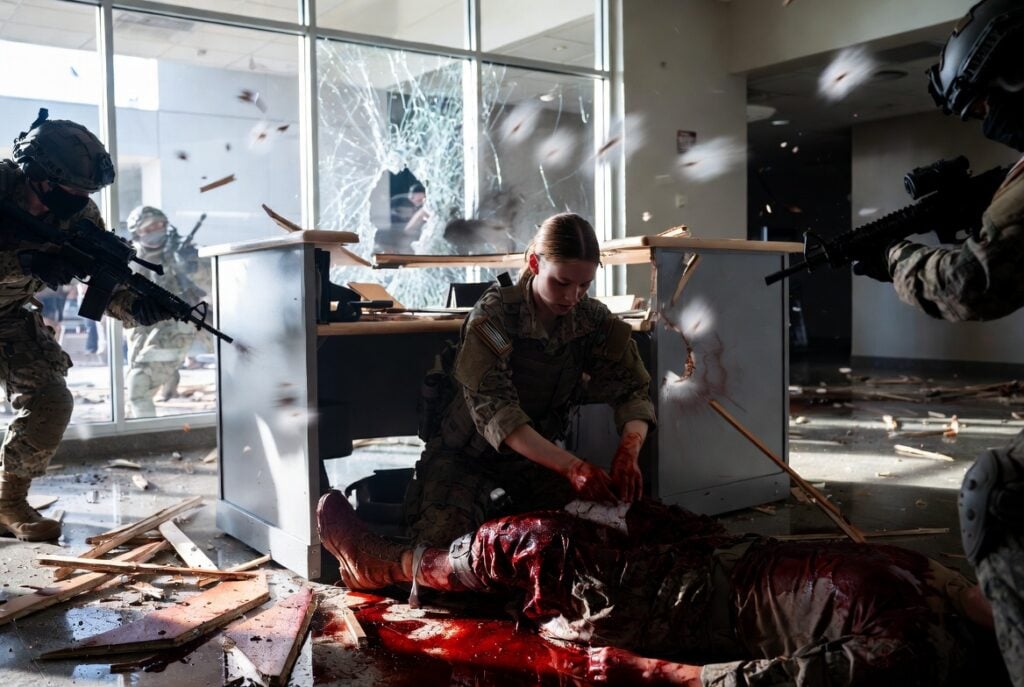
Maya immediately holstered her weapon and returned to Jenkins hands, resuming their medical work as if the shooting had been nothing more than a brief interruption. Patient stabilized enough for movement. Need lit her team in immediate medevac.
Morrison emerged from cover, staring at Maya like he’d never seen her before. Dererick followed weapon up, checking the down shooter. Oz just stood there, mouth open, trying to process what he’d just witnessed.
Did she just Derek trailed off looking at the shooter at Maya back at the shooter? That was a combat draw. That was a competition level draw on fire from concealment under stress at 75 ft.
Morrison moved to the stairwell, verified the shooter was no longer a threat, then returned to Maya. Rodriguez that shot. Not now, sir. Jenkins needs surgical intervention immediately. Can we get him to the ambulance?
The radio crackled. QRF actual. This is Overwatch. Confirm shooter down. Building secure. Affirmative, Morrison replied, still staring at Maya. Shooter neutralized by. He paused, searching for words. By our coreman, building is secure. Bring in medical.
Within minutes, the lobby flooded with personnel. Paramedics taking over Jenkins’s care, transferring him to a backboard and then to the waiting ambulance. Base security entering to secure the scene and begin investigation. Fire department checking for additional casualties.
Maya stood covered in Jenkins blood and began methodically cleaning and restocking her medic bag, hands steady, breathing controlled, face calm, as if she hadn’t just made a shot that most combat veterans couldn’t replicate under ideal conditions, let alone while treating a critical casualty under active fire.
Derek approached slowly like he was approaching something dangerous that might bolt if startled. Doc, that shooting, where did you learn to shoot like that? My father taught me petty officer. That’s not just learning to shoot. That’s elite level training. That’s thousands of hours of practice. That’s He stopped pieces clicking together in his mind. You’re not just Ghost’s daughter. You were trained by Ghost. As in personally trained, as in probably trained from childhood.
Maya didn’t deny it. Didn’t confirm it either. Just continued her methodical equipment check.
Viper Chin had arrived with the security team. She’d seen the aftermath that heard the radio traffic was now staring at Maya with an expression somewhere between awe and disbelief. A corman just engaged and neutralized an active shooter with a pistol, a female corman, while simultaneously treating a critical casualty.
This is I don’t even have words.
Let’s focus on securing the scene, Morrison said, clearly trying to process the same questions everyone else was wrestling with.
Rodriguez, you’ll need to give a statement to security, probably to NCIS as well. This was a justified shooting, no question, but protocol requires investigation. Understood, sir.
Master Chief Bradford arrived, having heard the outcome over the radio. He looked at the scene at the blood at Maya, standing there calm, as if this was just another day at the office.
Rodriguez, I need to see your complete service record, not the summary, the full package, because I’m starting to think there’s a lot more to your background than you’ve disclosed.
Yes, Master Chief, my full file is available through personnel command. Some sections are restricted, but you have clearance to access them.
Bradford pulled out his tablet, began pulling up records with the kind of focused intensity that meant he was done accepting surface level information. His eyes widened as he read. multiple national shooting championships, competitive circuit for six years, topranked junior shooter in three disciplines.
He scrolled further, offered Marine Scout Sniper Pipeline at 18, declined, chose hospital corman rating instead. He looked up. Why?
Maya had known this question would come eventually, had prepared her answer. But speaking it out loud in front of people, she needed to respect her as a medic first and foremost required courage that had nothing to do with facing gunfire.
Because I didn’t want to be just a shooter master chief. I wanted to be something more, something different from what everyone expected.
Because I didn’t want to be just a shooter master chief. I wanted to be something more, something different from what everyone expected.
Before Bradford could respond, hospital corman first class. Sarah Kim, the senior medic who had been mentoring Maya, arrived and went straight to her. Are you injured? Are you okay? I’m fine, chief. not hit. Sarah looked at Maya’s bloodcovered uniform, at her calm demeanor, at the scene of violence and medical chaos.
You saved Jenkins, treated him under fire, and neutralized the threat. That’s that’s beyond anything I’ve seen a corman do. I did what was necessary, what the situation required. No. Sarah shook her head. Most corman, including me, couldn’t have done what you just did. The medical treatment alone under that pressure is remarkable. but to also engage the shooter. That’s integration of skills at a level I didn’t think was possible.
The base commander arrived Captain Richard Hayes, a career surface warfare officer who had seen his share of action, but was visibly shaken by having an active shooter incident on his installation. He spoke briefly with Morrison, got the basic situation, then approached Maya.
Hospital Corman Rodriguez. Mia came to attention. Yes, sir. I’ve just received preliminary reports of your actions. You treated a critically wounded SEAL under fire, then engaged and neutralized an active shooter with your sidearm. Is that accurate? Yes, sir.
Hayes studied her for a long moment. That’s extraordinary performance. I’ll be recommending you for the Navy and Marine Corps commenation medal with combat valor device. Your actions saved Petty Officer Jenkins’s life and prevented further casualties.
He paused. I’d also like to understand how a hospital corman developed the combat shooting skills you just demonstrated. Long story, sir, but the short version is my father trained me from a young age. I chose medical over combat as my primary focus, but the skills remained clearly.
Hayes glanced at Morrison. Commander, I want a full afteraction report on my desk by tomorrow morning. include Rodriguez’s complete background and how her unique skill set might be utilized in future operations. I I sir.
After Hayes departed, the team gathered around Maya in an informal semicircle. The dynamic had shifted completely. No more dismissive jokes, no more questioning her competence, just quiet respect mixed with curiosity and a dozen unanswered questions.
Tommy Chen, the youngest team member, spoke first. Doc, that was the most incredible thing I’ve ever seen. The way you just switched from medic to warrior and back to medic like flipping a switch. It wasn’t a switch, Mia said quietly. It was integration, both roles simultaneously. I was treating Jenkins and maintaining tactical awareness. When the threat became immediate, I addressed it, then returned to medical care. They’re not separate identities. They are complimentary capabilities.
Matthews, who had been providing overwatch from outside, approached. That draw, that shot. I recognize the technique. It’s Ghost signature style. The way you acquire sight. Picture the trigger. Press the follow through. I’ve seen him demonstrated in training. You shoot exactly like him.
He taught me. Maya confirmed. Since I was 8 years old, competition shooting, tactical applications, everything. He’s a comprehensive instructor.
Derek sat down heavily on a concrete barrier processing everything. So, you’ve been able to shoot at this level the entire time. You qualified distinguished expert at the range yesterday, but that was probably you holding back, wasn’t it? You could have scored perfect if you wanted. The qualification was adequate to demonstrate competence. Perfect scores draw attention I didn’t want.
Why not? Viper asked genuine curiosity in her voice. Now, why hide capability? Most people lead with their strengths. Because I wanted to be valued for my medical skills first. I wanted people to see me as a corman who happened to have shooting capability, not a shooter who happened to have medical training. The distinction matters to me.
Oz nodded slowly. That’s why you were so calm during all the testing. Why you never got defensive when people questioned you. You knew you could prove yourself when it mattered, so the hazing was just noise essentially. Yes.
Morrison’s phone rang. He answered, listened to his expression growing serious. Understood. I’ll inform her. He ended the call and looked at Maya. That was the hospital. Jenkins is in surgery. Prognosis is good. He’ll survive thanks to your treatment.
The surgeon said, “Another 3 minutes of bleeding, and he would have been unsavable. Your intervention gave him the margin he needed.” Relief washed over Maya’s face, the first genuine emotion she’d shown since the incident began. Thank you, sir. That’s That’s good news.
His wife wants to thank you personally. She’s at the hospital now. That’s not necessary, sir. I was just doing my job. You did a hell of a lot more than your job.
Rodriguez Morrison gestured to the building. This entire situation, the medical treatment, the tactical assessment, the threat elimination, you operated at a level that most people train their entire careers to achieve. And you did it while everyone was underestimating you.
Master Chief Bradford mentioned something that made several people shift uncomfortably specialized insurance for naval special warfare personnel. Coverage for combat medics attached to sealed teams required unique underwriting with actuarial models accounting for deployment patterns, casualty rates, and the specific risks of providing medical care under fire.
Insurance providers specializing in special operations understood that corman faced different risk profiles than standard medical personnel. Requiring benefit structures that reflected the reality that saving lives in combat zones carried its own mortal dangers with premium calculations that most civilian brokers never encountered.
The weight of that reality settled over the group. This was what they did. This was what Maya had chosen to be part of. Not the sanitized Hollywood version of special operations, but the raw reality where people bled and died, where split-second decisions meant the difference between going home and coming home in a flag draped box.
Stop right here. What happens in the next 60 seconds will change everything. I’ve been holding back one critical piece of information about Maya’s background, and it’s about to become devastatingly relevant. Make sure you’re subscribed because missing this reveal would be criminal. The emergency call just came in. Real bullets. Real danger. Time to see what she’s really made of.
Gunnery Sergeant Foster, the Marine liaison, had been on the phone since the incident ended. Now he approached phone still in hand. Expression complicated. Rodriguez, I just spoke with your father. He heard about the shooting through the Grapevine News travels fast in the sniper community.
He’s on his way here. Maya’s calm demeanor cracked slightly. He’s coming here when he’ll be here by tomorrow morning. Caught a military transport out of Quantico. Foster paused. He’s proud of you. Said to tell you that.
The team noticed Ma’s reaction. The first visible sign of anything other than professional composure. Derek picked up on it immediately. You don’t want him here. It’s complicated, Mia said carefully. My father and I have different perspectives on how I should use my capabilities. He wanted you to be a sniper. He wanted me to follow his path, to be what he is. I wanted to be something else.
Viper understood in a way the men couldn’t. You wanted to prove you were more than just his legacy, more than just ghost daughter with inherited talent. You wanted to be your own person with your own identity. Yes, exactly that.
But today proved you can be both. Morrison said, “You are both. You saved Jenkins as a corman and stopped the threat as a warrior. You integrated both capabilities seamlessly. That’s not choosing one identity over another. That’s being completely yourself.”
Maya was quiet processing that perspective. She’d spent so long trying to be either medic or shooter, trying to keep them separate, trying to prove one didn’t diminish the other. It hadn’t occurred to her that the real answer might be integration rather than separation.
The investigation continued throughout the afternoon. NCIS agents interviewed everyone, documented the scene, reviewed security footage. The shooter, a former military member with PTSD who’d fixated on the base as a target, had been taken to the hospital under guard. He would survive to face charges thanks to body armor that had stopped Mia’s rounds from being lethal.
By evening, the team gathered in their team room for informal debrief. This wasn’t official, just warriors processing a traumatic event together, the way teams had done for thousands of years.
Derek was the first to speak. I owe Maya an apology. Actually, I owe her about a 100 apologies. I questioned her competence, dismissed her as just a medic, made assumptions based on her size and her gender and her age. And today she proves she’s more capable than most of the people in this room.
Agreed. Oz said, “When I saw her draw and fire, when I saw that shot placement, I realized I’d completely misjudged her. She’s not just competent, she’s elite level in both medical and combat skills.”
Viper added, “I was protecting territory, protecting my own position as a woman in this community by keeping other women out. That was wrong. Maya’s not a threat to my credibility. She’s an example of what’s possible. I should have been supporting her, not testing her.”
Doc Williams spoke next. I questioned whether she could handle combat trauma under stress. Today, she proved she can handle things I couldn’t handle. That medical treatment under fire was textbook perfect while simultaneously maintaining tactical awareness good enough to eliminate a threat. That’s integration at a level I’ve never seen.
Jake Turner, the jealous corman who’d spread rumors, looked uncomfortable. I said things, bad things about nepotism and favoritism. I was wrong. She earned her position 10 times over. I’m sorry.
Master Chief Bradford set down his coffee. Rodriguez, I need to ask you something, and I need a straight answer. If we deploy as a team, if we go into combat together, can you maintain this level of integration? Can you be both corman and combatant when the situation requires it?
Maya considered the question carefully. Yes, Master Chief, but I need the team to understand something medical is my primary mission always. I’ll engage threats when necessary to protect my patient or protect the team. But I’m not an assaulter who happens to have medical training. I’m a corman with advanced combat skills. The distinction matters for how I’m employed.
Fair enough, Bradford said. We need to build doctrine around that. Figure out how to integrate someone with your unique skill set into tactical operations without misusing you.
Morrison stood. That’s exactly what we’ll do. Rodriguez has demonstrated capabilities that are honestly unprecedented. Most medics can treat casualties. Most shooters can engage threats. She can do both simultaneously. That’s a force multiplier. We need to learn how to employ effectively.
Matthews raised a hand. Question for Maya. That shot you made today, 75 ft moving target from concealment under stress after treating a casualty. What’s the longest shot you’ve ever made?
Maya hesitated. This was entering territory she’d avoided the part of her background that meant comparisons to her father. That meant being reduced to just a shooter rather than being seen as a complete professional.
In competition, I’ve made accurate shots at 600 meters with a rifle in training with my father farther, but that’s not relevant to my role as a corman.
It might be, Matthew said thoughtfully. If we’re in a situation where we need medical support and our primary sniper is down, having a backup who can provide both capabilities is invaluable.
That’s getting into territory where we’re using her as a sniper rather than a medic. Morrison cautioned. We need to be careful about mission creep. Rodriguez chose this path deliberately. We should respect that choice.
I appreciate that, sir. Maya said, but Matthews makes a valid point. If the mission requires it, if my team needs it, I’ll do whatever role is necessary. I just don’t want that to become my primary identity again.
The discussion continued into the evening. The team working through the implications of having someone with Maya’s unique skill set, figuring out how to integrate her capabilities without losing sight of her primary medical mission.
By the time they dispersed for the night, something fundamental had shifted. Maya wasn’t the new corman anymore. Wasn’t the outsider trying to prove herself. Wasn’t Ghost’s daughter or a female medic or any of the other limited identities people had tried to assign her. She was Maya Rodriguez combat medic with elite shooting skills. A complete professional who’d proven she could excel under the worst conditions imaginable.
The next morning, Maya arrived at the team room to find her father waiting. Gunnery Sergeant Carlos Ghost. Rodriguez stood six feet tall, lean, and weathered with the quiet presence of someone who’d learned that real confidence didn’t need advertisement. His eyes were the same dark brown as Mia’s, and they held the same capacity for absolute focus.
“Miha,” he said, opening his arms. Mia hesitated for just a moment, then stepped into the embrace. Whatever complicated feelings existed between them, he was still her father, still the man who taught her almost everything she knew about shooting and tactics and discipline.
Hi, Dad.
They separated and Ghost studied her with eyes that missed nothing. I heard what happened. Heard you saved a seal’s life while taking down an active shooter. Heard you made a perfect combat draw under stress at 75 ft. Heard you did all of it while everyone thought you were just a medic.
I am just a medic, Dad. That’s what I chose to be.
No, Miha. You’re not just anything. You’re a medic who’s also an elite shooter. You’re both. You always have been both. You were just afraid to embrace that because you thought it meant becoming me.
Maya felt something crack inside her chest. A wall she’d been building for 6 years, a separation she’d been maintaining to preserve her identity.
I didn’t want to be your shadow. Didn’t want everything I did to be compared to you.
I know. and I pushed you toward shooting because I was proud of your talent, proud of what we’d built together. I didn’t understand that you needed to find your own path.
Ghost smiled sadly. You did find it. You became something I never thought to become a warrior who heals, a protector who saves lives instead of taking them. That’s not less than what I am. It’s more.
The team who’d gathered to meet Ghost watched the exchange with quiet respect. This was a private moment made public by necessity. A father and daughter working through years of complicated emotions in front of an audience.
I’m proud of you, Ghost continued. Not because you can shoot like me. And not because you use those skills yesterday. I’m proud because you chose to be a healer first. Because when you finally did use your combat skills, it was in service of saving a life, not taking one. That takes more courage than anything I’ve ever done.
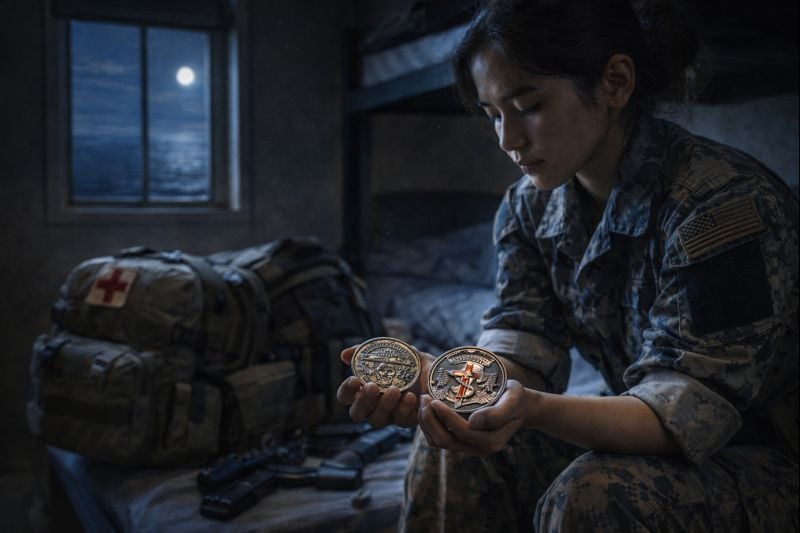
Maya’s eyes glistened. I thought you’d be disappointed. I didn’t become a sniper.
I was at first, but that was my ego, not wisdom. You made the right choice for who you are. And yesterday proved you didn’t lose those skills by choosing a different primary focus. You integrated them. That’s the genius of what you’ve done. You didn’t choose between warrior and healer. You became both fully.
He turned to Morrison. Commander, I came here to thank you and your team for accepting my daughter, for giving her the opportunity to prove herself on her own terms, and to offer any assistance you might need in integrating someone with her unique capabilities.
Morrison shook Ghost’s hand. Gunny, your daughter, has already revolutionized how we think about combat medicine. She’s proven that Corman can be full tactical participants, not just medical support. We’re still figuring out the doctrine, but she’s leading that development.
good because she’s always been a leader even when she didn’t realize it.
Ghost pulled a challenge coin from his pocket. Marine scout sniper weathered from years of carry. Miha, I want you to have this not because I want you to be a sniper, but because it represents what I value most, precision patience discipline and the courage to take the hard shot.
You demonstrated all of that yesterday in medical terms and combat terms. You’ve earned this more than most Marines I’ve given it to.
He pressed the coin into her hand, and Mia felt the weight of it, literal and metaphorical. Her father’s blessing not to follow his path, but to walk her own.
Thank you, Dad.
Thank you, Ma, for teaching me that there are many ways to be a warrior. Yours might be the most important.
Over the next few days, the base processed the aftermath of the active shooter incident. Jenkins recovered from surgery and returned to light duty. The shooter faced charges and psychiatric evaluation. The investigation concluded that Mia’s use of force had been completely justified and tactically sound.
But the bigger impact was cultural. Word spread through the special operations community about the corman who’d saved a life and stopped a threat simultaneously. Female service members reached out to thank Maya for representation. Medical personnel requested to train with her to learn her integration approach. SEAL team started asking whether their corman could develop similar capabilities.
Maya found herself at the center of a shift in how combat medicine was viewed, not as support, but as a full tactical capability with unique skills that could be force multipliers when employed correctly.
Commander Patricia Hayes, the base executive officer, summoned Mia to her office one week after the incident. Morrison accompanied her, unsure what the summons meant. Hayes’s office was professional, but sparse a career officer who valued function over decoration. She gestured for them to sit, then opened a classified folder.
Hospital Corman Rodriguez, I’ve been reviewing your performance over the past 2 weeks. Medical evaluations, tactical assessments, the active shooter incident, and feedback from your team. The picture that emerges is of someone with capabilities we don’t normally see integrated in a single individual.
Thank you, ma’am.
It’s not just a compliment, it’s an opportunity. Hayes slid the folder across the desk. Special Operations Command is forming a specialized task force for high-risk operations requiring both advanced medical capability and combat proficiency, humanitarian missions and hostile territories, hostage rescues with casualty complications, scenarios where traditional separation of medical and combat roles isn’t feasible.
Maya opened the folder, began reading. The mission profiles were exactly what Hayes described. Complex scenarios requiring seamless integration of medical and tactical capabilities.
They’ve requested you specifically, Hayes continued. Your performance has generated significant interest at the command level. This would be a voluntary assignment, high risk, but potentially high impact. You’d be working with an elite team developing doctrine for this type of integrated operations.
Morrison leaned forward. Ma’am, with respect, Rodriguez is assigned to my team. We’ve just integrated her. Just learned how to employ her capabilities. Taking her now would would be—
It would be her choice. Hayes interrupted gently. Commander, I understand your concerns, but this opportunity is potentially historic. Rodriguez could shape the future of combat medicine for special operations.
Maya studied the mission profile. The assignment included humanitarian crisis response in Syria, medical personnel, and civilians being held by a hostile force requiring rescue operations that would need both tactical precision and advanced medical support for potentially dozens of casualties.
One detail caught her attention. The intelligence report indicated that among the hostages were several doctors and nurses who’d been providing care to civilians under duress. medical professionals forced to work at gunpoint, threatened with violence if they didn’t comply.
She thought about Jenkins bleeding out in a lobby, about the civilians who had been shot trying to evacuate building 7, about all the times when having someone who could fight and heal would mean the difference between mission success and catastrophic failure.
Sir, she said to Morrison, permission to accept this assignment.
Morrison was quiet for a long moment, then he nodded. Permission granted, but you better come back in one piece, Rodriguez. This team needs you.
I’ll do my best, sir.
Hayes stood, extended her hand. Welcome to the task force, Petty Officer, Rodriguez. You’ll begin training in 2 weeks. Until then, continue working with your current team to document integration procedures. We need to capture what you’ve developed so it can be taught to others.
After they left Hayes’s office, Morrison walked Maya back to the team room in silence. Finally, he spoke. This is bigger than any of us realized. You’re not just a good corman with shooting skills. You’re potentially the first of a new type of operator.
Someone who doesn’t fit traditional categories, who integrates capabilities in ways we haven’t seen before.
I’m just trying to do my job, sir.
No, you’re creating a new job, and that’s important.
Morrison paused at the door. Your father was right. You didn’t become him. You became something he never thought to be. That’s worth more than any medal or commenation.
The team took the news of Maya’s reassignment with mixed emotions. Proud that she’d been selected for such an important mission. Disappointed to lose her, grateful for the short time they’d had to work with her.
Derek pulled her aside the day before she departed for task force training. Doc, I need to say something. When you first showed up, I treated you like you didn’t belong, like you were a burden we had to carry. I was wrong about everything.
You’re not a burden. You’re an asset. You’re not weak, you’re strong in ways I didn’t know how to recognize. And you’re not just Ghost’s daughter, you’re Maya Rodriguez, and that means something completely unique.
Thank you, Hammer. That means a lot.
Also, Derek grinned. If you ever need a reference for how not to treat new team members, feel free to use me as an example. I earned that distinction.
Maya laughed the first genuine laugh in weeks. I’ll keep that in mind.
The night before she left, the team gathered for an informal sendoff. No ceremony, no speeches, just warriors sharing time together before one of their own departed for a new mission.
Tommy approached her nervously. Doc, you said you’d mentor me. You’re leaving, but could you still answer questions? Help me figure out this Corman thing.
Of course, Tommy. Call anytime, email anytime. I’ll always make time to help you.
Thanks. You’ve shown me what’s possible. That being a medic doesn’t mean being lesser. It means being different. and different is valuable.
Oz handed her a small package. From all of us, something to remember the team.
Maya unwrapped it to find a custom challenge coin. On one side, the traditional seal trident. On the other, a medical kaducius integrated with a rifle and the words healer, warrior, complete.
We had it made special, Oz explained. Because that’s what you are. Not one or the other, both. Complete.
Maya felt tears threatening but held them back. This is this is perfect. Thank you all of you.
Morrison raised a coffee cup in toast. To Maya Rodriguez who taught us that assumptions are dangerous, that capability comes in unexpected packages and that the best operators are the ones who integrate rather than specialize.
May she continue to revolutionize how we think about combat operations.
To Maya, the team echoed.
That night alone in her barracks, Maya held the challenge coin from her father in one hand and the coin from her team in the other. Two different acknowledgements of who she was.
Ghost’s coin represented her past, the skills inherited, and taught the foundation that made everything else possible. The team’s coin represented her future, the integration she’d achieved, the new path she was forging, the operator she’d become.
She didn’t have to choose between them anymore.
Her phone buzzed. Text from her father. Heard about the task force assignment. Proud of you, Miha. You’re doing something I never imagined. Keep teaching the world that warriors can heal and healers can fight. Love you.
She typed back, “Thanks, Dad. Love you, too.”
Then another text. This one from Morrison. Task Force briefing materials attached. Looks like the hostage situation is worse than initial reports indicated. Medical personnel being forced to treat combatants under threat of execution. Civilian casualties mounting.
They need someone who can extract the medics and provide care simultaneously. They need you.
Maya opened the briefing materials, began reading through the intelligence reports and mission parameters. The complexity was staggering. Multiple hostile forces, unknown number of casualties, limited time, window for extraction, high probability of combat during medical operations.
Exactly the kind of scenario that required someone who could integrate both roles seamlessly.
Someone who could treat the wounded while engaging threats.
Someone who could be medic and warrior simultaneously without hesitation, without separation.
Someone like her.
She packed her gear methodically, medical equipment in one bag, tactical equipment in another. Both essential, both valued equally.
Checked her weapons, verified her medical certifications, reviewed her training materials. Two weeks until task force training began.
She wasn’t nervous, wasn’t scared, wasn’t doubting herself anymore.
She was ready.
Because Maya Rodriguez Hospital corman third class daughter of ghost competitive shooter combat medic warrior healer had finally figured out what her father meant when he’d told her that being both wasn’t a compromise.
It was completion.
And as she closed her eyes that night, the challenge coins resting on her nightstand, she smiled.
They’d laughed when they saw the medic.
They’d stopped laughing when she picked up the rifle.
But the truth, the real truth that nobody had expected was that she’d been both all along.
The medic bag and the rifle weren’t opposites. They were partners.
And Maya Rodriguez had just proven that the future of special operations, belonged to people who understood that integration, not specialization, was the key to handling impossible missions.
The phone buzzed one more time. Unknown number.
She answered, “Petty Officer Rodriguez.”
This is the task force commander. Welcome aboard. Your first mission briefing is in 14 days. One thing you should know before you arrive, the hostages include a medical team that’s been treating civilian casualties for 6 months under constant threat. They’re heroes. They’re also trapped.
And we need someone who speaks both languages, medical and tactical, to bring them home.
We need you.
Maya sat up, already reaching for her planning materials. Sir, I’m ready. When do we deploy?
Soon. Very soon. Get some rest, petty officer. You’re about to rewrite the rules for combat medicine in special operations.
The call ended.
Maya looked at her bags at her coins at the window, showing the dark Pacific Ocean beyond the base.
Somewhere out there, medical personnel were working under gunpoint to save lives.
Somewhere out there, a mission awaited that would require every skill she possessed, medical and tactical integrated seamlessly.
Somewhere out there, people needed someone who could drop the medic bag and pick up the rifle when necessary.
Someone who could be both completely without hesitation.
Someone exactly like her.
And Maya Rodriguez was more than ready to prove that healers could fight and warriors could heal.
The future of combat medicine had arrived.
And it looked nothing like anyone had expected.