The metallic clang of the stainless steel tray hitting the table echoed through the naval special warfare center cafeteria. Forty pairs of eyes turned. Grace Archer, a slight woman in the faded gray uniform of cafeteria staff, stood motionless, cleaning cloth in hand, watching the pool of coffee spread across the floor.
“Oops. Sorry about that, ma’am,” Connor Blake, 24 years old and three days removed from Hell Week, grinned wide. “My hand just slipped.” Ethan Carter beside him burst into laughter. “Bro, careful. She might break a nail cleaning that up.” Their round table—five SEAL recruits, all under 26—erupted in laughter. Other diners in the mess hall looked down at their plates. An uncomfortable silence rippled outward from the neighboring tables.
Grace knelt, her cloth moving in systematic patterns—outside to inside, not a drop missed. Her shoulders didn’t shake. Her hands didn’t tremble.
“You know what I heard?” Mason Fletcher, a sniper wannabe with three months of training, leaned toward his buddies. “They’re talking about letting women into SEAL training.” Connor spit out a mouthful of water. “What? No way. That’s ridiculous.” “Dead serious, bro,” Mason tapped his fingers on the table. “Equal opportunity and all that noise.” Ethan shook his head. “Women can’t be SEALs. Physically impossible. Hell Week alone would destroy them.” “Facts,” Connor glanced down at Grace, still wiping the floor. “I mean, no offense, ma’am, but it’s just biology. You ladies are built different. Not better or worse, just different.”
Grace stood, tray in hand, silent. Her eyes swept across the five faces—one second each—before she turned away. But in the next twenty minutes, everything they thought they knew about the cafeteria lady would shatter completely.
She moved through the dining area with deliberate efficiency, collecting plates, wiping surfaces, refilling condiment stations. The kind of invisible labor that kept a military base functioning. Nobody paid attention to the help. That was the point. Grace had been working here for two years—730 days of blending into the background, of being dismissed, overlooked, forgotten. She’d learned every face, every rank, every weakness. Information flowed around her like water around a stone.
The recruits’ table grew louder. Connor had an audience now. “I’m just saying,” he continued, volume increasing, “there’s a reason it’s called the teams. Physical standards exist for a reason. You can’t lower the bar just to make people feel included.” Mason nodded enthusiastically. “Exactly. Combat doesn’t care about your feelings. Either you can carry a wounded teammate or you can’t.” Ethan added, glancing around to make sure others were listening, “And let’s be real—when things go sideways, you want a warrior next to you, not someone who’s there because of some political quota.”
Grace paused at a nearby table, her hand tightening imperceptibly on the edge of a tray. The muscles in her jaw flexed once, then relaxed. She continued working, but Master Chief Arthur Gray, 52 years old and thirty years in special operations, watched from his corner booth. He noticed things—the way Grace moved through the room with perfect situational awareness, how she never turned her back to the main entrance, the way her eyes tracked movement with the precision of someone trained to assess threats. He had been noticing these things for weeks.
Grace entered the equipment storage room behind the kitchen. Supplies lined metal shelving units in perfect rows—everything organized with military precision, items arranged by size, frequency of use, expiration date. The kind of system that spoke of ingrained habits. She began restocking paper towels, placing each roll exactly two inches apart.
“Hey, lady, you got any protein bars?” Mason Fletcher stood in the doorway, smirking. Behind him, Connor and Ethan blocked the exit. Grace’s fingers paused mid-motion. Her internal count didn’t falter. 32 rolls. 33. She reached for another without looking at him. “Cabinet by the south wall,” she said quietly. “Second shelf.”
Mason didn’t move. “That’s pretty organized in here. Ex-military or something?” “My husband was.” The lie came easily. She’d used it dozens of times. Connor pushed into the room. “Let me guess. He couldn’t hack it.” Grace set down the roll she was holding, turned slowly, met his eyes. “He was killed in Helmand Province, 2011.” The truth and the lie woven together. Let them make assumptions.
Connor’s smirk faltered for half a second, then returned. “Sorry for your loss, but that doesn’t really answer the question, does it?” Ethan laughed. “Bro, leave her alone. She’s probably just OCD or whatever.” They left laughing about something else. Grace waited until their footsteps faded, then continued stocking. 34, 35, 36. Her hands didn’t shake. They never did.
An hour later, Grace carried a supply requisition to the outdoor seating area where instructors took their breaks. Captain Henry Hugo, the range master, sat reviewing qualification scores. Corporal Oliver Allen, the base armorer, was field-stripping an M4 carbine at a picnic table, parts laid out in precise order. Grace set down her delivery slip. “Ammunition requisition for next week’s qualification, sir.” Hugo glanced up, nodded. “Thanks. Leave it there.”
She turned to go. “Wait,” Oliver called out. He held up the bolt carrier group. “Ma’am, you ever seen one of these before?” The question wasn’t hostile, just curious—maybe bored. Grace looked at the component. Upper receiver, bolt carrier, charging handle, buffer spring assembly, gas tube, forward assist. Her brain cataloged each piece automatically. “My husband showed me some things,” she said carefully.
Oliver grinned. “Yeah, bet you can’t name three parts, though.” Behind her, she heard more footsteps. The recruits were back. Of course they were.
Before we continue with what happened next at that base, I need to tell you something important. What you’re about to witness isn’t just a story about respect or military tradition. It’s about the dangerous assumptions we make when we judge people by their appearance. If you’ve ever been underestimated, dismissed, or overlooked because of how you look, this story will hit differently. The next twenty minutes will show you exactly why you should never ever assume you know someone’s capabilities based on their current position. Hit that subscribe button right now because the reveals coming up will absolutely shock you.
Grace set down her clipboard, looked at Oliver, then at the disassembled rifle. “Upper receiver,” she said quietly, pointing. “Bolt carrier group, charging handle, buffer spring, gas tube, forward assist, ejection port cover, magazine release, trigger assembly, safety selector.” She stopped herself, but the damage was done.
Silence. Oliver stared at her. “That’s… that’s correct. All of it. How did you—” “Lucky guess?” Grace picked up her clipboard, started walking. “Hold up.” Connor stepped into her path. “That wasn’t luck. That was knowledge.” Mason appeared on her other side. “Yeah, specific knowledge. My girlfriend can’t name three parts, and her dad’s a Marine.” Ethan circled behind. “So, what’s the deal? You some kind of gun nut?”
Grace’s pulse remained steady—62 beats per minute, same as always. “YouTube,” she said flatly. “You can learn anything on YouTube.” She moved past them. Didn’t run. Didn’t rush. Just walked with the same measured pace she always used.
But Master Chief Gray, watching from thirty feet away, saw the micro-expressions—the brief tightening around her eyes, the way her right hand had automatically moved to her hip, where a sidearm would typically rest. Interesting. He pulled out his phone, opened the personnel database, typed Grace Archer. The file was thin. Too thin. Hired two years ago. Clean background check. Standard references. Nothing remarkable. But at the bottom, a single notation: Security clearance level three. DoD restriction applies. Gray’s eyebrows rose. Cafeteria workers didn’t need level three clearance.
He picked up his office phone, dialed an extension. “Lieutenant Iris, this is Master Chief Gray. I need you to run a deep background check for me. Full work-up and keep it quiet.”
That afternoon, Grace delivered fresh towels to the outdoor equipment shed. The route took her past the pistol range where Master Chief Gray was conducting qualification tests for the new SEAL class. Fifteen recruits, all male, ages 22 to 28. She knew their names, their hometowns, their average scores—information absorbed through weeks of overhearing conversations, reading clipboards left on tables, noticing which ones ordered extra protein, who was nursing injuries, who was on the verge of washing out.
Connor Blake, Phoenix, Arizona. 24, overconfident. Average shooter, 78% qualification rate. Mason Fletcher, Dallas, Texas. 26. Sniper aspirant. 82%. Decent, but not exceptional. Tendency to overcorrect for wind. Ethan Carter, San Diego, California. 25. Social climber, 75%. Inconsistent trigger discipline. She knew them better than they knew themselves.
“Fleming, you’re up,” Gray shouted. “Blake, Carter, Fletcher, you’re on deck. Watch and learn.” Grace kept walking, head down, almost past.
“Hey, miss expert.” She stopped, turned. Mason jogged over, grin plastered across his face. Connor and Ethan followed. “Since you know so much about weapons,” Mason said loudly enough for everyone to hear, “maybe you can tell me what I’m doing wrong.” He pointed at his target—a grouping spread across the seven and eight rings. “Can’t seem to tighten up my shots today.”
The recruits were watching now. Fifteen sets of eyes. Grace looked at the target. 25 yards. Standard M9 Beretta qualification. His grouping pattern showed clear indicators—shots pulling low and left, inconsistent vertical spread. No compensation for his natural breathing cycle. “You’re jerking the trigger,” she said quietly, “anticipating recoil, and your breathing is wrong. You’re holding your breath instead of firing on the natural pause between exhale and inhale, and you’re tensing your forearm before the shot. That’s pulling everything left.”
Captain Hugo, supervising from the range booth, walked over. “She’s absolutely right. That’s exactly what you’re doing, Fletcher. I’ve been trying to tell you for two weeks.” Mason’s face reddened. The other recruits snickered.
Connor stepped forward. “Okay, Miss Expert, if you’re so smart, why don’t you show us how it’s done?” Grace started to refuse. Then Ethan accidentally bumped into her bag, knocking it off her shoulder. Contents spilled across the gravel—wallet, keys, and a small photo in a protective case.
The photo showed a younger Grace, maybe 32, in desert camouflage, standing next to a man in Marine Corps dress blues. Both smiling, both alive. Connor picked it up, looked at it, his expression shifted. “Your husband?” he asked, some of the mockery fading. “Yes.” “How’d he die?” Grace’s jaw tightened. “IED route clearance patrol. He was trying to save his team.”
She reached for the photo. Ethan grabbed it first, studied it, then accidentally spilled his coffee on it. “Oh man, sorry.” His voice carried zero sincerity. “Slippery hands today, I guess.” The photo wasn’t damaged—the case was waterproof. But something in Grace’s posture changed. A shift so subtle most people would miss it. Her weight redistributed. Her spine straightened. The angle of her head adjusted by exactly three degrees.
She took the photo from Ethan’s hand, wiped it carefully, put it back in her bag. Then she looked at Connor. “One magazine, M9, 50 yards.” Master Chief Gray, who’d been about to intervene, froze. 50 yards with a pistol was extremely difficult. Standard qualification was 25 yards maximum. Even expert marksmen struggled to maintain accuracy at 50.
Connor’s eyes widened. “You’re serious.” “One magazine,” Grace repeated. “Then you leave me alone. Deal.” Connor glanced at his buddies, excited now. “But when you miss, you apologize to all of us for acting like you know things you don’t.”
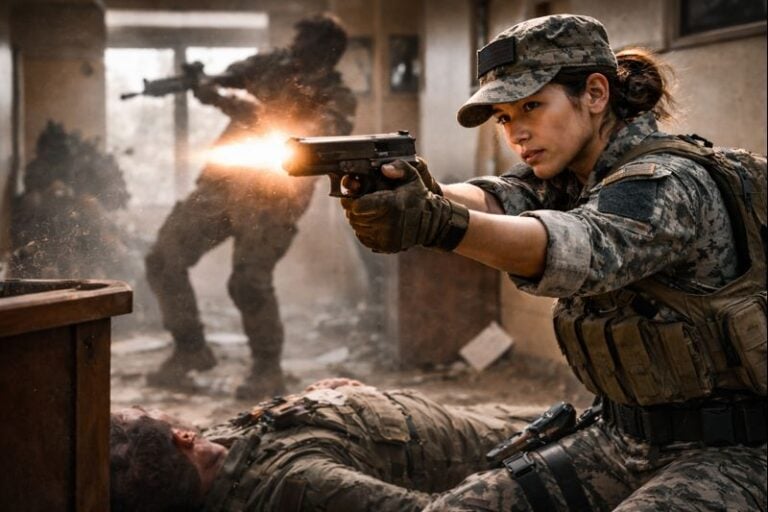
Grace walked to the firing line. Twenty people had gathered now. Word spread fast on a military base. Entertainment was rare. Captain Hugo handed her a loaded M9. “Ma’am, you don’t have to do this. These kids are—” “It’s fine.” Grace took the weapon. Her right hand wrapped around the grip. Index finger automatically extended along the frame, not touching the trigger. Her left hand came up in perfect support position. Thumbs forward, high grip, locked wrists. The stance was textbook—no, it was better than textbook. It was instinctive.
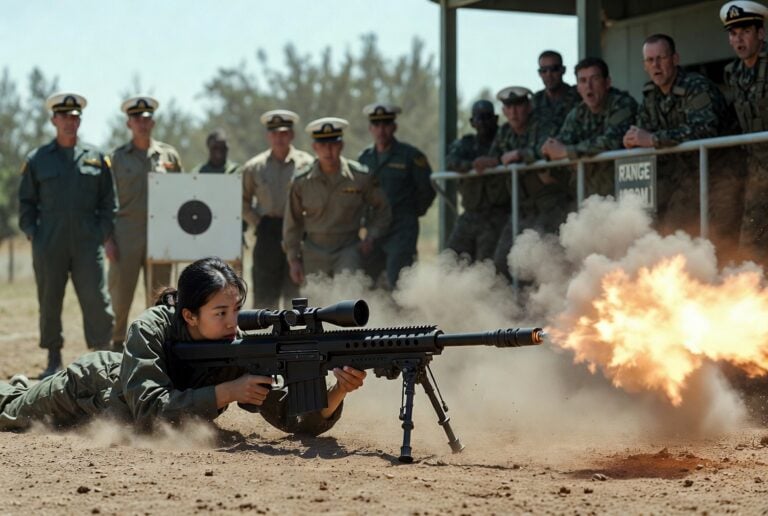
Master Chief Gray moved closer, watching. Grace’s breathing slowed, visible even from thirty feet away. In, out, in, out. Finding the rhythm, she raised the weapon, barely seemed to aim. Just looked at the target, indexed the front sight, and pressed. Two shots—rapid succession, so fast they almost sounded like one. Then two more. Two more. Two more. Two more. Ten rounds. Eight seconds. Controlled pairs. Every single hole in the center mass scoring zone. A grouping you could cover with a coffee mug at 50 yards.
The range went silent. Captain Hugo walked downrange with binoculars, studied the target, walked back. “Ten for ten. Center mass. That’s…” He looked at Grace with completely different eyes. “That’s expert-level marksmanship.” Connor’s mouth hung open. “That’s… that’s not possible. Nobody shoots that well without—” “Without what?” Grace set the M9 down carefully, barrel pointed downrange. “Without training.”
She walked past him. Past all of them. Mason grabbed her arm. “Hey, you can’t just walk away after—” Grace’s response was automatic, pure muscle memory. Her wrist rotated 90 degrees. Her free hand came across and applied pressure to Mason’s thumb joint. He released immediately, face contorting. “Don’t grab people,” she said calmly. “It’s rude.” Then she left. The recruits stood frozen.
Master Chief Gray pulled out his phone again. “Iris, bump that background check to priority one. Something’s not right here.”
Speaking of precision and accuracy, let me tell you about something that’s revolutionized health monitoring for active professionals. Advanced biometric tracking devices now offer military-grade sensors that can monitor heart rate variability, stress levels, and recovery metrics with the same accuracy used in tactical operations. These aren’t your typical fitness watches. They’re medical-grade monitoring systems designed for people who push their bodies to extreme limits. Whether you’re an athlete, first responder, or just serious about peak performance, this level of health data can be life-changing.
That evening, Grace walked through the base toward the parking lot. Her shift ended at 1800 hours—43 minutes from now. She had a routine. Follow routines. Routines kept you invisible.
“Ma’am. Miss Archer.” She turned. Private First Class Aiden Flynn, 22 years old, one of the youngest recruits, jogged to catch up. He’d been in the background during the range incident—quiet, observant. “I wanted to apologize,” he said quickly, “for what happened. Blake and those guys? They’re not bad people. They’re just insecure.”
Grace looked at him. “Overcompensating, trying to prove themselves by diminishing others.” Aiden blinked. “Yeah, exactly that.” “It’s fine. I’ve dealt with worse.” “Where’d you learn to shoot like that?” The question wasn’t challenging, just genuinely curious. Grace studied him for a moment—young, earnest, not trying to trap her or mock her. “My husband taught me,” she said. The lie was wearing thin. “Before he deployed. He must have been an incredible teacher.” “He was an incredible Marine.”
Aiden nodded slowly. “I lost my uncle in Fallujah, 2006. He was Force Recon.” Something flickered in Grace’s eyes. “I’m sorry for your loss.” “Thank you, ma’am.” Aiden hesitated. “If you ever want to talk about it, I mean… I know what it’s like losing someone over there.” Grace’s expression softened slightly. “That’s kind of you, Private.” She walked away before he could ask more questions.
But in her car alone, she sat for three full minutes before starting the engine, staring at nothing, remembering everything. Fallujah, 2006. She’d been there.
The next morning began with rumors. Someone had looked her up online, found nothing. No social media presence, no digital footprint beyond basic public records. In an era where everyone existed digitally, Grace Archer was a ghost. The word spread through the SEAL training center like wildfire. Who was the cafeteria lady? Where did she learn to shoot? Why was her personnel file classified?
Grace arrived at 0630 as always, unlocked the cafeteria, started the coffee machines, began prep work for breakfast. The rhythm never changed. At 0700, Master Chief Gray entered alone. He poured himself coffee from the station Grace had just finished setting up, stood there adding cream, saying nothing.
Finally: “How long were you in?” Grace didn’t look up from slicing fruit. “I don’t know what you mean, Master Chief.” “Yes, you do.” Gray’s voice was quiet but firm. “Your stance, your weapon handling, your situational awareness. That wasn’t YouTube training.” “My husband—” “Your husband was KIA in 2011. I checked. Gunnery Sergeant Thomas Mitchell. Excellent Marine, but he was infantry, not a sniper. And you handle weapons like someone with thousands of hours of training.”

Grace’s knife paused mid-slice. “Is there a point to this conversation, Master Chief?” “Lieutenant Iris ran your background. Your file has Department of Defense restrictions, security clearances that don’t match your current position, large gaps in your employment history between 2005 and 2013.” “A lot of military spouses have gaps in their work history.” “True.” Gray sipped his coffee. “But most military spouses don’t have files that require counterintelligence authorization to access.”
Grace set down the knife, looked at him directly. “I appreciate your curiosity, Master Chief, but I’m just here to do my job. I make coffee. I serve food. I clean tables. That’s it.” “Is it?” “Yes.” “Then why did Captain Hugo tell me you diagnosed Fletcher’s shooting problems in ten seconds? Problems it took me three weeks to identify.” “Lucky guess.” “And the 50-yard pistol work.” “My husband was a good teacher.”
“Stop lying to me.” The words hung in the air—not angry, just factual. Grace wiped her hands on her apron. “With respect, Master Chief, my personal history is my own business. I haven’t done anything wrong. I show up on time. I do good work.” “If you have a problem with my performance—” “I don’t.” Gray set down his cup. “I have questions about your qualifications. Specifically, why someone with your obvious training is working in a cafeteria instead of teaching.”
“Maybe I don’t want to teach.” “Or maybe you’re hiding.” Grace’s face remained neutral, but her hands resting on the counter showed the slightest tension—tendons standing out, muscles engaged. Gray noticed. Of course he noticed. “I’m going to find out who you are,” he said calmly. “Not to cause problems, but because someone with your skills shouldn’t be wasted serving lunch to recruits who don’t know what they don’t know.”
He walked toward the exit, paused at the door. “For what it’s worth, Miss Archer, your secret is safe with me. But secrets have a way of coming out, especially on military bases.” He left. Grace stood motionless for fifteen seconds, then returned to slicing fruit. The knife moved with mechanical precision, each piece exactly the same size—muscle memory performing familiar tasks while her mind calculated possibilities.
Gray was smart, observant. He’d keep digging. Others would follow his lead. The questions would multiply. She’d been exposed before—twice. Both times she’d moved, found new work, rebuilt anonymity. But she was tired of running, tired of hiding. And part of her, a part she’d buried deep, wondered what would happen if people knew.
The breakfast rush arrived. Two hundred hungry trainees flooded the cafeteria. Grace moved through the chaos with practiced efficiency—invisible again, just another face behind the serving line. Connor’s group came through around 0745. They took their food without comment, but she caught them whispering, glancing her direction, pulling up something on Mason’s phone. They were researching, digging, coming up empty. That frustrated them more than the shooting demonstration had.
Okay, if you’re still watching, you’ve probably noticed something’s not adding up about Grace. Those little details—the way she moves, the things she knows—they’re breadcrumbs. And trust me, where these breadcrumbs lead will blow your mind. Smash that like button if you’re hooked because we’re about to go way deeper.
At 0930, Lieutenant Anna Iris walked into the cafeteria. 32 years old, intelligence specialist, sharp eyes that cataloged everything. She approached the counter where Grace was restocking napkin dispensers. “Miss Archer, can we talk?” Grace nodded. They stepped into the small office behind the kitchen—empty, private.
“I’ll be direct,” Anna said. “Your background check came back with more red flags than a Chinese parade. Multiple security clearances, redacted service records, DoD classification markers that require presidential-level authorization to access.” “I was married to a Marine. Sometimes spouses get clearances for—” “No,” Anna cut her off. “This isn’t spousal access. These clearances are personal, tied directly to you under a different name.”
Grace said nothing. “Who are you?” Anna’s voice wasn’t hostile, just intensely curious. “Really?” “Someone who wants to be left alone.” “That’s not an answer.” “It’s the only one you’re getting.” Anna studied her for a long moment. “Master Chief Gray thinks you’re former intelligence. Maybe CIA. I disagree. Your weapon handling, the way you move, the tactical awareness—I think you’re former combat arms. Probably special operations. But there’s no record of women in special operations during the time periods we’re looking at.”
“Maybe you’re looking at the wrong time periods,” Grace said carefully. “Or the wrong branches.” Anna’s eyes narrowed. “What does that mean?” “It means I’m going back to work now, Lieutenant. Unless you’re placing me under arrest, we’re done here.” Grace moved toward the door.
“Marine scout sniper,” Anna said quietly. Grace froze, hand on the doorknob. “That’s my theory,” Anna continued. “The timeline fits, the skills fit, and there were a handful of women who went through scout sniper school in the early 2000s as part of a pilot program—classified. Most of it still buried.” Grace turned slowly; her face betrayed nothing, but her silence spoke volumes.
“I’m right, aren’t I?” Anna pressed. “You were one of them.” “I don’t know what you’re talking about.” “Yes, you do.” “No,” Grace’s voice was still. “I really don’t. And neither do you. Those programs you’re talking about—they don’t exist. Never did. And people who ask too many questions about things that don’t exist tend to have very short careers in intelligence.” The threat was clear.
Anna held up both hands. “I’m not trying to expose you. I’m trying to understand why someone with your background is hiding in a cafeteria.” “Maybe I’m not hiding. Maybe I’m exactly where I want to be.” “Why?” “Why would you want to be here?” “That’s my business.” Grace left the office, returned to work, but the net was closing—too many people asking questions, too many pieces falling into place. It was only a matter of time.
That afternoon, the situation escalated. Connor, Mason, and Ethan had been searching for hours, trying to find something—anything—about Grace Archer online, coming up empty. That made them more determined, more aggressive. At 1400 hours, they cornered her near the supply room.
“We know you’re hiding something,” Connor said, blocking her path. “Nobody shoots like that without serious training. Nobody knows weapons like you do without background.” “I told you—my husband—” “Your husband was infantry,” Mason interrupted. “We looked him up. Thomas Mitchell—good Marine, but he wasn’t a sniper, wasn’t in special operations. So where’d you really learn?”
Grace set down the box she was carrying. “Move.” “Please answer the question first.” “I don’t owe you anything.” Ethan laughed. “Come on. You made us look stupid yesterday. Least you can do is tell us who you really are.” “I’m someone who wants to do my job in peace.” “Not good enough.” Connor stepped closer, invading her space, trying to intimidate. “See, we’ve got a bet going. Mason thinks you’re former FBI. Ethan thinks maybe military police. I think you’re just a gun nut with too much time on your hands.”
“Or,” Mason said slowly, “maybe you’re nothing. Maybe yesterday was just dumb luck and you got in over your head.” He was baiting her, trying to provoke a reaction. Grace picked up her box, walked around them, didn’t engage. But as she passed, Ethan stuck out his foot. The trip was obvious, deliberate.
Grace saw it coming a mile away. Could have avoided it easily—but that would reveal training. So she stumbled, dropped the box, caught herself on the wall. Supplies scattered across the floor. The three recruits laughed. “Careful there, ma’am,” Connor said mockingly. “Wouldn’t want you to get hurt.”
Grace knelt, started picking up items. Her breathing remained steady, but inside something shifted. A line had been crossed.
Twenty feet away, Gunnery Sergeant Isaac Bradley watched from the maintenance office. 50 years old, retired Marine, working base maintenance to stay connected to the community he loved. He’d been watching Grace for weeks now. Something about her was familiar. He couldn’t place it until now—the way she moved to recover from the trip, the automatic assessment of her surroundings, the controlled breathing, the way her eyes tracked threats without moving her head. He’d seen that before. Long time ago, different continent, life-or-death situation.
Bradley pulled out his phone, scrolled through old photos—deployment albums from Iraq and Afghanistan, years of memories. Stopped on one: Helmand Province, 2010. His convoy had been ambushed. Six vehicles, thirty Marines pinned down by insurgents in elevated positions, taking casualties, radio screaming for help. Then the shots started coming from somewhere else—precise, methodical. One by one, hostile fire positions went silent. Seven targets, seven kills, all at extreme range. The convoy survived. They never saw their guardian angel. Never got a name. Just heard rumors later—call sign Ghost. Marine sniper. Classified unit.
Bradley zoomed in on one photo—his lieutenant standing next to a Bradley fighting vehicle, pointing up at a ridgeline 2,000 meters away. And in the very corner of the frame, barely visible, a figure in desert camouflage. Small, compact, face obscured by a shemagh. He zoomed in more, enhanced the image, looked at the eyes. Holy cow. Same eyes. Same person. Grace Archer was Ghost.
Bradley stood, started walking toward the cafeteria. He had to confirm, had to know for sure. After ten years, he might finally get to thank the person who’d saved his life.
But before he could reach her, Master Chief Gray’s voice echoed through the base PA system. “All training personnel report to range four. Qualification exercise in progress. I repeat, all training personnel to range 4.” Grace, cleaning up the spilled supplies, straightened. That was unusual. Qualifications weren’t scheduled for today. Something was happening.
Connor’s group jogged past, headed for the range, excited—probably another chance to show off. Grace finished cleaning, then against her better judgment walked toward range 4—just to observe, just to see what the commotion was about.
The range was packed—fifty people, all the instructors, all the recruits, even base administrative staff who normally avoided training areas. Master Chief Gray stood at the firing line next to a Barrett M82A1 .50 caliber sniper rifle.
“Gather around,” he called out. “Today, we’re going to talk about long-range precision shooting—specifically the level of skill required to engage targets beyond 1,000 meters.” He gestured to targets set up at various distances. “These targets represent threat scenarios in complex environments—wind, elevation, moving observations. The kind of shots that separate recreational shooters from true professionals.”
Connor raised his hand. “Master Chief, isn’t this a bit advanced for basic SEAL training?” “It is,” Gray agreed. “But I want you all to understand what excellence looks like—what real expertise requires.” He picked up the Barrett. “This weapon system, in the right hands, can engage targets at nearly 2,000 meters. But it takes thousands of hours of training. Years of experience. The kind of background you can’t fake.”
His eyes found Grace in the crowd. “I’m told we have someone on this base who might have that kind of experience. Someone who’s been hiding their qualifications.” Heads turned, looking for whoever Gray meant. Grace’s stomach tightened. This was a trap. He was calling her out publicly, forcing the issue.
“So here’s what I propose,” Gray continued. “A demonstration. Anyone who thinks they have the skill to take a thousand-meter shot with this rifle is welcome to try. No pressure, no judgment—just an opportunity to show what they can do.”
Silence. Then Connor stepped forward. “I’ll try, Master Chief.” “Good man, step up.” Connor took the rifle, positioned himself, spent two minutes acquiring the target, fired. Miss—not even close. Mason tried next. Slightly better. Still missed. Three more recruits attempted. None came close.
“This is hard,” Gray said simply. “This requires skills that most people will never develop. Skills that take years to master.” He paused. “Miss Archer, would you like to try?” Every eye turned to Grace. She stood at the back of the crowd, silent, calculating. This was the moment—say no and walk away, maintain cover but live with the weight of unfinished business; say yes and expose everything.
“I don’t think that’s appropriate, Master Chief,” she said carefully. “Why not? You demonstrated excellent pistol marksmanship yesterday. I’m curious to see if those skills translate.” “I really should get back to work.” “It’ll just take a minute.” The crowd was watching, waiting. Some faces showed curiosity. Others showed skepticism. Connor’s group looked smug, expecting her to fail.
Grace looked at the rifle, looked at Gray, saw the challenge in his eyes. He knew—or suspected—and he was forcing her hand. She had two choices: retreat and let the mystery continue, or end this charade once and for all.
Now, here’s something every veteran and active service member should know about. Specialized financial planning services designed specifically for military personnel offer unique benefits that civilian planners simply can’t match. These programs understand deployment cycles, VA benefits, TSP optimization, and transition planning in ways that make a massive difference for your long-term financial security. With tax advantages specifically for service members and investment strategies tailored to military life, the right financial guidance can literally add hundreds of thousands to your retirement.
Grace walked forward slowly. Each step measured. The crowd parted. She reached the firing line, looked at the Barrett. Hadn’t touched one in over a decade, but muscle memory was permanent. “Target is 1,000 meters,” Gray said quietly. “Wind from the northwest at 8 to 12 mph, temperature 74°, humidity 42%. Barometric pressure steady.”
Grace picked up the rifle, felt its weight—57 pounds with scope and loaded magazine. Her body remembered. She checked the scope, adjusted parallax, checked the dope card, did quick mental calculations for wind drift and bullet drop. Then she settled into position—body at 45° to the target, left leg forward, right leg back, weight distribution perfect. The rifle nestled into her shoulder like coming home.
Connor whispered to Mason, “She’s going to embarrass herself.” Grace controlled her breathing—in, out, in, out. Finding the rhythm between heartbeats. The scope steadied. The crosshairs settled on target. She waited, patient—reading wind indicators in the grass downrange, watching heat shimmer, feeling the pattern. The wind paused just for a moment—natural lull.
Grace pressed the trigger. The Barrett roared—.50 caliber round leaving the barrel at 2,800 feet per second. A half-second of flight time. Downrange, the target center-mass plate rang. Clean hit. Dead silence.
Grace set down the rifle. Looked at Master Chief Gray. “May I go back to work now?” Gray stared at her, then at the target, then back at her. “Who are you?” he asked quietly. “Someone who wants to be left alone.” She turned to walk away.
Connor stepped in front of her. “No way. That was— You can’t just walk away after—” Grace moved around him. Mason grabbed her arm. Big mistake. Grace’s training took over—pure instinct. Wrist rotation. Pressure point control. Mason’s hand released immediately, his face contorting in surprise and pain. She didn’t hurt him—just made it very clear he should let go. “Don’t grab people,” she said quietly. Then she walked away through the crowd toward the cafeteria, heart pounding, knowing she’d just revealed too much. Knowing there was no going back now.
Behind her, Master Chief Gray pulled out his phone, called Lieutenant Iris. “I need that file now. I don’t care what authorization it requires. Get it.” Bradley pushed through the crowd toward Gray. “Master Chief, I need to talk to you about her. I think I know who she is.” Gray looked at him. “You and me both, Gunny. You and me both.”
Stop right there. Before the big reveal, I want you to guess in the comments—what do you think Grace’s real background is? Military? Law enforcement? Something else entirely? Drop your theories below and make sure you’re subscribed because what happens in the next five minutes is screenshot-worthy.
The rest of the day was chaos. Word spread through the base faster than wildfire. The cafeteria lady had made a thousand-meter shot on her first try with a Barrett .50 cal. People who understood shooting knew what that meant. That wasn’t luck. That was elite-level training.
Grace tried to work normally, but every person who came through the line stared, whispered, took pictures. She’d become a spectacle. At 1600 hours, Commander Charlotte Hazel entered the cafeteria—base commander, 38 years old, sharp, fair, respected by everyone who served under her. “Miss Archer, my office now.” Not a request.
Grace followed her across the base into the administration building, up two floors, into a corner office with windows overlooking the Pacific Ocean. Commander Hazel closed the door, gestured to a chair. “Sit.” Grace sat. Hazel didn’t sit. She paced, thinking, then stopped, looked directly at Grace.
“I’ve been the commander of this base for three years. In that time, I’ve dealt with security breaches, training accidents, disciplinary issues, and about a thousand other problems. But I’ve never dealt with someone like you.” “I haven’t done anything wrong, Commander.” “Haven’t you?” Hazel pulled up a file on her computer. “Lieutenant Iris finally got clearance to access your full background. Do you know what it says?”
Grace said nothing. “It says that Grace Archer didn’t exist before 2013. Before that, the person using your social security number was named Grace Mitchell. Before that, the trail goes cold. Completely cold. As if you were erased from all military records.” “I was a military spouse. We moved a lot. Records get messy.” “Don’t insult my intelligence.” Hazel’s voice was sharp. “I know what sanitized files look like. I’ve seen them before—black operations, deep cover intelligence assets, classified programs that officially never existed.”
She leaned forward. “So I’m going to ask you one time, and I want a straight answer. Who are you?” Grace met her eyes. “I’m someone who did a job that needed doing, who served when called, and who wants to live quietly now. That’s all.” “That’s not all.” “That’s barely anything.” “It’s all you need to know, ma’am.”
Hazel studied her for a long moment, then nodded slowly. “Fair enough. But here’s my problem—you’re attracting attention. Master Chief Gray is convinced you’re some kind of special operations legend. Half my staff thinks you’re CIA. The recruits are losing their minds trying to figure out who you are.” “I’ll resign. Find work somewhere else.” “No.” Hazel’s voice was firm. “You’ve done nothing wrong. You’re an excellent employee. And frankly, I think this base could benefit from whatever skills you actually have.”
“I just want to serve coffee and clean tables.” “Why?” The question was genuine. “If you have the kind of training everyone suspects, why waste it on cafeteria work?” Grace looked out the window at the ocean, at the horizon where water met sky. “Because I’ve seen enough combat for three lifetimes,” she said quietly. “Because I lost people I loved. Because every time I pick up a rifle, I remember the weight of 300 decisions I can never take back.” The number slipped out, unintentional but telling.
Hazel’s eyes widened. “300.” Grace cursed internally. Stood up. “If there’s nothing else, Commander, I should get back to work.” “Sit down.” The command was absolute. Grace sat. “300 what?” Hazel asked carefully. “Mistakes, regrets, memories. Pick one.” “Kills.” The word hung in the air like smoke. Grace said nothing, which was answer enough.
Hazel sat down slowly. “Holy cow. You’re a sniper. Not just any sniper. 300 confirmed kills would make you…” She trailed off, thinking. “That would make you one of the highest-scoring snipers in modern military history.” “I don’t know what you’re talking about.” “Yes, you do.” “No, Commander. I really don’t. And if I did, those records would be classified above your pay grade and mine and everyone else’s on this base.”
Hazel leaned back in her chair. “You’re protecting something. Some program or unit that’s still classified.” “I’m not protecting anything. I’m trying to live my life.” “While hiding in a cafeteria.” “While finding peace in simple work. There’s a difference.” Hazel was quiet for a long moment. Then: “I’m going to respect your privacy, Ms. Archer. I won’t push for more information. But I’m also not going to let you waste your talents. Starting tomorrow, you’ll split your time—four hours in the cafeteria, four hours assisting with marksmanship training.”
“Commander, I don’t think that’s—” “An order.” Grace’s jaw tightened. “With respect, ma’am, I’m a civilian employee. You can’t order me to—” “You’re right. I can’t.” Hazel’s expression softened. “I’m asking. These recruits need to learn from someone who actually knows what they’re doing—not just textbook theory, real experience, the kind that saves lives in combat.”
“I’m not qualified to teach.” “That thousand-meter shot says otherwise.” “That was one shot.” “One perfect shot under pressure with dozens of people watching, after not touching a Barrett in years if I had to guess.” Grace looked away. “Think about it,” Hazel continued. “You don’t have to decide right now. But consider whether hiding your skills is really honoring the people you lost, or whether sharing those skills might give their sacrifices more meaning.”
The words hit harder than any order could have. Grace stood. “May I go, Commander?” “Yes. But Grace—” Hazel waited until she turned around. “Thank you for your service, whatever it was.” Grace left without responding. She made it to her car before the shaking started—hands trembling, breath coming faster, the armor she’d built over twelve years cracking. She sat in the driver’s seat, gripping the steering wheel, fighting for control. 300 decisions she could never take back. 300 faces she would never forget. 300 souls she’d sent to whatever came next. And now people wanted her to teach others how to do the same thing.
Grace closed her eyes, counted breaths, found center. The training that had kept her alive in a dozen combat zones now keeping her functional in a parking lot. After five minutes, she started the car, drove home—40-minute commute to a small apartment in Oceanside. Anonymous, sparse. Everything she owned fit in three boxes. Ready to move at a moment’s notice if necessary.
She made dinner—plain chicken breast and steamed vegetables. Ate mechanically, tasting nothing. Washed dishes. Organized her small living space. At 2100 hours, her phone rang—unknown number. She almost didn’t answer, but something made her pick up.
“Ms. Archer. This is Gunnery Sergeant Isaac Bradley. I work maintenance on base. We haven’t been formally introduced, but I was there today at the range.” “Okay.” “I need to ask you something, and I need you to be honest with me.” He paused. “Were you in Helmand Province in December of 2010?”
Grace’s heart stopped. “Why do you ask?” “Because my convoy was ambushed outside Forward Operating Base Delhi on December 15th. We were taking fire from three elevated positions—six vehicles pinned down. We called for air support, but nothing was available. We thought we were dead.”
Grace remembered—cold morning, wind from the east at 14 miles per hour, temperature 38 degrees. She’d been on overwatch 2,000 meters out. Saw the ambush develop. Engaged without authorization. Seven targets, seven kills. Saved thirty lives.
“And then someone started shooting,” Bradley continued. “Someone we couldn’t see. One by one, the hostile positions went silent. Seven shots, seven kills. We never found out who saved us. But the lieutenant told me later he’d heard rumors—call sign Ghost. Marine scout sniper. Classified unit.”
Silence on the line. “Was that you?” Bradley’s voice cracked slightly. “Were you Ghost?” Grace closed her eyes. “Gunny, I don’t know what you’re talking about.” “I think you do. I have a photo from that day—zoomed in on the ridge where we thought the shots came from. There’s someone in the frame, just barely visible. I’ve been looking at that person’s eyes for ten years. Same eyes I saw today.”
“A lot of people have similar eyes.” “Not with that shooting capability. Not with that calm under pressure.” He paused. “You saved my life. You saved thirty lives. I never got to say thank you.” “If someone did that,” Grace said carefully, “they were just doing their job. No thanks necessary.” “It’s more than necessary. It’s deserved.”
“People who do that kind of work don’t want recognition, Gunny. They want to be left alone.” “I understand. But I need you to know something—whatever happens on this base, whatever people figure out, you’ve got at least one person who knows exactly who you are and will never betray that trust.” “I appreciate that.”
“Tomorrow is going to be interesting,” Bradley said. “Master Chief Gray isn’t going to let this go. Neither are those recruits. The truth is going to come out.” “Maybe. Maybe not.” “If it does, I’ve got your back.” “Thank you, Gunny.” She hung up, sat in her dark apartment, knowing he was right. Tomorrow, everything would change.
The next morning, Grace arrived at 0630. The cafeteria was already buzzing—more people than usual, staff, instructors, recruits, all waiting to see if the mysterious woman would show up. She unlocked the doors, started the coffee, began her routine.
At 0700, Connor’s group entered, but their attitude was different now—less cocky, more cautious. They took their food, sat down, but kept glancing at her. Master Chief Gray arrived at 0715, approached the counter, waited until Grace looked up.
“Lieutenant Iris worked through the night,” he said quietly. “She found it—your real file, or what’s left of it.” Grace’s hand tightened on the coffee pot she was holding. “And she needs presidential authorization to open it. That’s not happening. But the metadata alone tells a story. Your file is classified at the same level as Tier 1 operations—the same level as SEAL Team 6 and Delta Force.”
“That doesn’t mean anything.” “It means everything.” Gray leaned forward. “You’re not former CIA. You’re not military police. You’re something much rarer. Something that officially doesn’t exist.” “You’re chasing ghosts, Master Chief.” “Maybe. But this ghost has a thousand-meter shot and 300 kills.” Grace set down the coffee pot. “I never said 300.” “You said 300 yesterday in Commander Hazel’s office. She told me.”

Another crack in the armor. Grace looked around—fifteen people in the cafeteria, all watching, all listening. This was it—the moment where everything fell apart. “I need to talk to you,” Grace said. “Privately. Please.”
Gray led her to a small conference room off the main dining area. He closed the door. They stood facing each other. “I’m going to tell you what I think happened,” Gray began. “And you can confirm or deny, but either way I need the truth. These recruits deserve better than the ego-driven nonsense they’re learning from each other. They deserve to learn from someone who’s actually been there.”
“Master Chief, let me—” He held up a hand. “I think you were part of a classified Marine scout sniper program in the mid-2000s. I think you deployed to Iraq and Afghanistan multiple times. I think you racked up one of the highest confirmed kill counts in modern military history. I think you retired—or were forced out—when the program was shut down. And I think you’ve been hiding ever since because you couldn’t deal with what you’d done.”
Every word was accurate—painfully accurate. Grace’s face remained neutral, but inside the walls were crumbling. “That’s quite a theory,” she said. “It’s not a theory. It’s the truth.” “Can you prove it?” “No. Your records are buried deeper than nuclear launch codes. But I don’t need proof. I just need you to stop lying to yourself.”
“And if I am who you think I am, what then?” “Then you teach. You share what you know. You make sure the next generation doesn’t repeat the mistakes of the past.” “I can’t.” “Why not?” “Because every time I pick up a rifle, I see their faces. All 300 of them. Every kill I made to save lives. Every decision that haunted me afterward. Every soul I’m responsible for.”
The words came out raw, unfiltered—years of repression breaking open. Gray’s expression softened. “I’ve killed people too. Not as many, but enough to know the weight. Enough to know you don’t ever really let it go.” “Then you understand why I can’t teach others to carry that same weight.” “No—I understand why you must.” Gray stepped closer. “Those 300 kills—they saved how many lives? Hundreds? Thousands? The skills you have, the knowledge you carry—it’s not a burden to hide. It’s a gift to share.”
“That’s easy for you to say.” “It’s true whether it’s easy or not.” Grace turned away, looked out the small window at the base—at the recruits running PT, at the instructors shouting cadence, at the whole machine of military training grinding forward. “They don’t know what they’re asking for,” she said quietly. “They think combat is glory. They think killing is heroic. They don’t understand the cost.”
“Then teach them the cost. Make sure they understand before they ever have to pull a trigger.” Grace was quiet for a long time. Then: “If I agree to this—if I come out of hiding—I need guarantees. My identity stays classified. My unit stays classified. No media, no publicity—just training.” “Done.” “And Connor’s group apologizes publicly for how they’ve treated me.” “Consider it done.” “And I want final say on curriculum. If I’m teaching, I’m teaching my way—no military politics, no shortcuts, real training or nothing.” “Absolutely.”
Grace turned back to face him. “You’re sure about this?” “I’ve never been more sure of anything.” She took a deep breath, let it out slowly—made the decision she’d been avoiding for twelve years. “Okay. But we do this my way. And the first lesson is respect. These recruits need to learn that expertise doesn’t always look like they expect.” “Agreed.” “When do you want to start?” “Today. Noon. Range 4. Full class. Tell them they are about to learn from the best.”
Grace smiled. “Thank you.” “Don’t thank me yet, Master Chief. You have no idea what you’ve just unleashed.”
They left the conference room together, walked back into the cafeteria. Conversations stopped. Everyone watched. Gray’s voice carried across the space. “Listen up. Noon today, range 4. Mandatory attendance for all training personnel. We’re having a very special guest instructor.” He looked at Grace. She nodded slightly.
Connor raised his hand. “Who’s the instructor, Master Chief?” “You’ll find out at noon. But I promise you—this is a lesson you’ll never forget.”
The morning crawled by. Grace finished her cafeteria shift, then went to the equipment room to change into more appropriate clothing for range work. She still had her old range gear in a locker—hadn’t touched it in years. Carefully folded combat pants, moisture-wicking shirt, tactical boots—all in neutral colors. She dressed slowly, each piece of clothing a layer of armor going back on. Protection against a world that demanded more than she wanted to give.
At 11:45, she walked to range 4. Fifty people were already gathering. Word had spread. This wasn’t just mandatory—it was historic. Connor’s group stood together, whispering, speculating, trying to guess who the mystery instructor was.
Grace walked past them to the firing line where Master Chief Gray waited. Beside him: Lieutenant Anna Iris, Captain Hugo, Commander Hazel, Bradley—all the key personnel. Laid out on a table: a Barrett M82A1, an M40 sniper rifle, an M4 carbine, and an M9 pistol—every major weapon system used by military snipers.
At exactly noon, Master Chief Gray called the crowd to attention. “Today, you’re going to learn from someone with combat experience most of you will never approach. Someone who’s been in situations you hope you never face. Someone who’s made the kind of decisions that separate warriors from weekend shooters.” He gestured to Grace. “Your instructor is Ms. Grace Archer. And for the next four hours, you will show her the respect she’s earned through service most of you can’t imagine.”
Connor’s group exchanged confused looks. This was the cafeteria lady. What could she possibly teach them? Grace stepped forward, looked at the assembled group, saw the skepticism, the doubt, the arrogance. Good. That would make the lesson more effective.
“My name is Grace,” she began. Her voice was calm but carried authority. “Some of you know me as the cafeteria lady. You’ve mocked me, dismissed me, treated me as invisible. That’s fine. You’re about to learn why that was a mistake.”
She picked up the Barrett. “This weapon system has an effective range of 1,800 meters. In the right hands, it can engage targets at over 2,000 meters. I’ve personally made shots at 2,200 meters under combat conditions—at night, with hostile fire incoming.” Dead silence.
“This rifle,” she picked up the M40, “is the standard Marine Corps sniper weapon. Effective range 1,000 meters. I’ve carried this rifle through four combat deployments. Used it to engage 300 targets—300 confirmed kills. Every one necessary.”
Connor’s face went white. “And this,” Grace held up the M9, “is what you’ll qualify with next week. Most of you will barely pass. Some will fail. Yesterday, I put ten rounds center-mass at 50 meters. That’s not showing off. That’s the minimum standard for someone who’s actually had to use this weapon to save lives.”
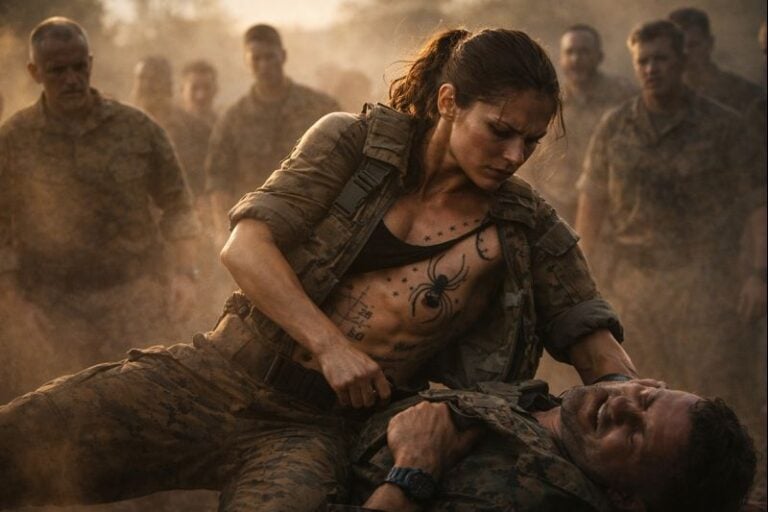
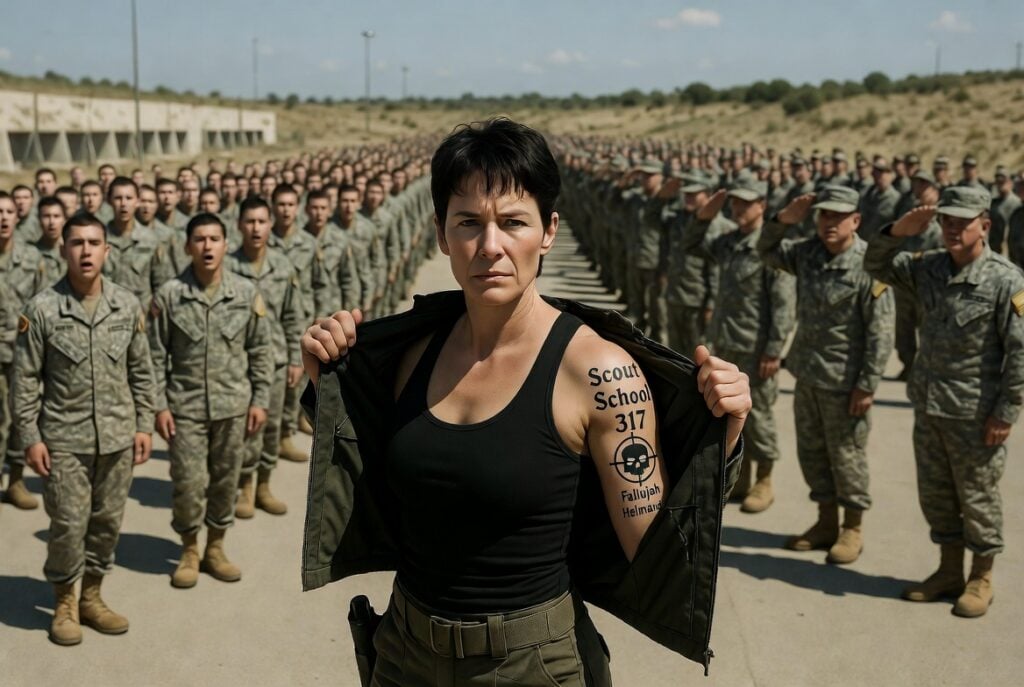
She set down the pistol, looked directly at Connor’s group. “You five have spent two days trying to figure out who I am—mocking me, testing me, trying to prove I’m nothing special. So let me save you the trouble.” Grace pulled off her jacket. Underneath, she wore a tank top. And on her left shoulder, visible to everyone, was a tattoo—black and gray ink, professional work, detailed and unmistakable: Scout Sniper School 317 arched across the top, 300 in large numbers at the center, the scout sniper logo—crosshairs with skull, Fallujah, Helmand at the bottom. Four hash marks on the side—one for each combat tour.
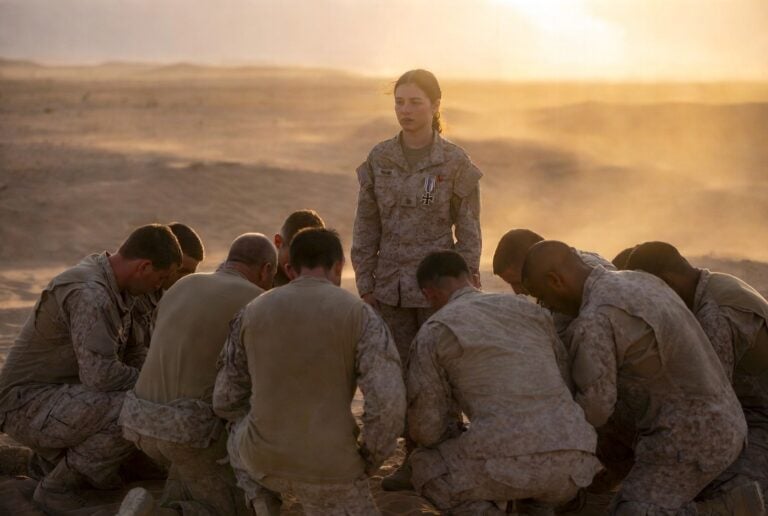
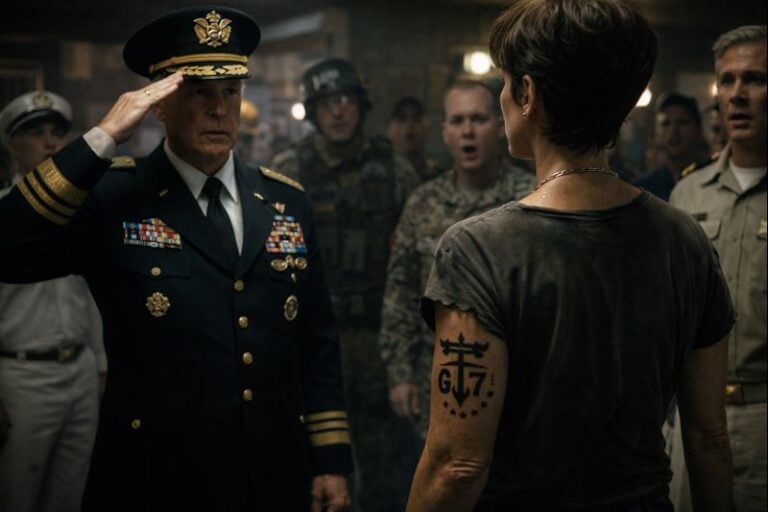
The crowd erupted—not in noise, in silence. Fifty people drawing breath at exactly the same moment. Master Chief Gray came to attention, rendered a full military salute. Commander Hazel stood, saluted. Captain Hugo, Lieutenant Iris, Sergeant Bradley—one by one, every military member present came to attention, saluted, showed the respect that 300 kills and four combat tours demanded.
Connor Blake stumbled backward. Mason Fletcher’s jaw hung open. Ethan Carter pulled out his phone, hands shaking, googling frantically. Grace stood in the center of it all—exposed, vulnerable. Every secret laid bare. And for the first time in twelve years, she felt the weight begin to lift.
Three seconds of absolute silence. Then Petty Officer Lily Jade, standing at the back of the formation, gasped. Her hand flew to her mouth. “Holy cow,” she whispered. “That’s Ghost. That’s actually Ghost.” The name rippled through the crowd like electricity through water. Ghost—the legendary Marine sniper whose exploits had become whispered stories in military circles. 300 confirmed kills, four combat tours, missions so classified they’d been erased from official records. And she’d been serving them coffee for two years.
Connor Blake’s legs gave out. He caught himself on Mason’s shoulder, face drained of color. “No, that’s not possible. Women weren’t even—” “Weren’t what?” Grace’s voice cut through his stammering. “Weren’t allowed in combat? Weren’t capable? Weren’t worthy?” She stepped toward him. “I was doing my job while you were in high school, Blake. I was saving lives while you were deciding which college to attend.”
Mason Fletcher dropped into parade rest—automatically, military bearing kicking in despite his shock. His hands shook slightly. These were the hands that had grabbed her arm yesterday—the hands that had touched someone with a combat record he couldn’t even comprehend.
Ethan Carter’s phone screen was visible to those nearby—search results for “Marine scout sniper 300 kills Ghost.” Article after article, forum posts, military history sites—all discussing the legendary sniper whose identity had never been confirmed until now.
Lieutenant Daniel Foster snapped to attention, tried to speak, but no words emerged. His face burned red. He’d spent two days telling anyone who’d listen that women couldn’t handle combat roles. And now he stood before living proof that he’d been catastrophically wrong.
Chief Petty Officer Paul Norbert removed his cover, held it to his chest. “Gunnery Sergeant,” he said, voice rough with emotion. “I—we didn’t know. We should have—I apologize completely.”
Grace surveyed the formation. Every face showed some variation of shock, awe, shame, or reverence. This was the moment she’d avoided for twelve years—the moment when privacy died and legend took over.
Commander Hazel stepped forward, her salute still crisp. “Gunnery Sergeant Archer, it’s an honor to have you on this base. Truly.” “I’m retired, ma’am. Just Grace.” “Retired or not, you’ve earned that title and more.” Hazel lowered her salute, but her bearing remained formal. “I wish you’d told us sooner.” “I had my reasons.”
Gunnery Sergeant Isaac Bradley pushed through the crowd, phone in hand. “May I, Gunny?” He held up his device, showing the photo from Helmand Province—zoomed in on the barely visible figure on the ridgeline. “I knew it was you. Ten years I’ve been looking at this photo, wondering who saved our lives that day.”
Grace looked at the image, remembered that morning—the cold, the wind, the calculations, seven shots, seven lives taken to save thirty. “You didn’t need to know,” she said quietly. “Yes, we did.” Bradley’s voice cracked. “Because every man in that convoy went home to their families. My son met his father because of you. My wife didn’t become a widow. That matters.”
Around them, phones emerged—fifty people recording, documenting. This moment would be all over social media within hours. The mystery solved. The legend confirmed. Grace closed her eyes briefly. Goodbye anonymity. Hello unwanted fame.
Lieutenant Anna Iris stepped forward with a tablet—her intelligence training overriding her shock. “I finally got partial access to your file, Gunny. It’s extensive.” She began reading. “Gunnery Sergeant Grace Archer, Marine Corps Scout Sniper, MOS 0317. Four combat deployments—Iraq, Fallujah 2005 through 2007; Afghanistan, Helmand Province 2009 through 2013.” Her voice grew stronger as she continued. “300 confirmed kills. Silver Star for actions in Fallujah, November 2006. Two Bronze Stars with valor. Purple Heart. Navy and Marine Corps Commendation Medal. Combat Action Ribbon.” The list went on.
Each credential landed like a hammer blow. The recruits who’d mocked her for two days now looked physically ill. “Your longest recorded shot,” Anna continued, “was 2,200 meters. Target eliminated during Operation Steel Curtain. Eight American lives saved. You operated alone for 72 hours behind enemy lines to make that shot.”
Grace’s jaw tightened. “That’s classified.” “Was classified. DoD declassified portions of your record last year—part of a historical review.” “I wasn’t informed.” “You didn’t maintain contact information after retirement.” Anna looked up from the tablet. “Why? Why disappear so completely?”
Grace looked at the assembled faces—young, eager, hungry for glory. They didn’t understand. This was why she’d hidden—because they saw medals and kills and thought it was heroic. They didn’t see the cost. “Because every number on that record represents a person I killed,” she said, voice carrying across the silent range. “300 people who woke up that morning not knowing it was their last day. 300 families who got news that destroyed their worlds. I did it to save American lives. I’d do it again. But that doesn’t make it glorious. It makes it necessary. There’s a difference.”
The weight in her words settled over the crowd like a physical presence. Master Chief Gray cleared his throat. “Gunnery Sergeant, would you be willing to share your experience with these recruits? Not the tactics—the reality. What it actually means to carry that burden.”
Grace studied the faces before her—saw Connor Blake’s shame, Mason Fletcher’s newfound respect, Ethan Carter’s dawning understanding. These kids needed to know before they ever picked up a rifle in anger. They needed to understand what they were really signing up for. “All right,” she said. “But first—Blake, Fletcher, Carter, front and center.”
The three recruits stumbled forward, stood at attention, trembling slightly. Grace approached them slowly, stopped three feet away, met each set of eyes in turn. “You three have spent two days trying to humiliate me—mocking my work, questioning my capabilities, treating me as less than human because I was in a service role.” Her voice remained calm. Deadly calm. “Do you understand why that was wrong?”
“Yes, Gunnery Sergeant,” Connor managed. “We—” “I’m not finished.” Grace stepped closer. “You were wrong not because I turned out to have a combat record. You were wrong because no human being deserves to be treated the way you treated me. Service is service—whether I’m serving coffee or serving my country, that work has dignity. The moment you forget that, you fail as leaders.”
Mason swallowed hard. “We understand, Gunny.” “Do you? Because I don’t think you do. You think the lesson here is ‘don’t underestimate people.’ That’s part of it. But the real lesson is simpler—treat everyone with respect. Period. Not because they might secretly be special. Because they’re human and they deserve it.”
Ethan’s voice came out strangled. “We’re sorry, Gunnery Sergeant. Truly sorry.” “I believe you’re sorry you were wrong. I’m not sure you’re sorry for how you treated me. There’s a difference.” Gray stepped forward. “But you’ll have a chance to prove it. All three of you just volunteered to be my teaching assistants for the next three months. You’ll help set up equipment, demonstrate incorrect technique, and generally make yourselves useful. Consider it penance.”
“Yes, Gunnery Sergeant,” they said in unison.
Grace turned to address the full formation. “Everyone here needs to understand something. The skills I have—they came at a cost. Four years of my life in combat zones, watching friends die, making decisions that still wake me up at night. Every shot I took, I had to live with forever.”
She picked up the M40 rifle. “This weapon doesn’t make you powerful. It makes you responsible. When you look through this scope and put crosshairs on another human being, you’re not a hero. You’re a tool—a necessary tool in protecting your teammates and your country. But never forget what it means.”
The crowd was absolutely silent, hanging on every word. “In Fallujah, November 2006, I was providing overwatch for a patrol. They walked into an ambush—six insurgents with RPGs and automatic weapons. My team was pinned down. I had clear shots on all six targets.” Grace’s voice remained steady, but her eyes showed the weight. “I took those shots. Six kills in 90 seconds. Saved twelve American lives. Got the Silver Star for it. But you know what I remember most? Not the medal. Not the thanks. I remember one of those insurgents was holding a picture of his family—it fell out of his pocket after I shot him. Wife, three kids. He was probably fighting for what he thought was right. And I ended him.”
Connor’s face showed raw emotion. This wasn’t the glory story he’d expected. “That’s the reality,” Grace continued. “You don’t get to be a sniper and pretend you’re just removing targets. You’re ending lives—human lives. It’s necessary. It saves more lives than it takes. But own what it is. If you can’t handle that truth, don’t pick up this rifle.”
If that reveal just gave you chills, wait until you see the next video I’ve got queued up. It’s about another woman who was completely underestimated in a military setting—and the way she proved herself is even more intense than this. Link in the description. Don’t miss it.
Commander Hazel stepped forward again. “Gunnery Sergeant, I’d like to formally offer you a position as director of our precision marksmanship program—civilian GS-13 equivalent, full benefits. You’d train the next generation of military marksmen—not just SEALs, all branches.”

Grace was quiet for a long moment. “I’ll need conditions.” “Name them.” “First—no publicity, no media, no ceremony. I teach, then I go home. I’m not a recruitment poster.” “Agreed.” “Second—I teach the whole picture, not just shooting: the psychology, the ethics, the aftermath. These kids need to know what they’re getting into.” “Absolutely.” “Third—I want Connor, Mason, and Ethan in my first class. If they can learn humility and respect, anyone can.”
Commander Hazel glanced at the three recruits. They looked terrified. “Good.” “Done.” “When can you start?” “Tomorrow. 0700. But today, I want to demonstrate something for everyone here.” Grace gestured to the Barrett .50 cal. “Master Chief, set up the long-range targets. Let’s show these recruits what expert-level marksmanship actually looks like.”
Over the next hour, Grace conducted a shooting demonstration that would be talked about for years—targets at 600m, 900m, 1,200m. Each one engaged with precision that seemed impossible. Between shots, she explained wind reading: “See those grass movements downrange? That tells you wind speed and direction. Heat shimmer—that’s your mirage. Tells you if wind is consistent or variable. You need to see the environment. Become part of it.”
Connor, Mason, and Ethan took notes frantically. The mockery from two days ago seemed like ancient history. Now they understood they were in the presence of someone whose skill level they might never reach.
At one point, Grace had Connor spot for her while she engaged a target at 1,500m. “Tell me what you see,” she instructed. “Target is… I think there’s wind from the left.” Connor’s voice was uncertain. “Don’t think—observe. What are the grass patterns showing? Movement from southwest to northeast? Maybe 8 mph.” “Good. That’s closer. But look at the mirage near the target. See how it’s moving?” Connor squinted through the spotting scope. “It’s wavy. Moving right.” “Exactly. That means wind at target distance is different from wind here. You need to account for both. This isn’t just math. It’s reading the battlefield.”
Grace made the shot—center mass. Connor’s jaw dropped. “Sixteen years of practice,” Grace said quietly. “And I still miss sometimes. Perfection isn’t the goal. Competence is.”
Before we wrap up, I want to mention something relevant to this story’s theme of specialized skills. Advanced professional certification programs in tactical disciplines, leadership development, and specialized technical fields are now more accessible than ever through online platforms. These aren’t basic courses—there are expert-level training programs developed by former special operations personnel, offering credentials that can transform your career. Whether you’re transitioning from military service or leveling up in civilian life, elite-level education is now available at your fingertips.
By 1600 hours, Grace had covered more material than most instructors covered in a week. The recruits were exhausted, overwhelmed, but educated in ways they hadn’t expected.
As the formation dispersed, Lieutenant Daniel Foster approached Grace hesitantly. “Gunnery Sergeant, I need to apologize properly for what I said about women in combat roles. I was wrong. Completely wrong. And I’m sorry.” Grace studied him. “Why were you wrong, Lieutenant?” “Because… because you proved women can excel in combat.” “No. Try again.” Foster thought carefully. “Because I made assumptions based on gender instead of capability.” “Closer, but still not there.” “I… I don’t understand.” “You were wrong because you judged an entire group based on your limited experience and preconceptions. Gender, race, background—none of it matters if someone has the skills and dedication. The moment you start categorizing people instead of evaluating them individually, you fail as a leader.”
Foster nodded slowly. “I understand. Thank you for the lesson.” “Show me you understand by changing how you lead. Words are easy. Action is what counts.”
Over the next three months, Grace’s program transformed the base culture. She taught four classes per week, each one packed with recruits from different branches. Word spread throughout the military community. People requested transfers to Coronado just to learn from Ghost.
Connor Blake, Mason Fletcher, and Ethan Carter became her most dedicated students. The three who’d mocked her most viciously now worked harder than anyone to prove they had learned their lesson. They set up equipment before she arrived, stayed late to clean weapons, asked thoughtful questions about ethics and responsibility.
One evening, after a particularly grueling training session, Connor approached Grace alone. “Gunny, can I ask you something personal?” “You can ask. I might not answer.” “How do you live with it? 300 kills. How do you wake up every morning and function?”
Grace set down the rifle she’d been cleaning. “Honestly, some days I don’t. Some days the weight is too much. But then I remember the alternative—every person I killed was actively trying to kill Americans. If I hadn’t pulled those triggers, how many of our people would have died?” “But how do you know for sure? How do you know you made the right calls?” “I don’t. Not always. That’s the burden. You make the best decision you can with the information you have. Sometimes you’re right. Sometimes you’re wrong. But you don’t get to freeze. Indecision kills more people than wrong decisions.”
Connor was quiet for a moment. “I don’t think I could do what you did.” “Maybe not. But if you ever have to, you’ll find strength you didn’t know you had. And hopefully the training I’m giving you will make those decisions a little clearer.”
By the end of three months, Grace’s students showed remarkable improvement. More importantly, they showed maturity. They understood that marksmanship wasn’t about ego or glory—it was about responsibility and service.
Chief Petty Officer Norbert, who’d dismissed Grace as a civilian on her first day, became one of her strongest advocates. He implemented a base-wide policy: any service member who showed disrespect to support staff faced immediate disciplinary action. “If we can’t respect the people who keep this base running,” he announced at a formation, “we don’t deserve to wear the uniform.”
Petty Officer Lily Jade, inspired by Grace’s example, submitted a formal request to attend Scout Sniper School. She was the first woman at the base to do so. When people questioned whether she could handle it, Grace’s simple response was: “Give her the same standards as everyone else. She’ll meet them or she won’t—but she deserves the chance.”
The base cafeteria was renamed Archer Hall. A bronze plaque was installed near the entrance, dedicated to Gunnery Sergeant Grace Archer, USMC (Ret.), Scout Sniper, Silver Star recipient—a reminder that service comes in many forms, and excellence is often found where we least expect it. Grace objected to the recognition, but Commander Hazel overruled her. “You don’t get to control how people honor your service. That’s their choice, not yours.”
Six months after the revelation, Grace stood before a class of thirty students—a mix of Marines, SEALs, and Army Rangers, all branches learning together. She had just finished demonstrating wind-reading techniques when her phone buzzed—unknown number. She ignored it. Continued teaching. It buzzed again and again.
“Take a 15-minute break,” she told the class. “Practice the breathing exercises we covered.” Grace stepped away from the range, checked her phone—three missed calls, same unknown number. Then a text message: This is JSOC. Call immediately. Priority one. Joint Special Operations Command.
Grace’s stomach tightened. She hadn’t heard from them since retiring. This couldn’t be good. She dialed the number. “Gunnery Sergeant Archer.” A male voice answered immediately. “This is Colonel Marcus Webb, JSOC operations. We have a situation.” “I’m retired, Colonel.” “I’m aware. This isn’t a recall. It’s a request. We need a consultation on an active operation.”
“What kind of consultation?” “The kind that requires your specific skill set. American hostages, rural Afghanistan. Rescue team needs overwatch. The shot is complicated.” Grace’s pulse quickened. “How complicated?” “1,400 meters. High wind variance, moving target pattern, limited window at night with possible hostile counter-sniper in the area.”
The parameters rolled through her mind automatically—windage calculations, scope adjustments, timing. It was possible. Barely. But it would take someone with extensive experience in those exact conditions. “You have plenty of snipers, Colonel. Why me?” “Because this particular target is in a valley we know well—Helmand Province. Same area you operated in. And because our intelligence suggests the counter-sniper is someone you engaged before successfully.”
Grace’s blood ran cold. “Who?” “We’re not certain, but radio chatter suggests call sign Jackal. Does that mean anything to you?” It did. August 2012. She’d been hunting a Taliban sniper who’d killed six American soldiers. They’d played cat-and-mouse for four days. Finally she’d gotten a shot—took it, but never confirmed the kill. The target had fallen, but his body was extracted before they could verify if Jackal had survived.
“The team is up in six hours. You don’t have to go in—we just need you to brief the team, share your knowledge of the area and the target. Maybe observe remotely.” Grace looked back at her class—thirty students depending on her. A life she’d built. Stability she’d craved. All of it waiting.
But somewhere in Afghanistan, American lives hung in the balance. And she had knowledge that could save them. “I need to make some calls,” she said. “Understood. But Gunnery Sergeant—this is strictly off-book, classified above top secret. If you agree, you can’t tell anyone where you’re going or why.” “I understand.”
Grace hung up, stood there for thirty seconds, mind racing. Then she called Commander Hazel. “Commander, I need emergency leave. Family situation, two weeks minimum.” “Is everything okay?” “It will be. I just need to handle something.” “Of course. Take whatever time you need.”
Next, Grace called Master Chief Gray. “I need you to take over my classes for a couple of weeks.” “What’s going on?” “Can’t say, but it’s important.” Gray was silent for a moment, then: “This is military, isn’t it? They called you back.” “I’m retired.” “That’s not a no.” “It’s all you’re getting. Will you cover my classes?” “Yes. But Gunny—be careful. Whatever this is.”
Grace returned to her students. “Change of plans. Master Chief Gray will be taking over instruction for the next two weeks. Keep working on your fundamentals. I’ll be back before you know it.” Connor raised his hand. “Is everything all right, Gunny?” “It will be.”
That evening, Grace packed a small bag—tactical gear she hadn’t worn in years, range estimation tools, ballistic charts for various ammunition types. The mental preparation for what she might be walking into.
At 2200 hours, a black SUV picked her up from her apartment—no markings, no explanation, just a driver who knew not to ask questions. They drove to Naval Air Station North Island. A C-17 transport waited on the tarmac. Grace boarded alone. The aircraft was mostly empty—just her, the crew, and a sealed briefing packet.
She opened the packet—satellite imagery of the target area, personnel files on the hostages (three American aid workers), intelligence reports on hostile forces, and a photo. The photo showed a distant figure on a ridgeline—thermal imaging, barely recognizable, but the posture was familiar. Jackal. Still alive. Still operating. This was personal now.
The flight took fourteen hours. Grace slept in small bursts, never fully resting—old habits, always ready, always aware. They landed at Bagram Airfield at 0300 local time. A Marine lieutenant met her on the tarmac. “Gunnery Sergeant Archer. Lieutenant Sarah Williams. I’ll be your liaison.” “Where’s the team?” “Briefing room. This way.”
Grace followed her through the base to a secure facility. Inside: twelve special operations personnel—a mix of SEALs, Marine Raiders, and Army Delta. All experienced, all watching her with curiosity and respect. A full colonel stood at the front.
“Gunnery Sergeant Archer, thank you for coming. I’m Colonel Harris, mission commander. Your reputation precedes you.” “I’m here to consult, Colonel—not participate.” “Understood. But I hope you’ll reconsider. Our primary sniper is excellent, but he’s never operated in this terrain. You have. And if Jackal is really out there, you’re the only one who’s bested him before.”
Grace studied the mission brief—hostages held in a compound, 1,400-meter shot from the only viable overwatch position. Small window during guard rotation, high winds, darkness, and possibly a hostile sniper who knew American tactics. This was suicide—almost.
“Your sniper can’t make this shot,” she said flatly. “He’s willing to try.” “Willing doesn’t matter. Can he read wind at that distance at night with thermals? Has he ever engaged a target while being counter-sniped?” “He’s highly trained.” “So was every American sniper Jackal killed. This isn’t about training. It’s about experience.”
The room was silent. The operators knew she was right. Grace looked at the mission timeline—hostages would be executed in 72 hours if no ransom was paid. The US didn’t pay ransoms. This was their only shot.
She thought about her students, about the life she’d built, about the promise she’d made to herself that she was done with killing. Then she thought about three aid workers who’d traveled to Afghanistan to help people—who were about to die unless someone saved them.
“I’ll need eight hours to prep,” she said quietly. “Full ballistic data for the area, wind patterns for the last month, intelligence on Jackal’s known positions, and a Barrett M82 with the exact specifications I used in 2012.” Colonel Harris smiled. “So you’re in?” Grace met his eyes. “I’m in. But after this, I’m done forever. Clear?” “Crystal. Good. Now let’s talk about how to kill a ghost.”
The next three days were intense preparation. Grace studied every detail of the terrain, memorized guard patterns, calculated dozens of firing solutions for different wind conditions, and prepared mentally for what she might have to do.
On the night of the operation, she hiked to the overwatch position—2,000 meters from the compound, alone, radio silence until the shot. She settled into position at 0200, checked her rifle, adjusted for elevation, temperature, humidity, set up her rangefinder, thermal scope, backup iron sights just in case. Then she waited—scanning, watching, ready.
At 0315: movement on a distant ridgeline—1,300 meters at her 8:00. Brief thermal signature. Someone changing position. Had to be Jackal. He was hunting her while she hunted his guards. The ultimate game.
Grace adjusted her position slightly, made herself a harder target, kept scanning between the compound and Jackal’s position. At 0345, the guard rotation began. Her window: 90 seconds. One shot, one chance.
Grace controlled her breathing, found the rhythm, waited for the wind to settle—crosshairs on target, finger on trigger. Just before she pressed: muzzle flash from Jackal’s position. Incoming round.
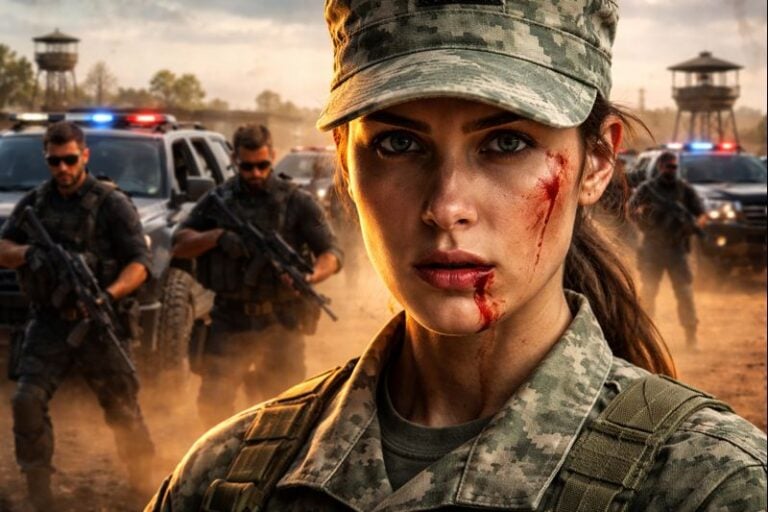
Grace moved—pure instinct. The round missed by inches, impacted the rock next to her head. Fragments cut her cheek. She returned fire—not at the compound, at Jackal. Counter-sniper engagement. Quick shot. Suppressive. Her round found him—thermal showed impact. Jackal signature went dark. No time to confirm.
Grace swung back to the primary target. Guard was moving. Window closing. She fired—1,400-meter shot. Wind, darkness, adrenaline—every variable against her. The guard dropped. Mission successful.
Three minutes later, the rescue team breached. Hostages extracted. No American casualties. Grace packed up, left the position, hiked back to the extraction point—bleeding from the fragments, exhausted, alive.
In the helicopter, Colonel Harris handed her a bottle of water. “That was the most incredible shooting I’ve ever witnessed.” “It was necessary. That’s all.” “We’re recommending you for another Silver Star.” “Don’t. I don’t want it.” “You earned it.” “I earned peace. That’s what I want now.”
Grace returned to Coronado three days later, walked back into her class like nothing had happened. Master Chief Gray gave her a knowing look but said nothing. Connor noticed the cut on her cheek. “Gunny, what happened?” “Hiking accident. Careless of me.” He didn’t believe her. None of them did. But they didn’t push.
That evening, Grace sat alone on the beach near her apartment, watching the sunset—thinking about three hostages who were now safe with their families, thinking about Jackal who’d finally been stopped, thinking about one last mission she’d never planned to take.
Her phone buzzed—text from an unknown number: Thank you. The Morrison family. One of the hostages. Someone had leaked her name. Grace deleted the message, but she smiled slightly. Maybe one more mission hadn’t been so bad after all.
A month later, Grace stood before her graduating class—thirty students who’d completed her intensive program, including Connor, Mason, and Ethan—transformed from arrogant recruits into humble, skilled marksmen.
“You’ve learned a lot in twelve weeks,” Grace told them. “Technical skills, tactical knowledge. But the most important lesson isn’t about shooting. It’s about character.” She looked at Connor specifically. “When you first met me, you judged me by my job, my appearance, my gender. You made assumptions that were wrong. But you learned. You grew. You became better. That’s what matters.”
“Yes, Gunnery Sergeant,” Connor said. His voice carried genuine respect now. “Thank you for giving us that chance.” “We all deserve chances to learn and grow. Never forget that.”
The ceremony ended with the traditional passing of the rifle—each graduate received a weapon from Grace’s hands, a symbol of trust, of responsibility, of the burden they were choosing to carry.
As the last student received his rifle, Commander Hazel approached the podium. “Before we conclude, I have an announcement. The Department of Defense has authorized a special commendation for Gunnery Sergeant Archer’s contributions to military training. Over the past six months, her students have achieved the highest qualification scores in the history of this base. Her methods are being adopted across all branches.” Applause erupted.
Grace tried to wave it off, but Hazel continued. “Additionally, Rear Admiral Benjamin Archer wishes to address the formation.” Grace’s head snapped up. Uncle Ben. She hadn’t seen him in three years. Hadn’t told him about any of this.
A distinguished man in Navy dress whites walked onto the stage—silver hair, stern face, three stars on his collar. He’d been promoted since she’d last checked. “Gunnery Sergeant Archer,” he said formally. “Or should I say niece.” The crowd murmured—this was news. “For three years I’ve watched you hide your talents, work beneath your capabilities, refuse recognition you deserved. I respected your choice. But I’m glad you finally came back to what you do best.”

He turned to the audience. “This woman saved my life in Fallujah. I was a captain then, pinned down by hostile fire. She was providing overwatch—took out six targets in under two minutes. I owe her everything.” Grace’s face remained neutral, but her eyes showed surprise. She hadn’t known he was there that day.
“The military is better with people like Grace Archer in it—not because of what she can do with a rifle, but because of what she teaches about service, humility, and dedication. These are lessons we all need.” He saluted her. The entire formation followed.
Grace returned the salute, then quietly left the stage—too much attention, too much recognition, the very thing she’d tried to avoid. But as she walked away, she heard the applause continue, heard the chanting: “Ghost, Ghost, Ghost.” Maybe, she thought, recognition wasn’t always bad. Maybe sometimes people needed heroes who looked different than they expected. Maybe her story could inspire others.
That evening, Grace returned to her small apartment. Her phone showed dozens of messages—interview requests, documentary proposals, speaking opportunities. She ignored them all, opened her laptop, started writing. If people were going to tell her story, she’d tell it right—the whole story: glory and cost, victory and trauma, the parts nobody wanted to hear but everyone needed to understand.
She titled the document The Weight of 300 and she began to write.
Three months later, her manuscript was complete—200 pages, raw, honest, brutal. She’d shared it with exactly five people: Commander Hazel, Master Chief Gray, a chaplain, Connor Blake, and her uncle. All five told her the same thing: publish it. The military needs this. Connor said, “Every recruit who thinks combat is glory needs to read this.”
Grace hesitated—publishing meant permanent exposure, meant she’d never have privacy again. But it also meant her lessons would reach beyond her classroom, would touch thousands of young people before they made irrevocable choices.
She signed with a small military publisher, insisted on no publicity tours—just the book, just the words. The Weight of 300 released six months later. Within weeks, it was required reading at every US military training facility. The raw honesty, the unflinching look at combat’s psychological cost, the emphasis on ethics and responsibility—reviews called it the most important military memoir of the decade.
Grace didn’t read the reviews, didn’t track sales—just kept teaching, kept training, kept serving in her own way.
One afternoon, a year after her identity had been revealed, Grace sat in the base cafeteria during a break—alone, drinking coffee, grading student assessments. A young woman approached—maybe 22, nervous. “Gunnery Sergeant Archer, may I sit?” “It’s a free country.”
The woman sat. “I’m Private Mia Chen. I just arrived at the base. I read your book three times and… and I wanted to thank you. I was thinking about leaving the military—thought I didn’t fit, thought maybe people like me weren’t meant for this life.” “People like you?” “Women. Especially women who don’t fit the typical warrior mold. But your book—it showed me that service comes in many forms. That the strongest warriors are often the ones who understand the cost.”
Grace set down her pen, looked at this young woman who reminded her so much of herself at that age. “You belong here,” Grace said firmly. “Not because you might be exceptional, but because you’re willing to serve. That’s enough.” “Will you train me when I’m eligible for advanced schools?” “If you work hard and earn it—yes.”
Mia smiled. “Thank you. That means everything.” She left. Grace returned to her grading, but she thought about that conversation—about Lily Jade, who’d just been accepted to Scout Sniper School; about Connor, Mason, and Ethan now teaching respect and humility to the next generation. Maybe, Grace thought, this was why she’d been forced to reveal herself—not to be a hero, but to show others that heroism wasn’t what they thought. That strength came from character, not just capability. That the best warriors were the ones who understood when not to fight.
The sun was setting as Grace walked to her car that evening. The base was quiet, peaceful. She’d found something here she’d lost in twelve years of hiding—purpose.
Her phone buzzed. She almost ignored it, then saw the caller ID: JSOC. Her stomach tightened. Not again. She answered. “Gunnery Sergeant Archer.” “Gunny, this is Colonel Harris. We have another situation.” “I told you I was done.” “I know, and I wouldn’t call unless it was critical. But there’s a target we can’t reach—parameters similar to the last operation. Your expertise could save American lives.”
Grace looked at the sunset, thought about her students, her book, the life she’d built—then thought about Americans in danger. “Send me the brief,” she said quietly. “I’ll review it. No promises.” “Thank you, Gunny. The country is lucky to have you—even if most people don’t know it.”
Grace hung up, stood in the parking lot, facing a choice she’d thought she’d never have to make again. She pulled out the photo she always carried—her fallen teammates from 2013. The faces of people who died doing the job she’d walked away from.
“I’m sorry,” she whispered to them. “I thought I was done. I thought I’d given enough.” But maybe you never gave enough when lives were at stake. Maybe service was something you chose every day, over and over—even when it cost you peace.
Grace got in her car, drove home, downloaded the mission brief, read it carefully, did the calculations, assessed the risks. Then she picked up her Barrett from the locked case under her bed, started cleaning it—preparing, just in case.
Because maybe Ghost wasn’t retired after all. Maybe Ghost was just waiting—ready, watching over those who couldn’t protect themselves. And maybe that was okay.
The rifle gleamed in the lamplight. Grace worked the bolt action—smooth, perfect, muscle memory eternal. Outside her window, the first stars appeared—the same stars that shone over Afghanistan, over hostages who needed rescue, over Americans who needed someone with her skills.
Grace set down the cleaning rod, picked up her phone, typed a message to Colonel Harris: I’m in. When do we leave? She hit send, then set the phone aside, went back to cleaning her rifle.
Some people retired and found peace. Others found purpose by staying ready. Grace had finally figured out which one she was—and she was okay with that.