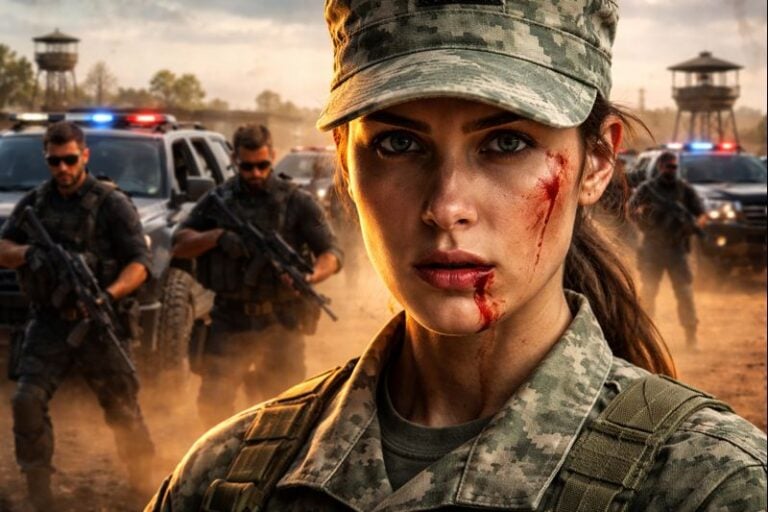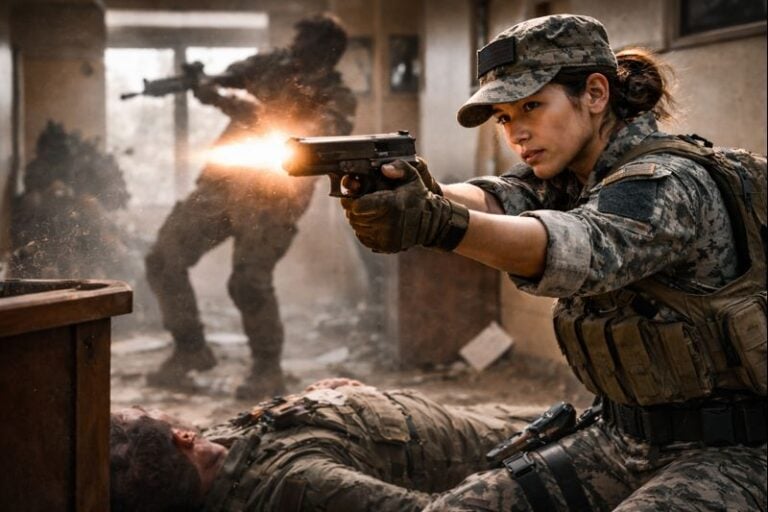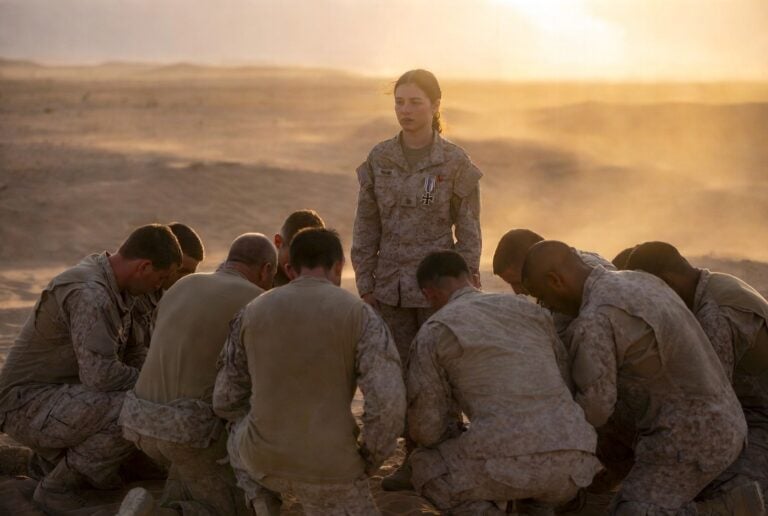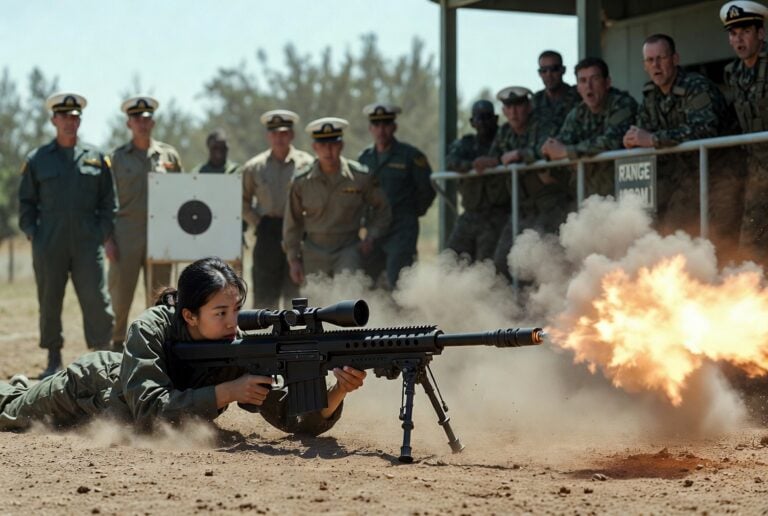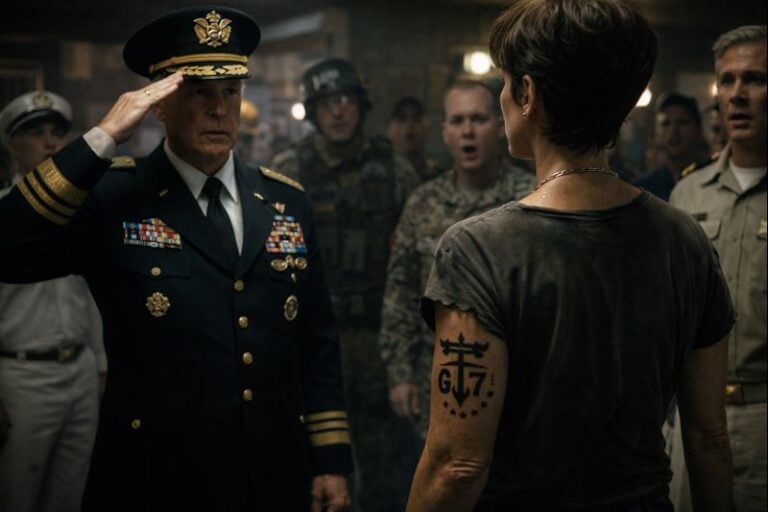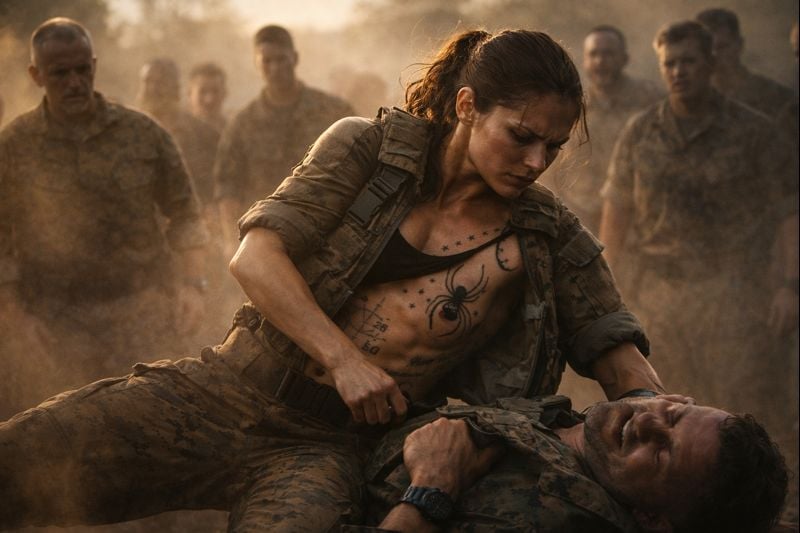
The mockery cut through the pre-dawn air at Naval Special Warfare Center like a blade. 180 pairs of eyes locked onto the single female trainee standing in formation at 0530 hours. Lieutenant Mara Sullivan stood at rigid attention, the California morning chill doing nothing to cool the heat of scrutiny burning into her skin. On her right forearm, clearly visible beneath the rolled sleeve of her combat shirt, a black widow spider tattoo marked her flesh. A spider.
Sergeant Kyle Drake’s voice carried across the training ground with deliberate volume designed for maximum humiliation. This is SEAL training, not some beach party, sweetheart. What’s next? Butterflies on your ankle. Laughter erupted from the formation. Sharp, cruel, the kind that strips dignity layer by layer. Mara’s eyes remained fixed forward, her expression carved from stone. No flinch, no reaction, just the steady rise and fall of her chest in perfect breathing rhythm.
Bet she got it spring break. Someone stage whispered from the rear ranks. Thought it’d make her look tough for the recruiters. Lieutenant Jessica Thorne, the only other woman present and an instructor assistant who’d earned her trident two years prior, shook her head with visible disdain. She’d fought too hard to carve her place here to tolerate another female who might dilute her achievement. Competition wasn’t welcome. Solidarity was a luxury she couldn’t afford.
Instructor Brian Walsh approached with measured steps, his eyes narrowing as he examined the tattoo more closely. The design was intricate, too intricate. Black ink formed geometric patterns around the spider’s body, coordinates barely visible in the webbing. He straightened suspicion, flickering across his weathered features. Sullivan Walsh’s voice carried authority earned through two decades of combat operations. That marking have some special meaning. Mara’s gaze shifted to meet his direct, unflinching. Yes, sir. It does. Care to elaborate? No, sir.
The silence that followed felt heavier than the 60-lb ruck every trainee carried. Then Drake’s laughter shattered it, triggering another wave of mockery that rolled through the assembled personnel like thunder. They assumed mystery meant nothing. They thought silence indicated weakness. They saw a woman trying too hard to belong in a brotherhood built on blood and brotherhood. They had no idea that in the next 20 minutes, everything they believed about the person standing before them would shatter like glass under a hammer.
Walsh held Mara’s gaze for three more seconds, searching for cracks in her composure. Finding none, he turned away with a dismissive gesture. Fall in for morning PT, 5 mile run. Sullivan, you’re on point. Let’s see if that ink can keep pace. The formation moved with practice efficiency boots, striking pavement in synchronized rhythm as they headed toward the starting line. Mara took her position at the front, aware of Drake positioning himself directly behind her.
His breath hit the back of her neck when he leaned close enough that only she could hear. Going to enjoy watching you break, he murmured. They always break. Always. She said nothing. Words were ammunition best kept in reserve.
The run began under a sky transitioning from black to deep purple stars fading as the Pacific horizon threatened sunrise. Mara settled into a pace that felt sustainable. Not fast, not slow, just steady. Her breathing remained controlled, her stride economical. Behind her, the pack spread out within the first mile, some pushing too hard too early, others falling back to conserve energy.
By mile two, she’d pulled ahead of 60% of the male trainees without appearing to increase effort. Her legs moved like pistons, mechanical and efficient. No wasted motion, no visible strain. Master Chief Tom Harrison, observing from a checkpoint, made a note on his clipboard. Interesting. Most candidates showed fatigue markers by this point. Sullivan looked like she was warming up.
Mile 3 brought Drake up beside her, his breathing harder than hers, despite his larger frame and supposed superior conditioning. He increased his pace. She matched it. He pushed harder. She stayed with him. her expression never changing her breathing, never ragged. Frustration flickered across his face before he dropped back, unable to maintain the unsustainable speed he’d chosen.
She finished in the top 15%. Not first. That would draw too much attention, but strong enough to make a point without making a statement. Drake crossed the finish line 30 seconds later, sweat streaming down his face. He bent over hands on knees gulping air. When he straightened, his expression had shifted from confidence to something darker. “Bginner’s luck,” he announced to anyone listening. “Let’s see how she handles the real stuff.”
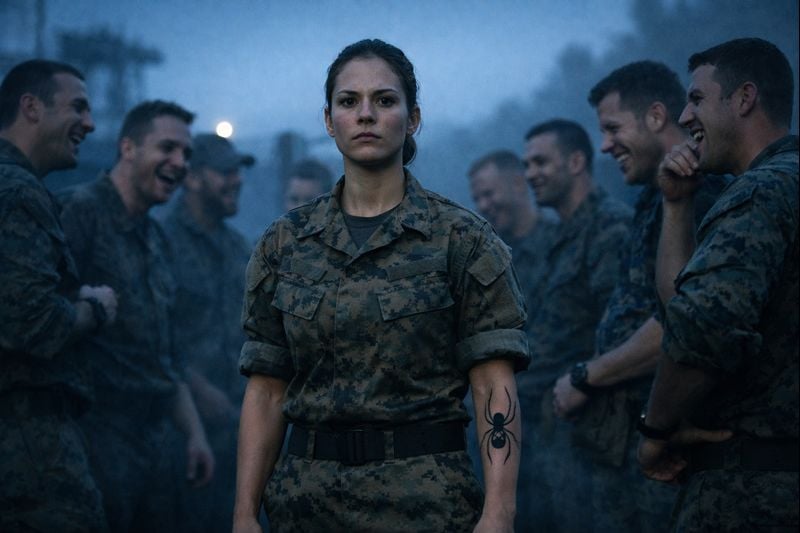
The real stuff materialized after a 10-minute recovery period. Walsh gathered the unit at the obstacle course, a brutal configuration of walls, ropes, and barriers designed to break bodies and spirits in equal measure. Standard protocol called for completion in under 12 minutes with full combat load. Drake had other ideas. “Sullivan,” he called out, voice carrying across the assembled trainees. “Since you’re so eager to prove yourself, let’s make it interesting. 60 lb in your ruck instead of 30. Show us what that spider tattoo really means.”
Before we continue with what happens next, if this story of hidden warriors and underestimated heroes resonates with you, hit that like button right now. This channel brings you real stories of extraordinary courage hiding in plain sight stories. the mainstream media won’t tell you. Subscribe and turn on notifications so you never miss these powerful tales. Drop a comment below telling us where are you watching from today. Let’s build a community of people who recognize that true strength doesn’t always announce itself.
Mara accepted the additional weight without protest. The extra 30 lb settled onto her shoulders like a familiar burden. She adjusted the straps with movements that suggested muscle memory rather than learning. Small detail. Nobody noticed.
The course began with a 12-t wall. She hit it at speed using momentum and technique rather than pure strength to vault over the top. The rope climb followed. 60 ft of braided hemp that burned palms and tested grip strength. Her hands moved in a pattern too smooth for someone supposedly new to this. Wrap lock. Pull. Wrap. Lock. Pull. Efficient. Practiced.
Corporal Ryan Jensen watched from the sideline with calculating eyes. He’d been assigned to monitor equipment. a mundane task that suited his real purpose. When Mara moved to the next obstacle, he stepped toward her gear bag with casual indifference, hand reaching for the water bottle. A small adjustment, a minor contamination. Nothing immediately dangerous, but enough to cause problems during the afternoon heat.
Leave it alone, the voice came from behind him. Corporal Emma Torres arms crossed, expression neutral. Whatever you’re planning, don’t. Jensen straightened all innocence. Just checking the equipment, making sure everything’s secure. Sure you were. Torres didn’t move, didn’t break eye contact. Just remember, actions have consequences.
Back on the course, Mara cleared the final obstacle. Her time logged at 11 minutes 42 seconds in the top 20%. With double the weight, Walsh checked his stopwatch twice, certain he’d misread the numbers. Lieutenant Marcus Bell, observing from the command tower, made his own notes. Something wasn’t adding up. Sullivan moved like someone with extensive training, not book learning, field experience.
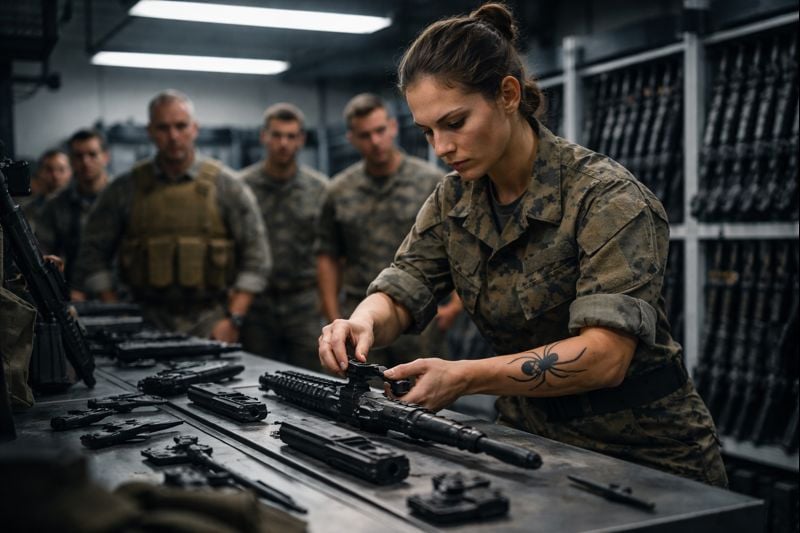
The afternoon brought weapons qualification. The armory smelled of gun oil and possibility. Rows of M4 carbines lined the walls, each maintained to exact specifications. Walsh decided to test Sullivan’s claimed weapons knowledge with something beyond the standard curriculum. Sullivan front and center. He held out an M4 magazine remove chamber cleared. You said you studied the manual. Field strip this weapon. You have 2 minutes.
Mara took the rifle, her hands finding the familiar contours without hesitation. Press, release, slide. The upper receiver separated from the lower. The bolt carrier group emerged with practiced ease. Firing pin, extractor, gas rings. Each component laid out in perfect order on the table before her. Walsh glanced at his stopwatch. 47 seconds. Fast. too fast for someone working from book knowledge alone.
Now do it blindfolded. Murmurss rippled through the observing trainees. That wasn’t standard protocol. That was showboating. Setting someone up for public failure. Mara accepted the blindfold without comment. Her fingers traced the disassembled components, reading them like braille. The reassembly began. Click, snap, slide. Each sound precise, each movement confident. The weapon came together as if assembling itself. She removed the blindfold. 49 seconds.
Walsh’s jaw tightened almost imperceptibly. Thorne’s expression shifted from smug anticipation to something closer to concern. Drake looked ready to throw something. Lucky guess. Walsh managed, though his tone lacked conviction. Let’s see you handle something you haven’t memorized from a manual. Strip down an M249 saw. No blindfold this time, but I’m betting you’ve never even touched one.
The M249 squad automatic weapon sat on the next table. Significantly more complex than the M4. More components, different operation system, requires specialized training that standard recruits don’t receive until later in their careers. Mara approached it with the same calm she’d shown all morning. Her hands moved across the weapon with familiarity that should have been impossible. Gas regulator unscrewed. Barrel released. Bolt assembly extracted. Feed tray mechanism disengaged. 43 seconds of practiced efficiency that suggested hundreds of repetitions rather than first time exposure.
When she reassembled it in 45 seconds, Walsh said nothing. He just turned and walked away unable to reconcile what he’d witnessed with what he knew about standard training pipelines. Thorne seized the moment of silence to plant seeds of doubt. She moved through the dispersing trainees with purpose voice low but audible. Someone must have coached her beforehand. No way she learned that in basic. Probably got special treatment, diversity quotas and all that.
The rumor took root quickly. Whispers spread. Doubts multiplied. By evening cow, half the unit believed Sullivan had received unauthorized assistance. The other half remained uncertain but suspicious. Only a handful, like Master Chief Harrison and Lieutenant Bell, kept their judgments in reserve.
Captain David Morris, observed all of it from his office window overlooking the training grounds. 28 years of service had taught him to trust his instincts, and his instincts screamed that something was off about this entire situation. Female integration into SEAL teams remained controversial. Political pressure from above met resistance from below. Sullivan represented everything he believed would compromise unit effectiveness. A woman, quiet, seemingly competent, but unproven in real combat conditions.
He made a decision. If Sullivan wanted to play in the big leagues, she’d face big league standards. No accommodations, no second chances. She’d succeed on merit or fail trying. Preferably the latter. One failure would validate his concerns and end this social experiment before it corrupted the program further.
That evening, after the unit had secured their gear and headed to the mesh hall, Mara remained behind on the pistol range. The sun painted the Pacific in shades of orange and gold. Seagulls cried overhead. She loaded magazine after magazine, practicing speed reloads with movements that flowed like water. Draw, aim, fire, drop mag, insert fresh mag, continue firing. No wasted motion, no hesitation. times that would make competition shooters jealous.
Petty Officer Sarah Chen, a junior sailor assigned to range maintenance, watched from the equipment shed. She’d been ordered not to interact with trainees, but something about Sullivan’s isolation resonated. Chen knew what it meant to be the only woman in a maledominated space. The subtle exclusions, the constant testing, the weight of representing an entire gender with every action.
Permission to speak, ma’am. Chen approached when Mara paused to reload. Mara glanced over. You don’t need permission. We’re the same rank when the sun goes down. I just wanted to say. Chen hesitated. Don’t let them get to you. What they’re doing, it’s not right. They’re testing me. Mara’s voice remained neutral. That’s what this place does. It tests everyone. Not like this. Not with this much venom.
Mara holstered her sidearm. The test isn’t what they do to me, it’s what I choose to do in response. Militarygrade fitness tracking has evolved beyond simplest step counting. Advanced biometric monitoring systems now measure heart rate variability, oxygen saturation, and recovery metrics that were once only available in professional athletic facilities. These sophisticated health monitoring devices use the same sensor technology developed for special operations personnel to track physical performance under extreme conditions. Modern fitness technology helps everyday athletes train smarter, recover faster, and push their limits safely, bringing military level health insights to civilian applications.
The next morning, brought another 5m run, but Drake changed the rules. Sullivan leads again, but this time she sets the pace. Whatever pace she chooses, the entire unit matches. If anyone falls behind, the whole unit runs an extra 5 miles. Let’s see how popular she is when her decisions affect everyone. Psychological warfare dressed as team building.
If Mara ran too fast, she’d exhaust weaker runners and earn their resentment. Too slow and she’d appear to be giving up, confirming suspicions of inadequacy. The perfect trap. She chose a pace designed to push without breaking. Sustainable discomfort. The kind that builds resilience rather than causing injuries. Mile after mile, she maintained the rhythm. Some struggled. None fell out.
By mile four, even Drake had to acknowledge the intelligence of her pace selection. By mile five, the unit crossed the finish line together grudging respect flickering in a few eyes. But respect from subordinates meant nothing if leadership remained hostile.
That afternoon, Captain Morris pulled Mara aside during a water break. His expression held no warmth, no encouragement, just cold assessment. Sullivan, I’m going to be direct. You don’t belong here. I’m recommending your dismissal from the program. You can withdraw voluntarily and maintain dignity or wait for the formal paperwork. Your choice.
Mara met his gaze without flinching. With respect, sir, I’m not withdrawing. I’ve met every standard exceeded most. Standards aren’t just physical lieutenant. It’s about fit, cultural compatibility, unit cohesion. Your presence creates friction that undermines effectiveness. Permission to speak freely, sir. Morris gestured impatiently. Granted, if my presence creates friction, the friction exists because of how others choose to respond, not because of my actions. I followed every order, met every requirement.
The problem isn’t my performance. It’s the perception that I shouldn’t be here regardless of performance. That perception exists for a reason. Does it, sir? Or does it exist because change always faces resistance? The standards are the standards. Either I meet them or I don’t. Everything else is noise.
Morris’s jaw tightened. Your evaluation period ends in one week. I’m moving up your final assessment tomorrow. 0600 hours. Combat scenario. Hostage rescue simulation. You’ll lead a team against opposition force. If you fail, you’re gone. If you succeed, he paused. Let’s just focus on the failure.
If you’re enjoying this story of someone proving everyone wrong, make sure you’re subscribed. We upload stories like this three times a week. Tales of quiet warriors, hidden heroes, and people who carry more weight than anyone realizes. Hit that notification bell so you catch the next one. Your support keeps these stories coming.
That evening, as Mara prepared her gear for the next day’s evaluation, she found her canteen empty despite having filled it that morning. Closer inspection revealed a small puncture near the bottom. Sabotage, not life-threatening, but designed to cause dehydration during critical moments. She said nothing, just retrieved a replacement canteen and conducted a thorough check of all her equipment.
Torres appeared at her bunk after lights out voice barely above a whisper. Jensen’s been messing with your stuff. Saw him near your gear bag this afternoon. Thought you should know. Appreciate the heads up. Why don’t you report it? File a complaint. Because complaints require proof. Proof requires investigation. Investigation creates drama that distracts from the mission. I handle my own problems.
Torres studied her in the darkness. You’re not like other people, are you? Mara’s response came after a pause long enough to be deliberate. We’re all the same. When the bullets fly, that’s when truth shows up.
The combat simulation began before dawn. Two teams, Mara led blue team. Drake commanded red team playing the role of hostage takers. The scenario, three hostages held in a mock building, multiple entry points, unknown number of hostile forces. Standard seal tactics applied. Except Drake had no intention of playing standard.
Blue team moved through their approach with precision. Mara used hand signals that felt natural too natural for someone supposedly learning them for the first time. Stack formation, button hook entry, room clearing patterns that flowed like choreographed dance. Her team responded to her commands with growing confidence. She knew what she was doing. Finally, someone who actually knew what she was doing.
They breached the building. Flashbangs detonated with concussive force. Simulated gunfire tracked by laser systems registered hits and misses in real time. Mara moved through the structure like water finding cracks, always choosing the path that minimized exposure while maximizing speed. Her weapon handling showed proficiency that exceeded the curriculum by orders of magnitude.
First room cleared. Two hostile forces neutralized with non-lethal paint rounds. Second room. Three more hostiles, all eliminated before they could respond. The hostages were located in the third room. Standard protocol called for methodical approach. Mara went non-standard. She read the layout in seconds. Recognized the trap.
Drake had positioned his people to create a fatal funnel. Anyone entering through the obvious door would walk into a kill zone. So, she didn’t use the obvious door. Using a technique not taught until advanced courses, she created a new entry point through an adjacent wall flanking the hostile positions before they realized the angle of attack had changed. 3 seconds. That’s how long it took to neutralize the remaining hostile forces. Once blue team entered from the unexpected vector, the hostages were secured. Zero casualties on either side. Mission success in 11 minutes 34 seconds. One of the fastest times recorded for this particular scenario.
Observing from the control room, Commander Jack Reeves leaned forward in his chair. He’d been watching the simulation with professional interest that had slowly transformed into something sharper, more focused. He’d seen those hand signals before, years ago, in classified briefings about operations that officially didn’t exist. He’d seen that room clearing technique demonstrated once by operators whose names never appeared on any roster.
Walsh checked the simulation results three times, certain the system had malfunctioned. Morris stood rigid, face unreadable, but jaw clenched. This wasn’t supposed to happen. Sullivan was supposed to crack under pressure, make mistakes that justified her removal. Instead, she’d executed at a level that exceeded half his veteran instructors.
The teams emerged from the simulation building. Drake’s face showed something between anger and disbelief. He designed the scenario to be unsolvable through conventional tactics. Sullivan had gone unconventional, smart, adaptable, exactly the qualities SEAL training was supposed to develop. But Drake’s pride couldn’t tolerate defeat.
As Blue Team removed their safety gear, he approached Mara with aggression barely contained within military protocol. You got lucky. Use tricks that won’t work in real combat. Veterans and active military personnel often face unique financial challenges that civilian adviserss don’t fully understand. Specialized financial planning services now cater specifically to military families, offering expertise in deployment finance management, VA benefits, optimization, and military pension planning. These services understand the complexities of hazardous duty pay, combat zone tax exclusions, and the intricacies of military retirement systems. Professional financial guidance designed for those who serve ensures that financial security matches the commitment made to national defense.
Mara’s response came quiet but clear. Real combat doesn’t follow training scenarios, Sergeant. It requires adaptation. That’s what I demonstrated. You demonstrated disrespect for established procedures. I demonstrated mission success within authorized parameters.
Drake stepped closer, invading personal space. Intimidation through proximity. You think you’re special? Think that little spider tattoo makes you tough? I think mission success speaks for itself.
His hand shot out, gripping her shoulder with unnecessary force. Listen here, Sergeant Drake. Morris’s voice cut through the confrontation. Step back now. Drake released her and moved away, but the anger in his eyes promised this wasn’t finished.
Morris approached with measured steps. His expression still unreadable. Sullivan, that was adequate performance. However, one successful simulation doesn’t qualify you for ongoing training. Your evaluation continues.
Before Mara could respond, Commander Reeves emerged from the control room. He walked with purpose, his senior rank, evident in bearing rather than decoration. Conversation died as he approached. Reeves commanded respect earned through decades of service in shadows most people never knew existed. He stopped in front of Mara, studying her with intensity that felt like a physical weight. His eyes traced the visible portion of her tattoo. Just the spider, just the obvious part, but his focus held something beyond casual observation. Recognition perhaps or suspicion. Sullivan. His voice carried authority that made Morris’s earlier commands sound hollow. That tattoo. Where’d you get it?
Don’t miss what happens next. This is where everything changes. If you’re invested in seeing justice served and respect earned, smash that like button and subscribe. Share this video with someone who needs to hear this story. Comment below with your reaction to what’s about to be revealed. This moment is unforgettable.
The question hung in the air like smoke before a fire. Every person in the training yard felt the weight of it. Mara held Reeves’s gaze, a silent calculation happening behind her eyes. How much to reveal? How much to withhold? The truth was dangerous, but lies were more dangerous still. Personal significance, sir. I’m sure it is, Reeves didn’t look away. I’m also sure you know exactly why I’m asking.
Morris interjected, confusion evident. Commander, I don’t understand the relevance. That’s because you don’t know what you’re looking at, Captain. Reeves’s tone remained professional, but carried an edge that suggested classified knowledge. Sullivan, I need you to come with me. We have things to discuss. privately.
The tension ratcheted higher. Drake looked ready to protest. Thorne’s expression showed calculation. Walsh appeared troubled. Morris struggled between defending his authority and deferring to superior rank. In the end, rank one. It always did.
Sir Lieutenant Sullivan is currently under evaluation for program dismissal. Any discussion should include should include me deciding what’s appropriate. Captain, you’re dismissed. All of you. Reeves gestured toward the training yard. Continue with scheduled activities. Sullivan, follow me.
They walked in silence toward the command building, leaving behind a training yard filled with whispers and speculation. Inside Reeves’ temporary office door closed and windows shaded, the atmosphere shifted from formal to something more complex. He gestured to a chair. Mara remained standing. Sit, Lieutenant. This isn’t a interrogation. She sat posture military perfect hands resting calmly on her knees, waiting.
Reeves circled to his side of the desk, but didn’t sit. Instead, he opened a drawer and withdrew a small metal case. From it, he produced something that made Mara’s composure crack for the first time since arriving at training. A challenge coin. Not just any coin, one marked with a design that matched her tattoo. A black widow spider with seven small stars beneath it.
“Shadow unit 7,” Reeves said quietly. I received this coin 12 years ago from a man who saved my team in a valley that doesn’t appear on any map. He wore that same marking. Told me only seven people in the world had earned it. All reported killed in action during a classified operation that officially never happened. He set the coin on the desk between them.
So either you stole that tattoo from someone with very specific knowledge or you’re one of those seven. And since tattoo theft would require detailed understanding of operation that killed everyone involved, I’m betting on the latter. which means you shouldn’t exist. Which means someone made you disappear for a reason. Which means your presence here isn’t random.
Mara’s hand moved slowly to the coin fingers, tracing its familiar contours. When she spoke, her voice carried weight that hadn’t been there before. Authority that had been carefully concealed beneath layers of manufactured humility. Everything you just said is classified beyond your current clearance level, commander. The fact that you have that coin suggests you’ve earned glimpses into operations most people never hear about. But glimpses aren’t the full picture.
Then give me the full picture. I can’t. Not without authorization that requires channels I don’t have access to from inside this training program.

Reeves leaned forward, hands flat on the desk. Why are you here, Sullivan? Really here. Because I’ve been watching you. Everyone’s been watching you. You move like someone with extensive training trying hard to appear moderately competent. You handle weapons like a career operator pretending to be a trainee. You make tactical decisions that come from experience, not textbooks. So I’ll ask again, why are you here?
The moment stretched. Outside the training yard continued its rhythm. Inside, two people who understood classified operations better than most negotiated the boundaries of need to know. Finally, Mara responded, “I’m testing the system, sir. Specifically testing whether female integration into SEAL training can succeed based purely on merit or whether institutional bias creates insurmountable barriers regardless of capability. My presence is an evaluation tool. The program doesn’t know it’s being evaluated. And your real rank, your real assignment, still classified, but higher than lieutenant,” she didn’t confirm or deny. Silence served as answer enough.
Reeves straightened processing implications. Morris has been trying to fail you out since day one. Yes, sir. Drake’s been actively sabotaging you. Yes, sir. And you’ve been letting it happen. The test only works if the system operates naturally. Interference would corrupt the data.
Data? Reeves shook his head. You’re talking about your career like it’s an experiment. It is an experiment, sir. one that matters for every woman who comes after me. If I fail, they’ll say it proves women can’t handle SEAL training. If I succeed with revealed advantages, they’ll say it proves nothing because I had special treatment. I have to succeed while appearing ordinary. That’s the only way the data has value.
Except you’re not ordinary. You’re shadow unit 7. That marking doesn’t go to ordinary operators, which is why it stays covered. Why my real record stays buried. why I maintain the fiction of being a standard trainee who happens to be female. She met his eyes directly. I need you to maintain that fiction too, commander. No special treatment, no revealed protection. Let the evaluation continue as designed.
Before Reeves could respond, urgent knocking interrupted. The door opened to reveal Lieutenant Commander Rachel Kim, intelligence officer, with authorization to interrupt anyone short of admirals. Her expression carried news that couldn’t wait.
Commander Reeves, I need immediate access to Lieutenant Sullivan’s complete service record, including classified sections. There’s been a security inquiry triggered by her performance metrics. Multiple red flags in the system suggesting possible foreign intelligence infiltration or identity theft. I need verification of her actual clearance levels before this escalates further.
Mara and Reeves exchanged a look. The situation had just become significantly more complicated. The very thing they’d hoped to avoid official scrutiny that would expose the real evaluation was happening ahead of schedule. Someone had noticed the discrepancies. Someone with enough authority to demand answers. The test was about to end whether they wanted it to or not.
Kim’s demand hung in the air like an undetonated explosive. Her security credentials gave her authority that superseded training protocols. National security concerns always trumped internal evaluations. Reeves made a calculation in the space of two heartbeats, weighing operational integrity against exposure risk.
Commander Kim, that request requires coordination with Naval Special Warfare Command. Lieutenant Sullivan’s records contain classified material that can’t be accessed through standard channels, even with your clearance level. He spoke with careful precision buying time without lying. I recommend we schedule a secure briefing with appropriate oversight rather than conducting an emergency review that might compromise ongoing operations.
Kim’s expression sharpened. With respect, sir, the flags in the system suggest possible compromise. Every hour we delay increases risk. If Sullivan is who her records claim verification should be straightforward. If she’s not, the implication dangled unspoken but clear.
Mara remained seated face neutral, but her mind raced through contingencies. Exposure now would corrupt the evaluation before critical data points could be collected. Morris hadn’t yet made his final dismissal recommendation. The program’s systemic biases hadn’t been fully documented. Premature revelation would waste months of careful positioning.
Lieutenant Commander Mara spoke with the measured tone she’d maintained throughout training. I understand your concerns. I’m willing to submit to any verification process you deem necessary. However, I request that process occur through proper channels with appropriate security protocols. My service record contains operational details that shouldn’t be discussed in unsecured environments.
The careful phrasing worked. Kim recognized the implicit message. This went deeper than standard classification. Whatever Sullivan’s actual status, it involved operations that required compartmentalized handling. Pushing too hard too fast might trigger responses from entities Kim didn’t want scrutiny from.
Very well. I’ll coordinate through SOCOM channels, but Lieutenant Sullivan, you’re restricted to base pending verification. No training activities, no interactions with the current class. Consider yourself in administrative hold. Kim’s tone borked no argument.
After Kim departed, Reeves closed the door again and faced Mara with an expression mixing respect and frustration. Your evaluation just got compressed. Morris will use this administrative hold as justification for dismissal. You won’t have time to collect the data you needed.
Then I need to accelerate the timeline. Mara stood her posture shifting subtly. The careful humility she’d maintained began dissolving, replaced by something more commanding. The final evaluation scenario Morris scheduled for tomorrow. I need you to ensure it proceeds despite the administrative hold. Frame it as completing my assessment before formal dismissal. He’ll agree because he wants me gone. And this gives him justification.
And then what? Then I give them something they can’t ignore or dismiss. Something that forces the truth into the open on my terms rather than through Kim’s investigation.
Reeves studied her recognition. Dawning. You’re planning to blow your cover. The evaluation was always going to end with revelation. I’d preferred to control the timing more carefully, but Kim’s inquiry forces acceleration. Better to reveal on my terms during a moment of undeniable performance than through administrative investigation that looks like I was hiding something improper.
Shadow Unit 7 isn’t just classified Sullivan. It’s burn before reading material revealing that marking publicly will create earthquakes. I know. But the alternative is having my evaluation dismissed as inconclusive. The data becomes useless. The systematic biases continue unchallenged. Women who come after me face the same barriers because nothing changed. Her voice carried absolute certainty. Sometimes the only way to prove capability is to remove any doubt about what you’re capable of.
The next morning brought unexpected developments. Morris, informed of the administrative hold, saw opportunity rather than obstacle. He accelerated Sullivan’s final evaluation from tomorrow to today, scheduling it for,400 hours. The scenario, high-risk hostage rescue against numerically superior force with time constraints and multiple failure points. He’d designed it to be impossible.
When Sullivan failed, and she would fail, he was certain her dismissal would be justified by performance rather than administrative complications. Drake received special instructions. Play the hostile forces. Use maximum aggression within safety maximum aggression within safety protocols. Make her crack. Make her protocols. Make her crack. Make her quit. Make her prove she didn’t belong. quit. Make her prove she didn’t belong.
Thorne spread word through the trainee Thorne spread word through the trainee population. Sullivan’s getting her population. Sullivan’s getting her finally eval today. Admin hold means finally eval today. Admin hold means she’s probably been lying about she’s probably been lying about something. Watch her fall apart. The something. Watch her fall apart.
The rumors took on lives of their own, rumors took on lives of their own, mutating with each retelling. By lunch, mutating with each retelling. By lunch, half the base believed Sullivan was a half the base believed Sullivan was a security risk. The other half thought security risk. The other half thought she’d fabricated her credentials. Use she’d fabricated her credentials. Only a handful of people knew different.
Reeves, Torres, Chen, who’d quietly maintained faith despite mounting evidence encouraging doubt. Master Chief Harrison, whose instincts kept telling him there was more to Sullivan than anyone realized, and Dr. Lisa Grant, the medical officer who’d examined Mara during in processing and recognized scars that didn’t come from training accidents.
The evaluation began under a brutal afternoon sun. 140 personnel gathered to witness. Some came from curiosity, others from Shod and Freuda, a few from genuine interest in seeing how the first female SEAL trainee in this cycle would handle the ultimate test. Mara stood in full combat gear weapon loaded with simulated ammunition face painted in camouflage patterns that made her features harder to read.
Drake commanded the hostile force his team positioned in a multi-story training structure that replicated urban combat environments. Three hostages, eight hostile forces, 12minute time limit. One rescue team Sullivan and four trainees randomly selected, none of whom wanted to be there.
Rules are simple, Walsh announced over the loudspeaker system. Rescue all hostages alive. Neutralize hostile forces. Complete within time limit. Any failure on those parameters results in mission failure and automatic evaluation failure. Sullivan, your team leader. Clock starts on your go.
Mara gathered her team, four young men who’d spent weeks watching her be mocked and dismissed. Their expressions ranged from skepticism to outright hostility. She had 12 minutes to succeed with a team that didn’t trust her against opponents who wanted her to fail under observation by an entire community invested in her defeat.
She checked her weapon one final time, a movement that drew Drake’s attention from his position in the third floor window. He’d positioned his people to create an impossible scenario. Every angle covered, every approach visible, every potential tactic anticipated and countered. Sullivan would come through the obvious entrance and walk into a prepared kill zone. Or she’d try the side entrance and trigger the claustrophobic close quarters situation where her smaller size would become a disadvantage. Either way, she’d fail.
Listen up, Mara addressed her reluctant team voice carrying authority they hadn’t heard before. I know you don’t trust me. I know you think I don’t belong here. You’re about to find out why you’re wrong. Follow my commands exactly. No improvisation, no hesitation. Do that and we’ll finish this in under 8 minutes.
The confidence in her tone created pause. Seaman Jake Morrison, the youngest team member at 19, asked the question others were thinking, “How can you be sure? Because I’ve done this before, for real, with actual bullets and actual consequences. This is training. I’ve lived through the real thing more times than you want to know.
Before anyone could respond, she signaled, “Go.” The clock started. What happened next would be dissected in training reviews for years to come.
Mara didn’t approach through the obvious entrance. She didn’t use the side approach. Instead, she led her team around to what appeared to be a completely inaccessible rear section of the building. While Drake’s forces watched the expected approaches, she identified a structural weakness in the building’s design, a ventilation access that standard tactical training overlooked because it appeared too small for entry. It wasn’t too small, it just required the right technique.
She demonstrated once flowing through the narrow opening with movements that suggested contortionist flexibility combined with precise body control. Her team followed, struggling but managing. They emerged inside the building’s lower level, completely bypassing the prepared defenses.
From there, Mara operated with efficiency that made Walsh reached for his radio to verify this was actually a trainee and not an infiltrated instructor. She moved through the structure using hand signals that weren’t in the standard manual clearing rooms with techniques that combined elements from multiple doctrines into something uniquely effective. Her team followed their skepticism, transforming into focus as they realized she genuinely knew what she was doing.
First floor cleared in 90 seconds. Drake’s forces hadn’t even realized the assault had begun. Second floor took 2 minutes. Three hostile forces neutralized before they could respond to threats from an unexpected vector. The hostages were located on the third floor, exactly where Mara had predicted, based on tactical logic Drake thought was too advanced for trainees to understand.
The third floor presented the real challenge. Drake had positioned himself and his best people there, anticipating Sullivan would arrive exhausted and desperate, if she made it that far at all. Instead, she arrived composed and ahead of schedule with a team that had started to believe in her leadership.
Advanced tactical training certifications have become increasingly valuable in both military and civilian security sectors. Professional development programs now offer specialized courses in crisis management, security assessment, and protective operations skills that translate across multiple career fields. These certification programs, often taught by former special operations personnel, provide credentials recognized by government agencies and private security firms worldwide. Continuous professional education ensures that security professionals maintain cuttingedge skills in an evolving threat landscape.
The final confrontation happened in compressed time. Drake saw Sullivan enter through yet another unexpected angle and made his move. not the simulated combat the scenario called for, but actual physical aggression that crossed from training into personal vendetta. He charged intending to use size and strength to overwhelm her to prove once and for all that women couldn’t handle physical confrontation with male combatants.

Mara’s response was pure reflex, no thought, just action born from countless repetitions in situations far more dangerous than this. She sidestepped, redirected his momentum, used his own force against him. Drake hit the floor hard, the impact driving air from his lungs. Before he could recover, she’d transition to a control position that neutralized his size advantage through leverage rather than strength.
“Mission protocol, Sergeant,” she said quietly, maintaining the hold. “You’re neutralized. Stay down.” Drake’s pride couldn’t accept it. He surged upward, grabbing for her tactical vest fingers, catching the fabric. The material stressed by the day’s activities, and this sudden violence gave way. The sound of tearing cloth cut through the observation silence. The vest ripped open, the shirt beneath tore, and their exposed to afternoon sunlight and 140 pairs of eyes, Mara’s complete tattoo became visible.
Not just the black widow spider they’d mocked, the full design. Geometric patterns formed coordinates 31° 47 minutes north, 35° 13 minutes east. Numbers woven into the web SU70004, and beneath the spider, seven small stars arranged in a pattern that matched no constellation, but held meaning for those who knew.
The training yard went silent, absolutely silent. Even the wind seemed to pause. Commander Reeves, watching from the observation tower, stood so abruptly his chair fell backward. His hand moved to his chest where beneath his uniform shirt an identical marking burned with remembered significance.
If this story moved you, there’s more where this came from. Check out our playlist of military heroes and underestimated warriors link in the description. Subscribe for new stories every week. And here’s a question for you. Have you ever been underestimated because of how you looked? Share your story in the comments. Real warriors recognize real warriors.
Master Chief Harrison whispered something that only those nearest heard. Holy cow, that’s shadow unit 7. The recognition rippled outward like shock waves. Not everyone knew what shadow unit 7 meant, but enough people did. Enough senior personnel, enough intelligence officers, enough operators with clearances high enough to have glimpsed references and classified briefings.
Shadow Unit 7 wasn’t just elite. It was legend. Ghost stories told in secured spaces. Operations that officially never happened. Seven survivors from a mission that killed everyone else. Seven operators who carried that marking as proof they’d walked through fire and come out the other side.
Drake released Mara’s vest like it had become electrified. He scrambled backward face, cycling through emotions too fast to name. confusion, disbelief, dawning horror as implications sank in. He’d been mocking, sabotaging, attacking. Not a struggling trainee, but an operator whose credentials made his own combat experience look like playground games.
Lieutenant Thorne took three involuntary steps backward, one hand covering her mouth. Every rumor she’d spread, every doubt she’d planted, every bit of social warfare she’d waged, all directed at someone who’d done things Thorne couldn’t imagine surviving. The realization crushed her carefully constructed superiority like paper in a fist.
Captain Morris stood frozen, his face draining of color. he’d been attempting to dismiss, had written evaluations recommending removal, had designed impossible scenarios meant to break someone who’d already been broken and rebuilt in ways that made SEAL training look gentle.
Instructor Walsh removed his sunglasses with trembling hands, squinting at the tattoo as if proximity might make it less real. Those coordinates, he knew those coordinates. Everyone with Middle Eastern deployment experience knew those coordinates. That was the valley where Shadow Unit 7 had operated, where 18 operators had gone in and seven had come out. Where the mission was so classified that even acknowledging it existed could trigger prosecution.
The hostages, momentarily forgotten, remained in their positions. The scenario had stopped being a scenario. Reality had torn through the training exercise like a hurricane through a house of cards. Mara stood slowly, making no attempt to cover the exposed tattoo. her team, Morrison Chen, who’d somehow ended up in the random selection, and two others stared with expressions mixing awe and fear. Morrison actually took a knee, unsure what protocol applied when you discovered your team leader was essentially military royalty.
Commander Reeves descended from the observation tower with measured steps, his bearing shifting to match the moment’s gravity. When he reached the training floor, he came to attention before Mara. His salute was parade ground perfect. The kind of salute reserved for Medal of Honor recipients and four-star generals. The kind that acknowledged not just rank, but sacrifice that transcended normal military service.
Lieutenant Commander Sullivan. Reeves’s voice carried across the silent yard, making her real rank official for the first time. Shadow Unit 7, Operation Damascus Gate, March 2009. I was Lieutenant Junior Grade Reeves helicopter pilot who extracted your unit. You saved my aircraft and crew when we took ground fire on approach. Stayed behind to provide covering fire while we got airborne. I’ve carried your coin for 12 years, not knowing if you’d survived.
Mara returned the salute with equal precision. When she spoke, her voice held authority that had been carefully hidden beneath layers of manufactured deference. Commander Reeves, good to see you made it to where you deserve to go. Your flying that night saved lives that mattered. Your intel is what made the mission possible.
The seven who survived. He stopped a motion breaking through professional control. We lost 11 good operators that night, but seven survived because you cracked their communications network and found the extraction route. Seven families got their people back because of you.
The crowd pressed closer, drawn by the unfolding revelation like witnesses to a historic moment. Thorne found her voice, though it emerged smaller than before. that operation. It was in the briefing archives, classified above top secret. They said everyone involved was either KIA or permanently reassigned to classified status. They said shadow unit 7 was disbanded.
It was Mara confirmed. Official records show all members killed in action. Unofficial reality is more complicated. We were reassigned to missions that required legal deniability. The tattoo marks us as survivors. Seven stars, seven operators who made it out when the mission went catastrophically wrong.
Walsh stepped forward, his earlier dismissiveness completely evaporated. The mission parameters I read, even the redacted version that was 18 operators against over 300 hostile forces in fortified positions. The operation should have been a complete loss. Instead, it became a textbook case for impossible odds overcome through superior tactics and absolute refusal to accept defeat. tactics and stubbornness.
Mara corrected with the faintest hint of dry humor and a lot of people making impossible choices. The mission succeeded. The cost was high, but the alternative would have been worse.
Morrison, still kneeling, found his courage. Ma’am, why are you here? Why put yourself through basic training when you’ve already words failed him? Already done things we can’t even imagine finishing the thought.
Mara’s expression shifted, becoming more serious. Because Shadow Unit 7 was all male, when I joined, I was the exception they made because the mission required specific skills I possessed. After that operation, when they officially disbanded us, questions emerged. Could women regularly serve in tier 1 units, or was I an anomaly, an exception that proved the rule rather than breaking it?
She gestured at the training facility around them. I volunteered to answer that question. Come here as a standard female trainee. Experience the program the way any woman would experience it. Document the systemic challenges, the biases, the barriers that exist regardless of capability. Then prove those barriers can be overcome not through special accommodation, but through meeting the same standards everyone else meets.
Morris finally found his voice, though it emerged rough with shame. You let me try to fail you out. Let Drake sabotage you. Let Thor undermine you. You could have revealed your credentials at any time and stopped it all.
Stopping it would have corrupted the data. I needed to experience the full range of challenges a female operator would face. The physical tests weren’t the problem. I expected those. The psychological warfare, the social isolation, the constant questioning of legitimacy despite meeting every standard. That’s what needed documenting because that’s what stops capable women from even attempting qualification. Not the physical requirements. the environment that treats female capability as impossible until proven otherwise then dismisses proof as anomaly.
Lieutenant Bell, who’d been silently observing throughout, spoke up. Your report is going to change everything, isn’t it? The policies, the training protocols, the entire integration approach.
It’s going to provide evidence that can’t be dismissed, Mara confirmed. When my evaluation shows that a female operator with proven tier one credentials still faced systematic attempts at removal despite meeting every standard, it demonstrates that the problem isn’t female capability. It’s institutional resistance to accepting that capability.
The immediate area had grown crowded as word spread. Personnel from across the base converged, drawn by rumors of something extraordinary happening at the training yard. Lieutenant Commander Kim pushed through the crowd tablet in hand expression, mixing vindication and chagrin.
I just received confirmation from Socom. Lieutenant Commander Sullivan’s security clearance is valid and current. Her assignment here was authorized at levels that required my inquiry to be routed through channels I’ve never accessed before. The flags in the system were intentional designed to trigger investigation that would be redirected to appropriate oversight.
She looked at Mara directly. I apologize for the administrative hold. I was doing my job, but apparently your job operates at altitudes mine doesn’t reach.
No apology necessary, commander. Your job is to catch anomalies. I was deliberately anomalous. You performed exactly as you should have.
The crowd murmured with growing energy. Phones emerged despite regulations against recording in training areas. This moment was too significant to remain undocumented. Images of Mara’s tattoo would circulate through military networks within hours, generating questions and speculation that would ripple across the entire special operations community.
Reeves raised his voice to address the assembled personnel. Lieutenant Commander Sullivan is here on evaluation assignment. Her presence and her methods are now declassified to the extent necessary for this unit to understand what you’ve witnessed. Shadow Unit 7 operated in environments that would break most of us. The seven who survived did so through skill, courage, and refusal to accept defeat. Sullivan voluntarily subjected herself to a program she’d already exceeded endured treatment no operator should face and maintained her composure and performance despite systematic attempts to remove her.
He turned to Morris directly. Captain, your evaluation of Lieutenant Commander Sullivan is hereby declared complete. I’m assuming oversight of her final assessment. Do you have objections?
Morris straightened face still pale but bearing restored. No sir, I have no objections. I have He struggled with words. I have profound apologies. Lieutenant Commander, I failed to recognize capability because I let preconceptions override evidence. That failure is mine, not yours.
Drake stepped forward next, moving like a man approaching a cliff edge. Ma’am, I there’s no excuse for what I did. the sabotage, the aggression, the His voice broke. I attacked you during evaluation. I could have seriously injured.
You could have tried. Mara interrupted gently. But you wouldn’t have succeeded. I’ve survived actual combat against people trying to kill me. Sergeant, training floor aggression, even violating protocol, wasn’t a real threat. Just another test, one I passed.
That doesn’t excuse it. No, it doesn’t. But it does provide data point about how male operators respond to female presence in competitive environments. Your actions, while inappropriate, were valuable for evaluation purposes. You’re going to face disciplinary review. That’s appropriate. But you’re also going to be part of the case study that changes how we train people to work in integrated units.
Thorne approached with visible reluctance. Eyes read. I spread rumors, undermined your credibility, tried to turn people against you because I felt threatened because I thought another woman succeeding would somehow diminish what I’d accomplished.
It wouldn’t have, Mara said. But that fear is part of what the evaluation needed to document. You fought so hard to earn your place that you saw another woman as competition rather than ally. That’s a systemic problem, not a personal failure. The system made you feel like there was only room for one woman. That scarcity mindset needs to be addressed in how we train and integrate female operators.
The conversations continued each antagonist facing consequences that mixed accountability with understanding. Jensen’s sabotage had been documented by Torres, leading to formal charges that would likely result in discharge. But even that became part of the evaluation how systems respond when misconduct is reported and proven.
The formal consequences came swiftly. Morris submitted revised evaluation recommending Sullivan not only complete training but be assigned as permanent instructor. Drake faced article 15 for violating safety protocols resulting in reduction in rank and removal from instructor duties. Thorne received formal counseling and was reassigned to different unit where she’d work on integration protocols from a different angle. Walsh, who’d been complicit through inaction more than action, received development plan addressing unconscious bias recognition.
But the institutional consequences went deeper. Within 48 hours, Naval Special Warfare Command issued directive requiring comprehensive review of all training protocols through integration lens. Mara’s report, still being finalized, was already shaping policy discussions at highest levels. Questions that had been considered settled. Whether women could serve in tier one units, whether integration created cohesion problems, whether standards needed adjustment, all reopened with new evidence that challenged previous assumptions.
Chen approached Mara 3 days after the revelation during a moment when the chaos had settled enough for private conversation. Ma’am, I wanted to thank you for what you did, for how you did it. I was considering dropping out of my advancement program because I didn’t think I could handle the environment. Watching you endure and overcome everything they threw at you, it changed my mind. If you can handle what you handled, I can handle my challenges.
Your challenges are just as valid as mine were. Mara responded. Different scale perhaps, but the core issue is the same. Proving capability in an environment that assumes you’re incapable until proven otherwise. That burden shouldn’t exist. But until the systems change, we carry it and we prove them wrong repeatedly until the proof becomes undeniable.
Morrison sought her out as well, though his approach was more tentative. Lieutenant Commander, I learned something watching all this. I learned that my assumptions about capability were based on appearance rather than evidence. You looked like someone who didn’t belong, so I assumed you didn’t. I never considered that my assumptions might be wrong. That’s something I need to fix about myself.
That self-awareness is the first step. Mara acknowledged. Most people never get there. They defend their assumptions instead of questioning them. You’re young enough to build better patterns. Use that advantage.
The week following the revelation brought unexpected visitors. Operators from other units requested meetings with Mara, seeking insight into her training methods and tactical approaches. Some came from genuine desire to learn. Others came from curiosity about the legend made real. A few came because they’d served with Shadow Unit 7 members and wanted connection to something they’d thought lost.
Commander Reeves orchestrated most of these meetings, recognizing that Mara’s presence offered opportunities beyond the integration evaluation. She represented a bridge between classified operations and official doctrine. Her experiences could inform training that would save lives in future operations. Her willingness to endure humiliation for data collection demonstrated commitment that transcended personal pride.
But the most significant meeting came from unexpected source. General Patricia Foster, two-star general responsible for personnel policy across all special operations forces, arrived at the training facility unannounced. Her presence triggered immediate speculation. Generals didn’t visit SEAL training unless something major was happening.
In a secured conference room, Foster reviewed Mara’s preliminary evaluation report with expression that revealed nothing. After 30 minutes of silence broken only by page turning, she looked up. Lieutenant Commander Sullivan, your report is going to detonate existing policies like a cluster munition. You understand that? Yes, ma’am. Good, because I’m going to use it to do exactly that.
The resistance to female integration has been defended as concern for unit effectiveness and safety. Your documented experience proves that resistance exists independent of performance. That’s a policy problem, not a capability problem. It requires policy solutions.
Foster leaned forward. I’m creating a task force to redesign integration protocols across all special operations training pipelines. You’re going to lead it. Congratulations on your promotion to commander. You’ll have authority to implement changes across all branches. You’ll have enemies who will fight every recommendation. But you’ll also have evidence they can’t dismiss and mandate they can’t ignore.
The promotion, the assignment, the authority, all delivered with military efficiency that left no room for refusal. Not that Mara would have refused. This was the objective. Not just proving capability, but transforming systems to remove barriers that never should have existed.
One question, ma’am. Mara said, “Shadow unit 7. My assignment here required declassifying aspects of that operation. How much remains classified?” Enough. Foster responded cryptically. The mission details remain sealed, but your survival and your capabilities are now part of your official record. You can’t go back to ghost status. That life is over. Understood. I knew it would be when I accepted this assignment.
Fosters’s expression softened fractionally. For what it’s worth, commander, what you did here took courage that goes beyond combat. Physical courage is tested regularly in our line of work. But walking into a hostile environment knowing you’d face degradation, sabotage, and systematic attempts at removal that requires different kind of strength.
You proved women can meet physical standards. But more importantly, you proved they can endure the psychological warfare that’s been keeping them out more effectively than any physical test.
After Foster departed, Mara stood alone in the conference room, looking out over the training facility where she’d spent months being underestimated. The evaluation was complete, the data collected, the report submitted, mission accomplished, but accomplished missions always led to new missions. Her tablet chimed with incoming message, encrypted, routed through channels that technically didn’t exist. She opened it, expecting instructions about the new task force assignment. Instead, she found something different.
The message header simply read, “Shadow unit 7 recruitment protocol activated.” Below it, a list of names. Seven names, each with photos and service records, each representing capability that had been overlooked, underestimated, or deliberately ignored by systems that couldn’t recognize excellence in unexpected packages.
Petty Officer Sarah Chen, junior sailor who’d maintained faith when evidence suggested doubt. Seaman Jake Morrison, young trainee who’d learned to question his own assumptions. Corporal Emma Torres, support personnel who’d recognized injustice and taken quiet action. Lieutenant Marcus Bell, officer who’d chosen fairness over comfort. Master Chief Tom Harrison, veteran who’d trusted his instincts over appearances. Dr. Lisa Grant, medical officer who’d seen scars and kept confidences. And one more, a name Mara didn’t recognize. Captain Elena Vasquez file indicated current assignment deep cover identity classified status listed simply as ghost below the names three words they’re ready recruit Mara felt something she hadn’t allowed herself to feel during months of evaluation not satisfaction not pride but purpose shadow unit 7 had been disbanded after Damascus Gate because the mission cost had been too high seven survivors scattered ed to various assignments, operating independently, maintaining silence about what they’d done and what they’d lost.
But new threats emerged constantly. New operations required capabilities that regular units couldn’t provide. New missions demanded operators willing to work in shadows except no recognition, sacrifice, comfort, and safety for objectives that mattered more than personal welfare. Shadow Unit 7 was being rebuilt, not as it was, but as it needed to be. Diverse, integrated, built from operators who’d proven capability under conditions designed to make them fail. Led by someone who understood both the mission requirements and the human cost of meeting them.
The message continued with operational details. A secure facility in Nevada. Training program that would make SEAL qualification look comfortable. selection process that tested not just physical and mental capabilities, but ethical decision-making under conditions where no good choices existed. Building a unit that could operate in gray areas where traditional military structures couldn’t reach, while maintaining accountability that prevented abuse of enormous power.
Mara closed the tablet, touching the tattoo on her arm. Seven stars. Soon maybe there would be 14. 21. The number didn’t matter. What mattered was capability deployed in service of missions that kept people safe without them ever knowing the danger existed.
She turned from the window already mentally drafting recruitment approaches for each candidate. Chen would be easy. She’d proven ready to step into larger roles. Morrison required more seasoning, but his self-awareness showed potential. Torres had the quiet strength that made for excellent operators. Bel understood leadership in integrated environments. Harrison brought wisdom that only decades of service provided. Grant’s medical expertise would prove invaluable in remote operations. And Vasquez, the ghost, another operator working in shadows, waiting for chance to be recognized for capabilities rather than dismissed for appearance.
Every shadow unit member started somewhere. Most started underestimated. The training yard outside had transformed from place of humiliation into proving ground for systemic change. The data collected here would reshape policies affecting thousands of operators. The evaluation that had seemed like personal test revealed institutional failures that demanded institutional solutions.
But personal missions always led to larger purposes. Mara left the conference room walking through facility that now treated her with respect bordering on reverence. Trainees stood straighter when she passed. Instructors nodded with acknowledgement that transcended rank. Even Morris, when their paths crossed near the command building, offered salute that carried genuine remorse and newfound understanding.
“Commander Sullivan,” he said after she returned the salute. “I learned more from being wrong about you than I learned from years of being right about everything else. That’s a gift, even though you paid the price for giving it.” We all pay prices, Captain. The question is whether the payment achieves something worth the cost. Did yours?
She considered the question seriously. Ask me in 10 years when the women coming through this program don’t face what I faced. When capability is recognized regardless of who demonstrates it. When the barriers that shouldn’t exist have been dismantled brick by brick. Then I’ll know if the price was worth it.
That evening, as sunset painted the Pacific in shades of orange and gold, Mara stood alone at the edge of the training ground where she’d been mocked for her tattoo. The black widow spider on her arm caught the fading light. Seven small stars beneath it holding significance only a handful of people understood.
One of those people approached from behind. Commander Reeves, carrying two cups of coffee, offered one without comment. They stood in companionable silence watching trainees run through exercises that would build them into operators capable of extraordinary things.
Damascus Gate, Reeves said finally. I never told anyone this, but that night when we were extracting your unit, I thought we’d lost you. You stayed behind providing cover fire when everyone else was aboard. By the time we circled back, the position was overrun. I reported you KIA in my afteraction report.
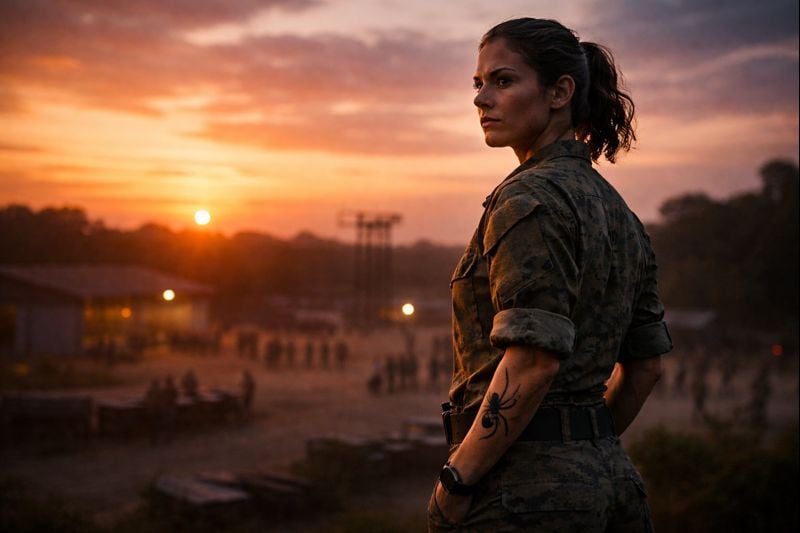
I was KIA, Mara responded quietly. On paper, that made the next missions easier. Dead women don’t get scrutinized. But you’re not dead anymore. You’re very publicly alive. That’s going to make the next phase complicated. Complicated is where we operate best. She touched the tattoo again, the gesture habitual.
Shadow Unit 7 was never about easy missions. It was about impossible missions, the kind that required people willing to become ghosts when necessary and warriors when required. That hasn’t changed.
Reeves sipped his coffee. The recruits you’re considering, they’re good people, but are they ready for what shadow unit 7 requires? Nobody’s ready until they survive it. You weren’t ready that night over Damascus. I wasn’t ready for my first mission. We became ready by refusing to break when breaking was easiest option.
She paused. They’ve already been tested in ways most operators never face. They’ve endured injustice and maintained integrity. They’ve proven capability in environments designed to make them fail. That’s the foundation. The rest is training.
When do you start recruitment? Tomorrow. Fosters’s task force work runs parallel. I’ll be redesigning integration protocols during the day, rebuilding Shadow Unit 7 at night until both missions are complete.
That’s going to kill you. I’ve survived worse. Reeves chuckled quietly. Yeah, you have. But for what it’s worth, commander, I’m glad you survived. The military needs people like you. People willing to prove what’s possible rather than accepting what’s convenient.
After he departed, Mara remained watching the trainees. One caught her attention. Young woman, maybe 20, struggling through obstacle course that had defeated her three times already. The fourth attempt showed the same determination as the previous three. She wasn’t faster, she wasn’t stronger, but she wasn’t quitting. Mara made a mental note. Add name to recruitment watch list.
Shadow Unit 7 would need people who understood that success sometimes meant getting up one more time than you got knocked down. People who demonstrated courage not through single heroic moments, but through sustained refusal to accept defeat.
Her tablet chimed again. New message. Not encrypted shadow unit traffic. Official tasking through Fosters’s channels. First meeting of integration task force scheduled for next Monday. Location Pentagon. attendees, joint chiefs, representatives, service secretaries, congressional oversight committee members, purpose-present evaluation findings and initial reform recommendations.
Mara felt familiar tightness in her chest, not fear, anticipation. This was different kind of combat, no weapons, no tactical advantage, just evidence arguments and willingness to face powerful people invested in maintaining systems that benefited them. the kind of fight that required different courage than physical combat demanded.
But she’d prepared for this fight through months of careful documentation and deliberate exposure to every bias and barrier the system could create. The evidence was undeniable. The recommendations were defensible. The moral authority came from lived experience rather than theoretical knowledge.
She’d proven capability in shadows. Now she’d prove it in spotlights. Both missions served the same purpose, creating space for excellence regardless of source, removing barriers that limited capability based on expectations rather than evidence. Building systems that served missions rather than protecting comfort.
The sun finished setting, leaving the training ground in twilight that blurred distinctions between day and night. Mar remained watching trainees continue their work even as darkness approached. The ones who stayed after minimum requirements were met. The ones who pushed past failure to find success. The ones who demonstrated potential that transcended current capabilities.
Those were the ones who’d built the future not just of Shadow Unit 7, but of integrated special operations forces that drew excellence from widest possible pool rather than narrowest acceptable demographic. The future where capability mattered more than appearance. Where performance spoke louder than preconceptions. where warriors were recognized by what they accomplished rather than what people assumed they could accomplish.
The tattoo on her arm caught moonlight now seven stars visible even in darkness. Seven survivors, seven witnesses to mission that had required everything and demanded more. Seven operators who’d walked through fire and emerged with scars that told stories most would never hear. Soon others would carry similar marks.
Not the same tattoo shadow unit 7 symbol remained specific to Damascus gate survivors, but the same commitment, the same willingness to serve in shadows, accept no recognition, endure misunderstanding and dismissal, all while maintaining absolute dedication to missions that protected people who’d never know protection had been necessary.
Mara’s phone buzzed. Text from Chen. Ma’am heard about the task force. Congratulations. If you need anything, let me know. Also, random question. What does it take to get selected for classified operations? Asking for a friend.
Mara smiled in the darkness. Not a random question. Never random. When operators started asking about selection for classified work, Chen was ready. The question proved it. Not asking for guarantees or shortcuts. Just asking what it takes. The right question from someone prepared to meet any answer with commitment.
She typed her response. It takes capability demonstrated consistently. Integrity maintained under pressure. Willingness to serve without recognition. And courage to walk into darkness, knowing the path back isn’t guaranteed. Your friend ready for that?
Three dots appeared, disappeared, appeared again. Finally, my friend is terrified, but also ready. How does she start? She already has. Everything that comes next is just training. I’ll be in touch.
The conversation ended, but recruitment had begun, not with formal process or official selection boards, but with quiet identification of operators who’d proven themselves in shadows, waiting for someone to recognize what they’d already become.
Shadow Unit 7 was rebuilding, not as tribute to past glory, but as response to present necessity. New missions demanded new operators. New threats required new approaches. The old model, homogeneous teams drawn from narrow demographics had served its purpose. The new model would serve better.
Diverse capabilities, multiple perspectives, excellence drawn from anywhere it could be found rather than only where tradition looked. Mara walked back toward her temporary quarters path lit by stars and distant facility lights.
Tomorrow would bring new challenges, task force work, policy battles, resistance from people invested in maintaining systems that benefited them. But she’d faced resistance before. Overcome it through evidence and persistence and refusal to accept defeat as permanent condition.
The evaluation that had started with mockery had ended with revelation. The mockery had served its purpose, documenting barriers that needed removal. The revelation had served its purpose, proving those barriers could be overcome. Now came harder work.
Translating evidence into policy, converting proof into practice, building systems that worked as they should have worked all along.
But for tonight, this moment, Mara allowed herself satisfaction. She’d completed the mission, survived the test, proven the point. Seven stars on her arm represented seven survivors. Soon more operators would carry their own marks. Different symbols, same commitment.
The tradition continued. The mission evolved. The work remained. Real warriors don’t advertise. They just show up when needed. In shadows or spotlights, in uniforms or civilian clothes, with recognition or without. The mission always matters more than the acknowledgement. The service transcends the ceremony. The sacrifice speaks louder than the salute.
Mara touched her tattoo one final time before entering her quarters. Seven stars, seven survivors, infinite missions still ahead. The story of Shadow Unit 7 hadn’t ended at Damascus Gate. It had merely paused, waiting for the right moment to continue. That moment had arrived. The next chapter was beginning.
And this time, the shadows would be populated by warriors who’d proven themselves not despite doubts, but through overcoming them. Not by meeting diminished expectations, but by exceeding standards that should have applied equally all along. Not through special accommodation, but through demonstrated excellence that couldn’t be dismissed, denied, or ignored.
The future of special operations walked through those training grounds every day. Some would falter, others would succeed. All would be judged by capability rather than appearance. By performance rather than preconception, by what they accomplished rather than what people assumed they could accomplish.
That was the legacy worth building. That was the mission worth completing. That was the future worth fighting for. And Mara Sullivan, once ghost, once dead on paper. Now commander and architect of change would ensure that future became reality. One policy at a time, one recruit at a time, one mission at a time, until the shadows were filled with warriors who deserved to be there and the light recognized them all.